

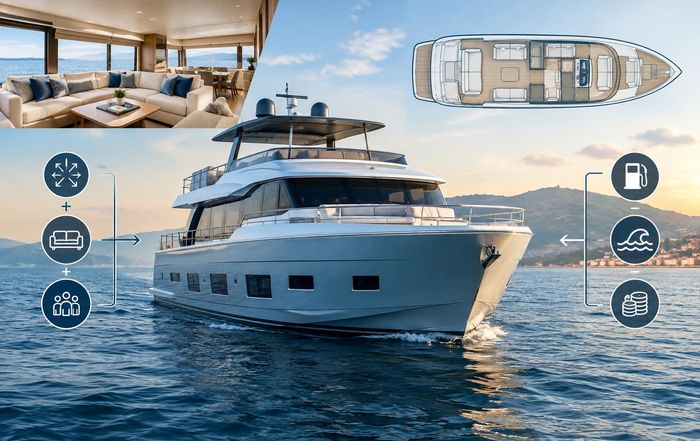
The Design Trade-Offs Behind Wide-Beam Motor Yachts
A wider motor yacht can feel, on paper, like an easy win: more interior volume, a steadier platform, larger cabins, and more room for amenities that matter on long trips. In practice, beam is one of the most consequential decisions in yacht design because every extra metre alters the hull's behaviour, the engineering envelope, berth compatibility, fuel burn, and even how the boat is used at anchor. That is why the appeal of a broad-shouldered yacht has to be weighed against compromises that are less obvious than the extra space itself. For readers comparing layouts and performance, the question is not whether a wide beam is "better," but what kind of ownership experience it creates and what it costs elsewhere.
The trade-offs are easiest to understand when they are viewed through the lens of naval architecture rather than styling alone. Beam influences stability, wetted surface, drag, structural loads, and the distribution of weight across the hull. It also shapes how designers think about hull form, cruising range, and the way a yacht is expected to perform in real-world conditions. On larger yachts, those decisions can be amplified by regulations, class rules, and the practical demands of technology, business, and sustainability. The result is a design problem that is as much about compromise as it is about luxury.
Why wider feels better at first glance
The most immediate benefit of extra beam is interior volume. A wider hull usually allows designers to create larger saloons, broader guest cabins, more generous crew spaces, and more usable storage without pushing the overall length into a different ownership bracket. That matters because many buyers want the livability of a much larger yacht without moving up to a substantially longer platform that may be more expensive to berth, crew, insure, and maintain. Beam also gives designers more freedom to place staircases, service routes, and social spaces in ways that improve daily usability. On a family boat, that can translate into a more practical galley, safer circulation, and a better separation between guest and crew areas, which is one reason the subject often overlaps with family cruising and lifestyle-oriented yachting.
There is also a comfort argument. A wider yacht can have a greater initial sense of steadiness at rest, which many owners and guests interpret as comfort even before the boat is underway. That is particularly attractive for anchorages, marina life, and entertaining. Wider aft decks and flybridge arrangements can also create more sociable outdoor spaces, which helps explain why beam is often discussed alongside design trends and boat layouts. In the luxury segment, the extra width can make a yacht feel less like a narrow passageway and more like a floating residence. That emotional effect is real, but it can obscure the engineering costs that come with it.
The performance penalty is not always dramatic, but it is real
A broader hull generally presents more resistance to the water, especially if the extra beam is not carefully balanced by the rest of the hull shape. More beam can mean more wetted surface, which can increase drag and affect fuel consumption. The effect is not identical on every yacht; much depends on deadrise, displacement, propulsion choice, and whether the hull is designed for planing, semi-displacement, or displacement speeds. Still, designers cannot add beam without asking what it does to efficiency, trim, and seakeeping. For owners who care about range, operating cost, and speed consistency, those questions matter as much as the extra square footage.
Regulators and classification bodies pay close attention to stability and structural integrity, which is why beam is never just an aesthetic choice. In Europe, the European Boating Industry and the broader framework of the European Union reflect how seriously marine design is treated as a technical and safety matter, while in the United States the U.S. Coast Guard remains central to recreational vessel safety oversight. Wider yachts can be more stable in some respects, but they also present different load paths and structural challenges, especially when heavy features such as beach clubs, cranes, garages, and large tender storage spaces are integrated into the stern. That is one reason many modern wide-beam yachts depend on advanced engineering and materials expertise from firms such as Lloyd's Register and DNV, which help shape the standards behind safe and efficient design.
Berthing, marina access, and the hidden geometry of ownership
One of the least glamorous but most important trade-offs is where the yacht can actually go. Beam affects marina compatibility, lock and canal access, and the availability of berths in popular cruising destinations. A wider yacht may fit comfortably in a private berth but prove awkward in older marinas, crowded harbours, or regions where dock space is constrained. This is not a theoretical issue; it changes how often the owner can use the boat, how easily it can be repositioned, and whether spontaneous cruising is realistic. For many owners, the difference between a yacht that fits standard infrastructure and one that requires special arrangements is the difference between frequent use and occasional use.
This is also why wide-beam yachts are often discussed in the context of global cruising rather than only on the dock. A vessel that is superb in one home port may be less convenient in another market, particularly where berths are narrow or expensive. In some regions, the problem is not just marina width but the entire logistics chain around refuelling, provisioning, and haul-out. Owners who cruise widely often discover that beam changes the practical geography of ownership more than length does. A longer yacht can sometimes be accommodated with planning; a wider one can be excluded outright from certain facilities.
Stability, comfort, and what beam can and cannot solve
A common assumption is that more beam automatically means a more comfortable yacht. That is only partly true. Wider yachts can offer better initial stability, which reduces the feeling of roll in some conditions, but comfort underway depends on the full design package: hull shape, weight distribution, stabilisation systems, centre of gravity, and the way the boat interacts with waves. A broad, heavy yacht can still feel lively or awkward if its proportions are poorly judged. Conversely, a narrower yacht with sophisticated stabilisers and a well-developed hull can feel remarkably composed.
This is where modern marine technology has changed the conversation. Active fin stabilisers, gyroscopic systems, and smarter monitoring tools can compensate for some of the compromises of beam, but they do not erase them. They add cost, weight, maintenance demands, and sometimes noise or complexity. For that reason, beam should be seen as one part of a broader comfort strategy, not a substitute for it. Readers interested in the technical side often find it useful to compare design decisions across technology coverage and reviewed yachts, because the same beam dimension can feel very different depending on how the rest of the hull is executed.
The structural and weight-management challenge
Extra beam can make a yacht structurally more demanding, especially when designers try to preserve clean lines and open-plan interiors. A wider hull may need additional reinforcement to manage torsional loads and the stresses created by large openings, broad glazing, and expansive deck cut-outs. That can lead to more weight, and weight is always the enemy of performance and efficiency. In other words, the design team may gain volume only by paying for it with material, engineering complexity, or both.
This is especially relevant on yachts with large windows, folding terraces, and open transom arrangements that have become increasingly desirable in modern luxury yacht design. The more the architecture opens toward the sea, the more carefully the structure must be managed. Owners often see only the result: a bright, expansive interior and a dramatic connection to the water. Behind that, however, is a careful balancing act between stiffness, displacement, and the need to keep the yacht within a sensible operating envelope. When beam is increased, the temptation is to fill the new volume with amenities; the engineering challenge is to do that without making the yacht unnecessarily heavy.
Why wide-beam yachts dominate some segments more than others
Beam has different value depending on the yacht category. On smaller and mid-size motor yachts, extra width can transform liveability because the gains in interior space are immediately felt. On very large yachts, by contrast, the same increase may be less dramatic relative to the total volume, yet still materially affect docking, handling, and construction. That is one reason why beam is so central in the business of yacht building: builders have to decide which segment they are targeting and how much compromise their customers will tolerate in exchange for space.
The market has also become more segmented by use case. Some buyers want a family cruiser with a generous saloon and easy boarding. Others want a long-range yacht that can cross oceans with fewer compromises. Still others prioritise entertaining, beach-club layouts, and the kind of indoor-outdoor flow that wide beam makes easier. In each case, beam serves a different purpose. That is why the same measurement can be a selling point in one brochure and a drawback in another. The best designers do not simply maximise beam; they decide where width adds value and where it begins to interfere with the boat's intended mission.
Sustainability and efficiency are making the trade-off sharper!
The environmental conversation has made beam a more serious subject than it once was. Wider yachts can support more amenities and greater comfort, but they can also increase displacement and fuel consumption if not carefully engineered. As owners and builders face greater scrutiny over emissions and operating efficiency, the old assumption that "bigger is always better" has become harder to justify. This is especially true for yachts expected to cruise frequently rather than sit mostly at anchor. Efficiency is no longer only a technical issue; it is also a reputational and regulatory one.
Industry groups and classification bodies have been pushing the sector toward more measured design choices, with a stronger emphasis on lifecycle impact, propulsion efficiency, and responsible operation. The International Maritime Organization sets the broader regulatory tone for shipping, while organisations such as the International Council of Marine Industry Associations help frame recreational boating's response to environmental pressure. In the yacht sector, the design question is increasingly: how much beam is enough to deliver the desired life onboard without creating unnecessary drag, weight, or energy demand? That is a more nuanced question than many buyers expected a decade ago, but it is now central to how serious yacht projects are conceived.
The practical bottom line for buyers
For prospective owners, the real issue is not whether a wide-beam motor yacht is desirable in the abstract. It is whether the width serves the way the yacht will actually be used. If the priority is entertaining, family comfort, and a sense of spaciousness at anchor, extra beam can be a major advantage. If the priority is range, marina flexibility, easier handling, and lower running costs, a narrower but more efficient design may be the better long-term choice. The smartest purchases usually begin with a candid assessment of cruising grounds, crew expectations, and the balance between onboard volume and operational freedom.
That is why serious buyers often look beyond glossy renderings and compare how beam affects the full ownership picture across reviews, cruising plans, and even the history of yacht design. Beam is one of those dimensions that seems straightforward until it starts shaping everything else. It can make a yacht feel more generous, more stable, and more luxurious, but it can also make the boat more demanding to berth, more expensive to run, and more complicated to engineer. The best wide-beam yachts succeed because their designers have accepted those trade-offs rather than pretending they do not exist.