

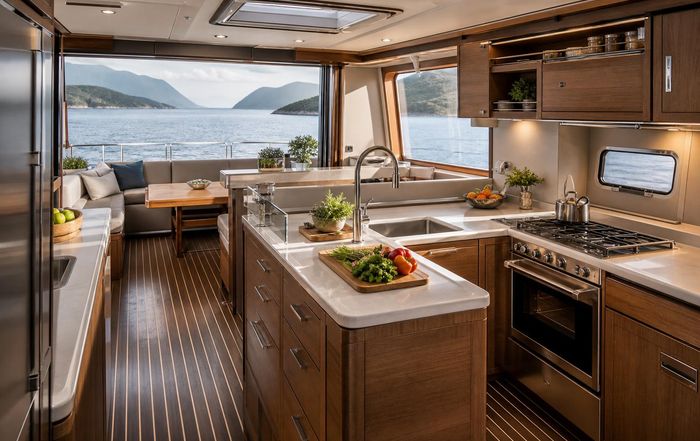
Best Galley Layouts for Extended Cruising
Designing an effective galley for extended cruising is one of the most consequential decisions an owner or long-range charter client will make. Over days, weeks, or even months at sea, the galley quietly becomes the operational heart of the yacht, shaping comfort, safety, crew efficiency, and ultimately the success of the voyage itself. For the team here conversations with designers, captains, and liveaboard owners consistently return to a single conclusion: a galley that works beautifully underway is rarely an accident; it is the product of deliberate choices about layout, equipment, ergonomics, and workflow that reflect both the boat's mission and the people who will use it. This feature examines the most effective galley layouts for extended cruising, compares their strengths and trade-offs, and explores how contemporary design and technology are reshaping expectations for life at sea. It draws on practices seen in the superyacht sector, bluewater cruising community, and commercial vessels, while remaining anchored in real-world constraints of space, power, and motion.
Why Galley Layout Matters More Offshore
In coastal cruising or day-boating, galleys are often judged by how they look at the dock. For extended passages, the evaluation is very different. A well-designed galley must function as a secure, efficient workspace in varied sea states, with reliable access to provisions, manageable power consumption, and safe movement for the cook and crew. When yachts venture far from shore, the galley also becomes a central pillar of morale. Hot meals prepared safely and efficiently in rough weather can transform the onboard experience, particularly on demanding routes such as transatlantic crossings or high-latitude expeditions.
Professional galley design on larger yachts has long been influenced by commercial maritime standards and hospitality best practice. Organizations such as The Royal Yachting Association and American Boat and Yacht Council provide safety and installation guidelines for gas systems, electrical equipment, and ventilation, which indirectly shape layout decisions. Readers can explore broader safety considerations in cruising-oriented resources from bodies like the Cruising Association or offshore training materials from the World Cruising Club, where the role of the galley in long-distance comfort is repeatedly emphasized.
From the perspective our editorial team, the most successful galley layouts seen in recent reviews are those that integrate seamlessly with the yacht's overall design philosophy. High-performance cruisers, displacement passagemakers, and superyachts each present different constraints, but the core principles-secure footing, bracing points, efficient workflow, and adequate storage-remain constant.
Core Principles of Offshore Galley Design
Before comparing specific configurations, it is useful to outline the shared principles that underpin the best galleys for extended cruising. These principles recur across the diverse vessels covered in our boat and yacht reviews, regardless of size or price segment.
First, the cook must be able to work securely at sea. This means a layout that allows bracing on at least two sides, often through U-shaped or corridor arrangements, with carefully placed grab rails and handholds integrated into cabinetry, overhead structures, and companionways. Open, domestic-style island kitchens that look appealing in a marina can become hazardous in a seaway, particularly on sailing yachts that heel significantly.
Second, the work triangle between stove, sink, and refrigeration must be compact and logical. Extended cruising magnifies inefficiencies; a few extra steps taken hundreds of times a day become fatigue. Leading naval architects and interior designers, including those featured in Boat International and Yachting World, repeatedly highlight the importance of minimizing unnecessary movement in the galley. Readers interested in broader design thinking in yachting can explore more at our dedicated yacht design section.
Third, storage must be abundant, secure, and intelligently organized. Offshore provisioning involves heavy, dense items, large volumes of dry goods, and awkwardly shaped spares and tools. Lockable lockers, deep drawers with positive latches, bottle racks, and custom dividers help prevent dangerous movement of contents in rough seas. Recessed fiddles on countertops and raised lips on shelves further reduce the risk of items becoming airborne.
Fourth, systems integration is critical. Refrigeration, ventilation, water production, and power management are all directly linked to galley functionality. Modern energy-efficient appliances, induction cooktops, and improved insulation can significantly reduce generator hours and fuel consumption, aligning with emerging expectations for lower-impact cruising. Those interested in a broader perspective on sustainable systems at sea can learn more about sustainable business practices from the United Nations Environment Programme and related maritime initiatives.
Finally, the best galleys reflect the specific cruising style of the owner. A couple on a performance cruiser crossing oceans will prioritize different features than a family using a semi-displacement yacht for seasonal Mediterranean or Caribbean cruising. On yacht-review.com, the most successful projects are those where owners, designers, and builders have clearly defined the intended use profile, then tailored the galley accordingly.
The U-Shaped Galley: Classic Offshore Workhorse
Among experienced bluewater sailors and long-range motor yacht crews, the U-shaped galley remains the most widely praised configuration for serious offshore work. In this layout, the cook stands within a three-sided enclosure, typically with the open side facing a bulkhead or companionway, allowing bracing from multiple directions and minimizing the risk of being thrown across the space in a sudden roll or wave impact.
The U-shaped arrangement naturally supports the classic work triangle, with the stove and oven typically on one leg, the sink on the second, and refrigeration and preparation surfaces on the third. Because everything is close at hand, the cook can prepare meals even in challenging conditions while maintaining one hand for the boat. This configuration is particularly prevalent on ocean-going monohull sailboats, where heel angles can be significant and the ability to wedge oneself securely is paramount.
Manufacturers of bluewater-oriented sailing yachts, often profiled in specialist publications such as Practical Boat Owner and Sail Magazine, frequently adopt a U-shaped galley near the companionway, slightly below deck level, to keep weight low and movement contained. This location also improves communication with the cockpit, which is valuable on long passages with small crews. For readers planning serious offshore voyages, our cruising section regularly highlights examples of U-shaped galleys that have proved themselves on demanding routes.
The main trade-off of the U-shape is that it tends to limit the number of people who can work in the galley simultaneously. On larger yachts with professional crews, this can be a constraint, although superyacht galleys often mitigate the issue with extended counter runs and adjacent pantry or prep areas. On smaller cruising yachts, however, the single-cook nature of the U-shape is often an advantage, reducing congestion and confusion in a space that must remain safe even when others are moving through to access cabins or heads.
The L-Shaped Galley: Versatility with Caution
The L-shaped galley offers a versatile compromise between seagoing practicality and a more open connection to the saloon or cockpit. By utilizing two perpendicular runs of cabinetry, it creates a corner where the cook can brace effectively, while opening one side to the living area. This layout is common on both sailing and motor yachts in the mid-size range, where designers seek to maximize visual space without sacrificing too much safety.
In an L-shaped configuration, the stove is often placed on the shorter leg, with the sink and refrigerator on the longer run, or vice versa. When executed well, the cook can work primarily in the corner, with easy pivoting between appliances and preparation surfaces. However, if the open side is too exposed, or if the distance between key elements becomes excessive, the L-shape can lose some of its offshore suitability, particularly in beam seas where lateral motion is pronounced.
Production builders in the United States and Europe have refined the L-shaped galley extensively over the last two decades, influenced by evolving customer expectations for more social, open interiors. Publications such as Cruising World and Yachting Magazine often feature L-shaped galleys in performance cruisers and family motor yachts, where the cook can remain engaged with guests while preparing meals. For owners focused on lifestyle and entertaining, our lifestyle coverage frequently showcases L-shaped layouts that balance sea-kindliness with conviviality.
From a design perspective, the success of an L-shaped galley for extended cruising depends heavily on the inclusion of adequate grab points, secure seating nearby, and careful consideration of traffic flow. Designers must avoid creating a corridor through the working area, which can be both inefficient and dangerous in heavy weather. When these details are addressed, the L-shape can be a strong choice for mixed-use yachts that alternate between offshore passages and relaxed coastal cruising.
Linear and Corridor Galleys: Efficiency in Motion
Linear galleys, arranged along a single side of the hull, and corridor galleys, configured as parallel runs facing each other, are widely used on motor yachts and catamarans where beam and volume allow more flexibility. For extended cruising, these layouts can deliver excellent workflow and storage, but they require careful handling of motion and access.
A linear galley along one side of the saloon creates an open, apartment-like feel that many owners appreciate. It allows long stretches of counter space, generous refrigeration, and full-size domestic appliances, which are increasingly common on larger yachts and long-range trawlers. Publications such as Passagemaker and Motor Boat & Yachting frequently highlight linear galleys on displacement and semi-displacement cruisers designed for ocean passages, where the boat's motion is generally more predictable than that of a light sailing yacht.
However, a pure single-sided arrangement can be challenging in rough weather if the cook has no opposite surface to brace against. To address this, many designers integrate island units, raised rails, or closely spaced furniture on the opposite side to create a quasi-corridor effect. True corridor galleys, where two full runs face each other, offer the best of both worlds: abundant storage and preparation space, plus secure bracing points on either side. This layout is common on larger yachts where the galley is positioned on a lower deck, often serving both crew and guests through dumbwaiters or service stairs.
Catamarans, both sailing and power, often adopt linear or corridor galleys due to their wide beam and relatively level sailing attitude. The reduced heel angles compared with monohulls make open layouts more viable offshore. Multihull builders featured in sources such as Multihulls World and Sailing Today have increasingly placed galleys in the bridgedeck saloon with panoramic views, transforming the cooking experience on extended cruises. For those considering multihulls for long-range travel, the boats section at yacht-review.com regularly examines how different builders handle galley layout in relation to performance and comfort.
The main risk with corridor galleys is congestion, particularly on owner-operator yachts where guests frequently pass through the area. Thoughtful separation of crew and guest circulation, use of sliding doors, and clear zoning between working and social spaces can mitigate this challenge. When executed carefully, corridor galleys provide some of the most efficient workspaces seen on extended-cruising yachts.
Dedicated Crew Galleys versus Open Family Spaces
On larger yachts with professional crews, the galley is often a semi-industrial workspace located away from the main guest areas, with a separate pantry or show galley closer to the saloon for light service and demonstration cooking. This separation allows chefs to work intensively without disturbing guests and provides space for commercial-grade appliances, walk-in refrigerators, and bulk storage essential for extended voyages far from reprovisioning hubs.
Regulations and best practices from organizations such as the Maritime and Coastguard Agency (MCA) and classification societies influence the design and equipment of these professional galleys, particularly on charter and commercial vessels. Industry resources such as the Superyacht Services Guide and The Crew Report frequently discuss how galley design affects crew efficiency, safety, and guest satisfaction. Owners and managers interested in the business implications of crew-centric design can explore broader perspectives in our yachting business coverage.
In contrast, owner-operated yachts and family cruisers often integrate the galley directly into the main living space. This arrangement emphasizes social interaction, with the cook part of the conversation rather than isolated below decks. For extended family cruising, especially with children, this can be invaluable, allowing supervision and shared experiences around food preparation.
The best layouts in this category manage to combine openness with the ability to "close down" the galley in rough weather, using features such as partial bulkheads, swing-out stools that double as bracing points, removable fiddles, and secure appliance mounts. Designers are increasingly creative in using sliding partitions and glass panels to provide visual connection when desired and separation when conditions demand a more secure workspace.
Storage, Refrigeration, and Provisioning Strategy
No discussion of galley layout for extended cruising is complete without addressing storage and refrigeration. Long-range voyaging demands a provisioning strategy that assumes limited access to fresh supplies and variable quality of shore-side infrastructure. The galley layout must therefore integrate both immediate-use storage and deeper reserves, often distributed throughout the hull for weight balance and redundancy.
Modern yacht refrigeration has benefited from advances in compressor efficiency, insulation materials, and control systems. Manufacturers highlighted in independent testing by organizations such as Practical Sailor and technical resources from Ocean Navigator have shown that well-designed marine fridges and freezers can significantly reduce energy consumption compared with older systems. For owners interested in the technical underpinnings of onboard systems, our technology section regularly explores innovations that directly affect galley performance.
From a layout perspective, the most effective extended-cruising galleys often feature a combination of top-loading and front-loading refrigeration. Top-loading units are more efficient at retaining cold air when opened, which is advantageous in hot climates and for infrequently accessed stores. Front-loading units, meanwhile, are more convenient for daily use and better suited to integrated, domestic-style kitchens. Many long-range yachts also incorporate dedicated cool drawers, wine storage, and separate freezers, all of which must be accessible without disrupting the main workflow.
Dry storage is equally important. Deep bilge lockers, under-sole compartments, and high-level cupboards all have roles to play, but their use must be balanced against stability considerations and ease of access. On ocean passages, items buried too deeply are functionally unavailable. Successful layouts therefore reserve the most accessible spaces for high-turnover provisions and cooking tools, while using more remote lockers for long-life reserves, spare parts, and emergency supplies.
Ergonomics, Safety, and Human Factors
Extended cruising exposes any ergonomic weakness in a galley. Work surfaces that are too high or low, poorly placed lighting, hard-edged corners, and awkward access to heavy pans or appliances all become cumulative irritants and potential safety hazards. Professional yacht chefs and experienced liveaboard cruisers increasingly collaborate with designers to refine these details, drawing on insights from hospitality and human-factors research.
Good galley ergonomics start with clear sightlines and sufficient headroom. While many offshore galleys are partially below decks, careful placement of windows, hatches, and reflective surfaces can prevent the sense of working in a cave. Adequate ventilation, through a combination of opening ports, powered extraction, and air-conditioning, is essential not only for comfort but also for moisture and odor control. Health and safety guidance from organizations such as the World Health Organization on indoor air quality, while not yacht-specific, underscores the importance of avoiding prolonged exposure to cooking fumes in confined spaces. Owners can learn more about indoor air quality as part of a holistic approach to onboard health.
Anti-slip flooring, rounded corners, and secure latches on all doors and drawers are fundamental safety features. On gas-equipped yachts, automatic shut-off valves, gas detectors, and proper bottle storage are critical, as outlined in standards from bodies like the American Boat and Yacht Council and Royal Yachting Association. Induction cooktops, increasingly common on larger yachts with robust electrical systems, offer additional safety benefits by reducing open flame risk and residual surface heat, although they require careful consideration of power capacity and redundancy.
The placement of the galley relative to escape routes, fire extinguishers, and muster points is another key factor. On extended cruises, crews must be able to respond quickly to incidents such as grease fires or electrical faults, which means clear access and well-rehearsed procedures. Articles in Safety at Sea and training materials from offshore racing and cruising organizations repeatedly emphasize the importance of realistic galley-based emergency drills.
Lifestyle, Culture, and the Evolving Role of the Galley
As yacht owners increasingly view their vessels as platforms for extended living rather than occasional recreation, the cultural role of the galley is evolving. What was once a purely functional space is now often a centerpiece of onboard lifestyle, reflecting broader trends in open-plan homes and gourmet cooking. High-end builders and refit yards, frequently profiled in titles such as Boat International and ShowBoats International, are responding with layouts that combine professional-grade functionality with refined aesthetics and materials.
For long-range cruisers, this shift has positive implications. Better equipment, more thoughtful lighting, improved sound insulation, and higher-quality finishes all contribute to making the galley a place where time is enjoyed rather than merely endured. Owners planning ambitious itineraries-from circumnavigations to polar expeditions-are increasingly investing in galleys that support diverse culinary experiences, from fresh-caught seafood to regional specialties discovered along the way. Our travel features often highlight how food and cruising destinations intertwine, with the galley serving as the bridge between local markets and onboard dining.
This lifestyle-driven approach also extends to how galleys interface with exterior spaces. On many contemporary yachts, designers create seamless transitions between interior galleys and aft decks, beach clubs, or flybridge grills, enabling flexible service arrangements and al fresco dining. For extended cruising in warm climates, this flexibility can be transformative, allowing cooking heat to be kept outside when desired and creating multiple "zones" for different times of day.
Sustainability and Resource Efficiency in the Galley
Sustainability has become an increasingly prominent concern among yacht owners, designers, and builders, and the galley is a central arena where environmental considerations intersect with daily life aboard. Energy-efficient appliances, improved insulation, LED lighting, and intelligent power management systems all contribute to reducing fuel consumption and generator hours, aligning with broader industry efforts to minimize environmental impact. Organizations such as the Water Revolution Foundation and initiatives reported by SuperyachtNews highlight how efficiency gains in hotel load, including galleys, can significantly reduce a yacht's overall footprint.
Water management is another key aspect. Extended cruising often relies on watermakers, and galley layouts that encourage sensible water use-through efficient taps, thoughtful sink design, and clear separation of greywater systems-can reduce strain on equipment and fuel consumption. Owners interested in the intersection of yachting and sustainability can explore further perspectives in our dedicated sustainability section, which regularly examines practical steps for more responsible cruising.
Waste handling is equally important. Effective layouts incorporate segregated bins for recycling where facilities exist, secure storage for waste between ports, and convenient access routes for disposal when alongside. International regulations under MARPOL, summarized by the International Maritime Organization, set out clear rules on garbage disposal at sea, and compliance is increasingly monitored in popular cruising regions. Designing the galley with these requirements in mind helps ensure that sustainable intentions translate into daily practice.
Choosing the Right Galley Layout for Your Cruising Plans
For readers here today contemplating a new build, major refit, or the purchase of a long-range cruiser, the choice of galley layout should be approached with the same seriousness as hull form, rig, or propulsion. The decision hinges on several interrelated questions about intended use, crew structure, and personal preferences.
Owners planning serious offshore passages with small crews often find that a compact, secure U-shaped or well-executed L-shaped galley near the companionway provides the best balance of safety and efficiency. Those focusing on mixed coastal and bluewater cruising, especially with family and friends aboard, may prefer a slightly more open L-shaped or linear layout that encourages social interaction while retaining adequate bracing points and safety features. On larger yachts with professional crews, dedicated corridor galleys with adjacent pantries and service routes can deliver the highest levels of culinary capability and guest privacy.
In all cases, it is advisable to "test drive" the layout conceptually. Prospective owners should imagine preparing a full meal in a seaway, reaching for heavy pans, moving between stove and sink, opening the fridge, and accessing storage while the boat rolls and pitches. Observing how experienced crews use similar layouts during sea trials or charters can be invaluable. Our global yachting coverage and latest news reports often feature firsthand insights from captains and chefs who live with these decisions day after day.
Ultimately, the best galley layout for extended cruising is the one that aligns most closely with the yacht's mission and the people who will sail her. When layout, equipment, and systems are thoughtfully integrated, the galley becomes far more than a functional necessity; it evolves into a place where the pleasures of good food, shared experiences, and safe, confident voyaging come together. For owners and crews who aspire to spend significant time at sea, investing in the right galley design is not a luxury but a foundational element of a successful cruising life.