

Best Onboard Fitness Ideas for Cruising Yachts
Maintaining physical fitness while cruising has evolved from a niche concern into a central pillar of the modern yachting lifestyle. Owners and long-range cruisers increasingly expect their yachts to support the same level of wellness they enjoy ashore, and designers, builders and captains are responding with creative, highly tailored solutions. For the Yacht Review fans, which spans performance-minded sailors, bluewater families and superyacht professionals alike, onboard fitness is no longer an afterthought; it is a defining feature of how people live, work and travel at sea.
This article explores the most effective onboard fitness ideas for cruising yachts, from compact equipment strategies on sub-50-foot boats to fully integrated wellness decks on large superyachts, while considering design, safety, lifestyle and business implications across the global market.
Why Fitness Matters More to Today's Cruising Owners
The rise of wellness as a core value in luxury travel has been extensively documented by organizations such as the Global Wellness Institute, which has tracked strong, sustained growth in wellness tourism and fitness-oriented experiences worldwide. As this trend intersects with the expanding cruising community, owners are asking naval architects and interior designers to prioritize movement, mental health and recovery spaces alongside traditional amenities.
Long-term liveaboard cruisers have an added incentive. Time at sea often involves irregular schedules, limited access to shore facilities and periods of enforced inactivity during passages. Without a deliberate approach to exercise, strength, balance and cardiovascular fitness can decline, with knock-on effects on seamanship, safety and overall enjoyment. For a detailed look at how cruising patterns have evolved alongside lifestyle expectations, readers can explore the long-form features on cruising culture and practice at yacht-review.com.
The most successful onboard fitness solutions therefore focus on practicality and sustainability rather than spectacle, building routines and spaces that can be maintained over months and years of voyaging.
Designing Space for Movement on Cruising Yachts
The first and often most challenging question is where onboard fitness actually happens. On smaller cruising yachts, every square metre serves multiple purposes, while on larger vessels the question becomes one of zoning, circulation and guest experience.
Many naval architects now speak of "flex spaces" rather than dedicated gyms. On a 40- to 60-foot cruising yacht, the most common solutions include convertible saloons where a table drops to create a mat area, foredeck or flybridge zones that double as yoga decks when at anchor, and cockpit benches that support resistance bands and body-weight training. Builders such as Oyster Yachts, Hallberg-Rassy and Lagoon have begun to highlight these multi-use spaces in marketing materials, even when they are not formally labelled as gyms.
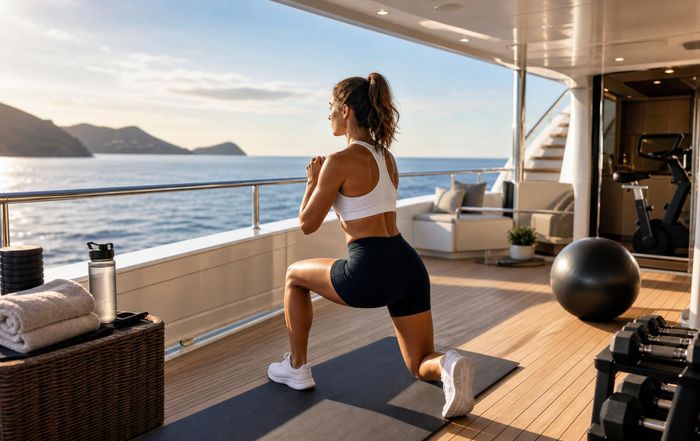
On larger superyachts, the trend is toward fully integrated wellness decks, often located close to the waterline and combined with beach clubs, fold-out platforms and spa areas. Feadship, Benetti and Sanlorenzo have each delivered recent yachts where gyms open directly onto sea terraces, allowing guests to move seamlessly between strength training, open-water swimming and relaxation. Interested readers can review broader design trends in the superyacht sector through Boat International and SuperYacht Times, which regularly profile new builds with innovative fitness and wellness spaces.
For owners considering a refit, interior designers emphasize the importance of headroom, ventilation and stowage. A space that looks adequate on paper may feel cramped once a tall guest attempts overhead presses or dynamic stretching. Proper airflow and air-conditioning are equally critical, particularly in tropical anchorages, and must be balanced against noise and vibration from adjacent machinery spaces. For a deeper dive into how these practical constraints shape modern yacht interiors, the design features at yacht design and layout provide useful context.
Compact Equipment Strategies for Smaller Cruising Yachts
Onboard fitness for sub-50-foot cruising yachts is primarily a question of intelligent equipment selection and stowage. Heavy, rigid machines are rarely practical, but a carefully chosen kit can support a surprisingly comprehensive programme.
Many experienced cruisers rely on a combination of resistance bands, suspension trainers, compact adjustable dumbbells, foldable benches and yoga or Pilates mats. These items can be stowed in lazarettes or beneath settees and brought out quickly without disrupting the boat's normal use. Reputable health and training resources such as Harvard Health Publishing and Mayo Clinic have long emphasized the effectiveness of body-weight and resistance-band training for maintaining strength and mobility, which aligns well with the constraints of life aboard.
Kettlebells and compact rowing or cycling machines are increasingly seen on performance-oriented cruisers where weight allowances permit. Foldable rowing machines that can be lashed along a cabin side or stowed in a forepeak provide both cardiovascular and strength training in a relatively small footprint. Lightweight, low-profile exercise bikes designed for apartments can also work on larger monohulls and catamarans when they are secured properly for sea.
For readers exploring equipment choices for their own boats, the gear-focused articles within the boats and equipment section of yacht-review.com offer additional insight into what performs well in the marine environment, including considerations of corrosion resistance, serviceability and long-term durability.
Open-Deck Training: Using the Yacht Itself as a Gym
One of the most compelling aspects of onboard fitness is the ability to use the yacht itself as both environment and equipment. Many captains and owners develop routines that exploit the natural features of their vessels.
Deck-based circuits are common, especially on passagemaking yachts. Simple sequences of push-ups, step-ups, lunges, planks and balance drills can be performed on non-skid decks or flybridges when conditions allow. Toe rails, handrails and mast bases serve as anchor points for resistance bands, and cockpit coamings become platforms for triceps dips or single-leg squats. On multihulls, broad foredeck nets and flybridge lounges offer generous space for yoga, stretching and core work, particularly at sunrise or sunset when temperatures are more comfortable.
Some long-range cruisers integrate stair climbing into their daily routine, using internal companionways or external flybridge ladders for repeated ascents. While this requires careful attention to safety and non-slip surfaces, it can be highly effective for cardiovascular conditioning and leg strength. Professional fitness organizations such as the American Council on Exercise have repeatedly highlighted stair climbing as a low-impact, high-benefit exercise, which translates well to the vertical architecture of many yachts.
The key, as many experienced owners attest, lies in developing repeatable routines that fit the rhythm of life aboard. Ten to twenty minutes of focused deck-based training, performed consistently, often delivers more sustainable benefits than sporadic, equipment-heavy sessions that are difficult to maintain during passages or rough weather.
Water-Based Fitness: Turning the Sea into a Training Ground
For cruising yachts, the surrounding ocean is not just scenery; it is a vast training environment. Swimming, paddleboarding, kayaking and snorkelling all contribute to cardiovascular health, strength and mental wellbeing, and they are naturally integrated into the cruising lifestyle.
Open-water swimming, when conducted with appropriate safety precautions, offers full-body conditioning and a powerful mental reset. Many yachts now carry towable buoys and visibility aids, and some superyachts deploy chase boats or support RIBs to accompany swimmers. Organizations such as FINA and national swimming federations provide guidance on open-water safety, which yacht crews and owners increasingly consult when establishing onboard protocols.
Stand-up paddleboarding has become almost ubiquitous among cruising yachts, from family catamarans to large explorer vessels. It offers a blend of balance, core strength and low-impact aerobic exercise, and inflatable boards pack down into compact bags that stow easily. Kayaks and surf skis serve a similar role, particularly in regions with sheltered bays and fjords where long, exploratory paddles are part of the cruising itinerary.
Diving and snorkelling add another dimension, combining moderate physical exertion with exploration of marine ecosystems. For those interested in the wider environmental context, resources from organizations such as NOAA and UNEP provide up-to-date information on reef health, marine protected areas and responsible underwater tourism, helping owners align their fitness activities with broader ocean stewardship.
For inspiration on destinations where water-based fitness naturally blends with cruising, readers can explore the travel narratives and destination guides at yachting travel and destinations, which highlight anchorages and coastal regions that reward active exploration.
Integrating Fitness into Long-Range Cruising Routines
Sustaining fitness on extended voyages requires more than equipment and space; it demands routines that respect the operational realities of passagemaking, watchkeeping and weather. Successful long-range cruisers often treat fitness as another seamanship task, scheduled and prioritized alongside maintenance and navigation.
On ocean passages, where deck time may be limited by sea state, exercises that can be performed safely in the saloon or owner's cabin become particularly valuable. Short, high-frequency sessions of mobility work, isometrics and body-weight strength training can be slotted between watches. Some crews follow structured programmes developed ashore with personal trainers, adapting them to the available space and conditions, while others rely on simple frameworks such as daily push-up and plank challenges or mobility flows.
Sleep management and nutrition are integral to this equation. Research compiled by institutions such as Johns Hopkins Medicine and Cleveland Clinic underscores the interplay between sleep, recovery and exercise performance. Onboard, fragmented rest during passages can undermine the benefits of even well-designed fitness routines, so many skippers encourage moderate, sustainable sessions rather than intense, exhaustive workouts when the crew is already fatigued by demanding conditions.
Once at anchor, routines often shift to take advantage of calmer conditions and shore access. Dinghy landings become the starting point for coastal hikes, trail runs or cycling excursions, while beach workouts provide a change of environment and the chance to move on stable ground. For those balancing work and cruising, the lifestyle coverage at yachting lifestyle and wellbeing offers additional perspectives on integrating professional commitments with health-conscious cruising.
Wellness Suites and Professional-Grade Gyms on Superyachts
At the upper end of the market, superyachts and expedition vessels are redefining what onboard fitness can look like. Fully equipped gyms with free weights, cable machines, treadmills, rowing ergometers and Pilates reformers are now standard on many new builds above 50 metres, and wellness suites incorporating saunas, steam rooms, cold-plunge pools and treatment rooms are increasingly common.
High-profile yards and designers have embraced this shift. Lürssen, Oceanco and Amels have each delivered yachts where wellness areas rival those of boutique hotels, often with floor-to-ceiling windows, sea terraces and direct access to the water. Industry media such as Yachting Magazine and Boat International frequently feature these spaces, noting that charter guests and private owners alike now view them as essential rather than optional.
Many of these yachts employ onboard personal trainers, yoga instructors or wellness directors, sometimes on a rotational basis. This mirrors broader trends in luxury hospitality, where personalized wellness programming has become a key differentiator. For charter-focused owners, investment in professional-grade fitness facilities can therefore be both a lifestyle choice and a commercial strategy, enhancing the yacht's appeal in a competitive market. Those interested in the business impact of such investments can explore broader market analysis in the yachting business and investment section of yacht-review.com.
The challenge for designers is to reconcile these ambitions with regulatory, technical and operational constraints. Gym equipment must be securely mounted for sea, noise and vibration must be controlled, and ventilation and humidity management are critical, particularly in spa areas. Classification societies and flag states have also begun to pay closer attention to the safety aspects of heavy equipment and water-adjacent wellness zones, influencing layout and engineering decisions.
Technology-Enabled Training at Sea
Advances in digital fitness have transformed how owners and crew maintain training continuity while cruising. High-bandwidth connectivity, increasingly supported by satellite constellations such as Starlink and VSAT services, allows live or on-demand access to virtual classes, personal training sessions and wellness content from platforms like Peloton, Apple Fitness+ and Les Mills+.
Onboard, this typically translates into multipurpose media spaces where large screens and sound systems support both entertainment and guided workouts. Some superyachts incorporate interactive fitness mirrors or smart strength systems that provide real-time feedback on form and performance. Wearable devices from companies such as Garmin, Suunto and Apple help owners track activity, sleep and recovery, with data synchronized when connectivity permits.
For smaller cruising yachts, offline-capable apps and downloaded video libraries are particularly valuable, ensuring that training plans remain accessible during offshore passages or in remote anchorages with limited coverage. The broader implications of connectivity for navigation, safety and lifestyle are explored in more detail in the marine technology and innovation coverage at yacht-review.com, which frequently examines how emerging technologies reshape life at sea.
While technology expands possibilities, many experienced cruisers emphasize the importance of resilience and adaptability. Connectivity can be intermittent, hardware can fail, and sea conditions can disrupt planned sessions. The most robust onboard fitness strategies therefore combine digital tools with low-tech routines that can be executed anywhere, at any time.
Safety, Risk Management and Medical Considerations
Any discussion of onboard fitness must address safety. Exercising on a moving platform presents unique challenges that differ from land-based gyms, and prudent owners and captains take a structured approach to risk management.
Non-slip surfaces, secure handholds and adequate clearance around equipment are essential, particularly on sailing yachts where heel angles can change rapidly. Free weights should be stowed or locked when not in use, and heavy machines must be bolted or strapped to prevent movement in rough conditions. On deck, workouts should be avoided when the vessel is underway in challenging seas, and crew should be briefed on man-overboard risks associated with activities near open railings or swim platforms.
From a medical perspective, pre-existing conditions, age and training history all influence what constitutes appropriate exercise at sea. Maritime medical providers and telemedicine services increasingly support yachts in developing fitness and wellness protocols tailored to individual needs. Guidance from established health organizations such as the World Health Organization and national health services underscores the importance of gradual progression, proper warm-up and cool-down routines, and recognition of warning signs such as chest pain, dizziness or unusual shortness of breath.
Owners and captains also consider the implications of remote cruising, where access to emergency medical care may be delayed. In such contexts, conservative programming and emphasis on injury prevention become even more important. This risk-aware approach aligns with broader seamanship principles and reinforces the view that onboard fitness is part of the vessel's overall safety culture.
Sustainability and the Future of Onboard Wellness
As the yachting industry grapples with its environmental footprint, onboard fitness intersects with sustainability in several ways. Low-impact, human-powered activities such as swimming, paddleboarding and cycling ashore align naturally with efforts to reduce reliance on carbon-intensive toys and tenders. Lightweight, durable equipment with long service lives reduces waste and simplifies logistics, while digital training solutions can lessen the need for frequent travel by trainers or wellness consultants.
Industry initiatives led by organizations such as the Water Revolution Foundation and the Superyacht Eco Association encourage owners and yards to adopt more sustainable operating practices, from efficient propulsion to responsible cruising itineraries. Integrating wellness into this framework reinforces a holistic view of yachting where personal health, crew welfare and environmental stewardship are interdependent rather than competing priorities. Readers wishing to explore this broader context can consult the sustainability-focused articles at yachting and environmental responsibility, which examine how owners and builders are adapting to new expectations and regulations.
Looking ahead, several trends are likely to shape the next generation of onboard fitness solutions. Modular equipment designed specifically for marine environments, biometric integration with yacht management systems, and AI-driven personalized training plans that adapt to sea conditions and schedules are all areas of active development. At the same time, there is a growing recognition that the most effective onboard fitness is often the simplest: regular movement, meaningful connection with the sea and shore, and routines that support long-term physical and mental resilience.
Conclusion: Building a Culture of Movement at Sea
For the global community that turns to yacht-review.com for insight into boats, cruising and the broader yachting lifestyle, onboard fitness is best understood not as a collection of gadgets or a single dedicated room, but as a culture of movement that permeates life at sea. Whether on a compact bluewater cruiser or a 90-metre superyacht, the most successful approaches share several characteristics: they respect the constraints of the vessel, integrate seamlessly with daily routines, prioritize safety and sustainability, and reflect the personal goals of owners, guests and crew.
By viewing the yacht itself as a dynamic training environment, leveraging both simple equipment and sophisticated technology, and aligning fitness practices with responsible cruising and environmental awareness, today's yacht owners can transform their vessels into platforms for lasting health and inspiration. In doing so, they reinforce a vision of yachting that is not only about reaching beautiful destinations, but about arriving stronger, more balanced and more deeply connected to the oceans that make this lifestyle possible.
For readers interested in how these ideas manifest across different vessel types and cruising programmes, the in-depth yacht reviews and case studies and broader global yachting perspectives on yacht-review offer a wealth of examples. As the industry continues to evolve, onboard fitness will remain at the heart of how the next generation defines a truly modern cruising yacht.