

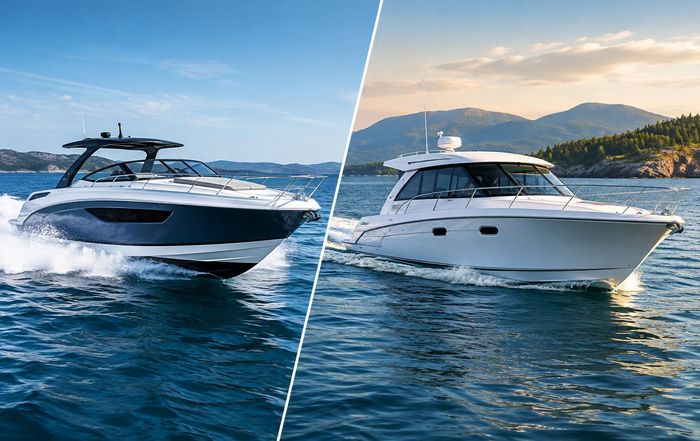
Sport Cruiser vs Express Cruiser: What Really Sets Them Apart
The terms sport cruiser and express cruiser are often used interchangeably in brokerage listings, showroom brochures, and casual dockside conversation, which is part of why buyers can end up confused before they even step aboard. In practice, the overlap is real: both are typically powered motor yachts designed for fast passage-making, comfortable overnighting, and easy weekend use. Yet there are meaningful differences in layout, performance emphasis, helm placement, and the kind of boating each style tends to suit best. For anyone comparing models in the current market, the distinction matters less as a strict category rule and more as a clue to how a boat will feel to own and use. That is especially true if you are also weighing broader priorities such as reviews, design, and cruising habits rather than simply comparing specs on paper.
The labels are not as fixed as they seem
One reason the terminology causes so much confusion is that boat builders and dealers do not always use the labels consistently. In some markets, "express cruiser" is the more common umbrella term for a sleek, open-cockpit motor yacht with a single-level social area and a lower cabin deck. "Sport cruiser," meanwhile, is often used to suggest a more performance-oriented version of that idea: lower profile, sharper styling, and a stronger emphasis on speed or handling. But there is no universal rulebook enforced by a regulator or classification body. A model marketed as a sport cruiser in one country might be called an express cruiser in another, or simply a motor yacht elsewhere. If you want to understand how the terminology is evolving across the industry, it helps to track broader news, technology, and business coverage rather than relying on a single brochure description.
That said, the labels still carry useful signals. "Express cruiser" usually points to a boat designed around open-air living, quick access between helm, cockpit, and salon, and a relatively compact but practical overnight layout. "Sport cruiser" generally implies the same ingredients, but with a little more visual aggression and often a stronger performance story. The distinction is subtle enough that many buyers will encounter hybrids, especially in Europe and North America, where styling trends and regional expectations differ. For a reader trying to compare boats across brands and markets, the best approach is to treat the name as a starting point and then inspect the deck plan, propulsion, and intended use.
Where the real differences usually show up
The most visible distinction is often the profile. A sport cruiser tends to look lower, longer, and more aerodynamic, with a cockpit and windshield arrangement that suggests speed even when the boat is sitting still. An express cruiser may look slightly fuller, with more emphasis on usable volume and social space than on an especially racy silhouette. This is not merely cosmetic. Designers are balancing windage, interior headroom, guest comfort, and the need to create a boat that can be run by an owner-operator or a small crew. For readers interested in how those choices affect onboard experience, the lifestyle and boats sections offer useful context beyond marketing language.
Inside, both types typically place the main living area below deck, with a forward master berth or convertible arrangement, a compact galley, and one or more guest berths or lounge spaces. The difference is often in how much of the hull volume is sacrificed for a more dramatic exterior line. A sport cruiser may trade a little interior height or stowage for sleeker proportions and a more dynamic feel at the helm. An express cruiser may preserve a more generous saloon, better visibility from the helm, or a more versatile cockpit for dining and lounging. In other words, the question is not simply "which is bigger?" but "what has been prioritized in the design brief?"
Performance, handling, and propulsion
Most buyers associate sport cruisers with higher performance, and that expectation is often justified, though not guaranteed. These boats commonly feature twin inboard diesel engines, sterndrive packages, or high-output gasoline setups depending on size and market. The emphasis is usually on brisk acceleration, responsive handling, and a sense of agility in coastal cruising conditions. Express cruisers can be just as quick, but they are more likely to be judged on a broader comfort envelope: efficient cruising speed, predictable handling, and a balance between pace and livability. The performance conversation also depends heavily on hull form, weight distribution, and propulsion choice, so two boats with the same label can behave very differently.
This is where current propulsion trends matter. Across the wider marine sector, builders are refining hull efficiency, improving joystick docking systems, and integrating smarter monitoring and control systems. Organizations such as the International Maritime Organization and ICOMIA continue to shape the broader environmental and technical conversation, while engine and systems makers such as Volvo Penta and Mercury Marine influence what owners can realistically expect from modern propulsion packages. For buyers, the practical takeaway is simple: the label alone tells you little about fuel burn, noise, or maneuverability. Sea trial data and propulsion details matter far more than the badge on the brochure.
Comfort at anchor versus comfort underway
The way a boat is used often matters more than the name applied to it. A sport cruiser may be especially appealing to owners who prize the feeling of driving the boat, making quick passages, and spending most of the day in motion. It is frequently chosen by couples or smaller groups who want a stylish platform for coastal runs and marina-hopping, with enough accommodation for a weekend or a few nights away. An express cruiser can be better suited to owners who want a slightly more flexible social layout and a little more tolerance for family use or longer weekend stays. That distinction becomes more obvious when comparing cockpit seating, galley access, and the flow between indoor and outdoor spaces.
Many modern buyers also care about noise, vibration, and the overall quality of the ride at displacement and semi-planing speeds. Here the difference between categories can blur, because one builder's sport cruiser may feel calmer and more refined than another builder's express cruiser. Hull engineering, trim control, and weight management can matter as much as styling. If you are comparing boats from different eras, it is also worth considering how sustainability priorities are changing design choices, from lighter construction to more efficient systems and alternative propulsion experimentation. Those developments may not redefine the category names, but they are gradually changing what buyers expect from a premium coastal cruiser.
Interior layout and family usability
Family use is one of the clearest tests of whether a particular boat really fits the "sport" or "express" description in a meaningful way. A sport cruiser may feel more intimate and driver-focused, which is excellent for a couple or a small group of friends, but less convenient if you regularly need separate sleeping spaces, extra storage, or a larger galley. An express cruiser may offer a more forgiving layout, with a saloon that converts more easily, better headroom, or a cockpit that works better for children and mixed-age groups. That does not automatically make it the better family boat, but it often makes it the easier one to live with.
This is also where buyers should think carefully about boarding, circulation, and safety aboard. A lower, sleeker profile can look elegant, but it may also mean tighter steps, less enclosed handhold protection, or a cockpit that is optimized for adults rather than all-day family use. For readers comparing practical ownership considerations, the family section can be especially relevant, because the right cruiser is often the one that matches real routines rather than idealized weekend plans. A boat that feels perfect for sunset entertaining may be less convincing when the plan includes luggage, wet gear, snacks, and sleeping arrangements for four.
Which one suits which buyer?
The better choice depends on what kind of boating is most important. If the priority is style, speed, and the sensation of piloting a sleek, responsive machine, a sport cruiser usually has the edge. It tends to appeal to buyers who want a boat that feels energetic and visually assertive, with the helm experience at the center of the design. If the priority is a more balanced package with a little more day-to-day flexibility, the express cruiser often makes more sense. It can still be fast and stylish, but it usually leans a bit more toward usable space and practical cruising comfort.
That difference also shows up in how owners talk about their boats after a season or two. Sport cruiser owners often praise the driving experience and the looks, but may be more willing to compromise on storage or cabin volume. Express cruiser owners often appreciate the versatility and the easier social layout, even if the boat is not as visually dramatic. Neither approach is inherently superior. The right answer depends on whether the boat will be used mainly for day trips, overnight escapes, family weekends, or a mix of all three. For readers following the broader market, travel and global coverage can also help show how cruising habits differ across regions and why the same model may be valued differently in different places.
How to compare models without getting distracted by the badge
The smartest way to shop is to ignore the category label until the end of the process. Start with the real questions: how many people will sleep aboard, how often will the boat run at speed, how much time will be spent anchored versus underway, and whether the owner prefers entertaining, fishing-adjacent versatility, or pure cruising comfort. Then compare cockpit usability, helm visibility, engine access, fuel capacity, and cabin ventilation. Only after that should you decide whether the boat feels more like a sport cruiser or an express cruiser in practice.
It also helps to look at the builder's broader philosophy. Some manufacturers consistently favor performance and sharp exterior lines, while others design around volume and all-round comfort. Industry events and launches often reveal these tendencies more clearly than catalog copy does, which is why following events and community new can be useful for prospective buyers. And because the market is always evolving, the same model family may shift over time toward more efficiency, more luxury, or more open-plan living. In that sense, the labels are less a hard taxonomy than a shorthand for design intent.
The bottom line is that sport cruisers and express cruisers occupy neighboring territory, not separate worlds. The first usually leans harder into style and performance, while the second tends to balance pace with a little more everyday usability. For most buyers, the better boat is the one whose layout, handling, and onboard rhythm match the way they actually cruise, not the one whose name sounds more exciting on a brochure.