

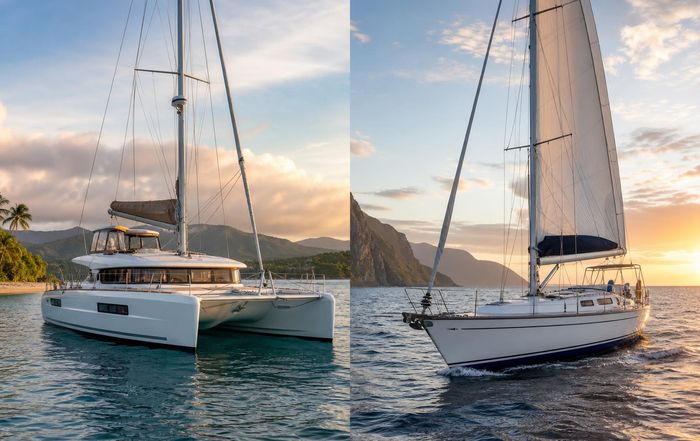
Catamaran or Monohull for Extended Cruising: A Strategic Choice for Serious Sailors
Extended cruising has moved from distant dream to practical ambition for a growing number of owners, couples, and families. As refit yards fill with bluewater projects and new-build order books stretch across leading yards, one question consistently dominates early planning: should an owner choose a catamaran or a monohull for long-distance cruising?
For the team here which regularly evaluates both production and semi-custom yachts for boat enthusiasts and serious cruisers, this decision is no longer a simple matter of tradition versus trend. It has become a nuanced business and lifestyle choice, shaped by evolving design philosophies, advances in materials and systems, changing climate and routing considerations, and a broader shift toward liveaboard comfort and hybrid work-at-sea lifestyles.
Join us as we examine the catamaran-versus-monohull question through the lens of extended cruising, drawing on recent developments in naval architecture, brokerage and charter trends, and bluewater experience, while focusing on the practical implications for owners planning multi-month or multi-year voyages.
The Modern Cruising Context: Why the Choice Matters More Than Ever
The rise of long-term cruising is well documented in industry data from organizations such as Cruising World, Sail Magazine, and the global rally circuits. The continued popularity of events like the ARC (Atlantic Rally for Cruisers), organized by World Cruising Club, provides a useful barometer of real-world usage patterns and vessel types crossing oceans. According to recent ARC fleet lists and post-rally reports, catamarans now represent a significant and growing share of transatlantic participants, particularly among family crews and owners seeking higher onboard comfort, while monohulls continue to dominate among performance-oriented sailors and traditionalists.
At the same time, builders such as Lagoon, Fountaine Pajot, Leopard, Outremer, Balance Catamarans, Hallberg-Rassy, Oyster Yachts, Amel, X-Yachts, and Bavaria have refined their cruising offerings, integrating lessons from circumnavigations, charter fleets, and owner feedback. The result is that both catamarans and monohulls now offer levels of safety, redundancy, and livability that would have been rare in production yachts several decades ago.
For readers of yacht-review.com, many of whom follow our detailed yacht reviews and sea trials, the key question is not whether a catamaran or a monohull is "better" in the abstract. Instead, the focus is on which platform better supports a specific extended-cruising strategy, including intended cruising grounds, crew profile, budget, risk tolerance, and lifestyle expectations.
Comfort and Liveability: Space, Motion, and Everyday Life Afloat
When owners consider long-term cruising, they are increasingly evaluating yachts as floating homes and remote offices as much as sailing machines. In this respect, catamarans hold a clear structural advantage: they provide significantly more living space for a given length overall, and that space is distributed in a way that supports privacy, separation of functions, and a more residential feel.
Modern cruising catamarans in the 40-50 foot range typically offer expansive saloons with 360-degree views, large cockpit areas on a single level with the main living space, and multiple cabins with en-suite heads spread across the hulls. For families or owners hosting guests, this layout can dramatically improve day-to-day comfort, reduce friction among crew, and support mixed-use activities such as remote work, schooling, and extended hosting. Observers of the charter market, including analysts at Boat International and Yachting World, have noted that this liveability factor is a core reason why multihulls dominate crewed charter fleets in regions such as the Caribbean and Mediterranean.
For monohulls, especially those purpose-built for bluewater cruising, liveability has improved substantially through wider beams carried aft, raised saloons, and better integration between cockpit and interior. Builders like Oyster and Amel have invested heavily in ergonomics, sound insulation, and climate control, recognizing that extended cruising comfort is not solely a matter of square footage but also of noise levels, motion characteristics, and ease of movement below decks. Owners often note that while monohulls may feel more compact for a given length, they can provide a more secure, enclosed feeling in heavy weather, with deep cockpits and robust handholds throughout the interior.
Motion at sea is another critical dimension of comfort. Catamarans are generally more stable at rest and under way, with significantly reduced heel, which can be transformative for crew prone to seasickness or for those planning to work remotely at sea. However, multihulls can exhibit a faster, sometimes more abrupt motion in certain sea states, particularly when beam-on to short, steep waves. Monohulls, by contrast, heel under sail and may roll more at anchor, yet many experienced sailors find their motion more predictable and easier to adapt to over long passages, particularly upwind.
Readers planning cruising itineraries can explore how different hull forms interact with real-world sea states in our dedicated cruising insights and passage-planning coverage, where motion comfort is increasingly discussed as a primary safety and wellbeing factor rather than a secondary lifestyle consideration.
Performance and Passage-Making: Speed, Angles, and Real-World Routing
Performance discussions around catamarans and monohulls have evolved significantly with the rise of high-performance cruising cats and the continued innovation in performance-oriented monohulls. In theory, light, well-sailed catamarans can achieve higher average speeds than comparable monohulls, particularly off the wind, due to their reduced wetted surface area and the ability to sail without the drag associated with heel. In practice, many production cruising cats are optimized more for volume and comfort than for outright speed, while performance cats and trimarans occupy a more specialized niche requiring experienced crews and careful attention to loading.
For extended cruising, the key performance considerations are often average passage speed, ability to maintain speed in light airs, and capability when sailing upwind or close reaching. Publications such as Sail Magazine and Practical Sailor have highlighted that modern cruising catamarans, when kept within their intended displacement and sailed with appropriate sail plans, can deliver impressive passage times and, crucially, can keep boat speed sufficiently high to reduce exposure to adverse weather systems. This can be a significant safety advantage on ocean passages, provided routing is conservative and the crew remains mindful of structural limits.
Monohulls, particularly those with efficient hull forms and modern rigs, continue to excel when sailing upwind or in mixed conditions. For high-latitude cruising or itineraries involving significant amounts of beating into head seas, many bluewater sailors still prefer the seakindly motion and upwind capabilities of a well-designed monohull. Furthermore, in the event of heavy weather requiring heaving-to or deploying storm sails, monohulls have a long and well-documented track record with established techniques described in resources such as Adlard Coles' Heavy Weather Sailing and guidance from organizations like the Royal Yachting Association (RYA).
It is worth noting that performance is increasingly linked to systems and energy management as much as hull form. The growing adoption of solar arrays, hydro-generators, and in some cases hybrid propulsion, particularly on catamarans with large coachroof areas, supports more autonomous cruising and reduces reliance on engine hours. Owners interested in the intersection of performance and onboard systems can explore further analysis in our marine technology features, where the balance between speed, energy generation, and comfort is examined in detail.
Safety and Seaworthiness: Stability, Redundancy, and Risk Profiles
Safety remains the most sensitive and debated aspect of the catamaran-versus-monohull decision, particularly for ocean passages. The discussion often centers on different types of stability and the consequences of extreme events.
Monohulls are designed to heel and, in the worst case, can capsize and then self-right due to their ballast keel and hull form. This ultimate stability is a cornerstone of traditional bluewater thinking and is reflected in standards such as the CE Category A - Ocean classification and guidance from naval architects and safety organizations. In a knockdown or roll, a well-found monohull may suffer damage but has a structural tendency to return upright, which can be a decisive psychological and practical advantage for some crews.
Catamarans, by contrast, rely on form stability. They resist initial heel strongly and provide an extremely stable platform in normal conditions, but if pushed beyond their design limits, they can capsize and are unlikely to self-right. However, modern cruising catamarans are engineered with substantial safety margins, and capsizes in well-managed cruising contexts remain rare relative to the size of the global fleet. Studies and incident analyses referenced by bodies such as World Sailing and various national maritime safety agencies suggest that most serious catamaran incidents at sea involve a combination of extreme weather, over-canvassing, or structural compromise, rather than inherent design flaws.
On the positive side, catamarans offer notable redundancy and buoyancy benefits. With two hulls, separated machinery spaces, and multiple watertight compartments, they can often remain afloat and habitable even after significant damage to one hull. This has been highlighted in several real-world incident reports where multihulls have remained viable platforms following groundings or collisions. Furthermore, the elevated bridgedeck and high freeboard of many modern cats provide additional safety margins against boarding seas in typical trade-wind conditions, although slamming in short seas remains a design and comfort consideration.
Monohulls offer their own forms of redundancy, often through simpler, more centralized systems and the ability to carry deep-reefed sail plans and storm sails optimized for survival conditions. Many bluewater-oriented monohulls also feature watertight bulkheads, robust companionway designs, and protected cockpits, which can be critical in heavy weather. Owners contemplating challenging routes or high-latitude expeditions will find extensive case studies and historical context in our sailing history and exploration coverage, where monohulls have traditionally dominated.
Ultimately, the safety profile of either platform depends heavily on skipper judgment, conservative sail plans, structural integrity, and maintenance. Modern design standards, classification rules, and the work of organizations such as ISO and World Sailing have raised the baseline of safety for both monohulls and multihulls, but the fundamental differences in stability and failure modes remain and should be weighed carefully in the context of each owner's cruising ambitions and risk appetite.
Draft, Access, and Cruising Grounds: Where the Yacht Can Go
One of the most compelling arguments for catamarans in extended cruising is their typically shallow draft. Many production cruising cats draw between 1.1 and 1.5 meters, enabling them to access lagoons, river anchorages, and shallow bays that are off-limits to deeper-keeled monohulls. This opens up a wider range of anchorages in regions such as the Bahamas, much of the South Pacific, and numerous coastal cruising areas where depth is a limiting factor.
This shallow draft also offers practical safety and convenience advantages, allowing multihulls to anchor closer to shore, reduce dinghy commuting distances, and in some cases use tidal windows to access otherwise constrained harbors. For extended cruising in archipelagic regions, this flexibility can transform the cruising experience, turning marginal anchorages into comfortable, sheltered bases.
Monohulls, particularly those with deep fin or bulb keels, must be more conservative in their anchorage choices and often anchor further offshore. However, many bluewater-focused designs now offer lifting keels, centerboards, or twin-keel configurations that reduce draft while maintaining good upwind performance. These solutions introduce additional mechanical complexity but can provide a valuable compromise for owners seeking both offshore capability and inshore access.
The choice of cruising grounds is therefore a critical strategic factor. Owners planning predominantly trade-wind circuits through shallow, coral-rich regions may find a catamaran's draft and maneuverability decisive. Those targeting higher latitudes, deep natural harbors, and more open-ocean passages may be less constrained by draft and more focused on seakeeping and upwind performance. Our global cruising and travel features regularly highlight how draft and access shape real-world itineraries, from the Caribbean and Pacific to Northern Europe and beyond.
Ownership Economics: Purchase, Operation, and Resale
Extended cruising is as much a business decision as a lifestyle one, particularly for owners who may plan to charter their yacht part-time, operate in multiple jurisdictions, or eventually resell into a global market. The economics of catamarans and monohulls differ in important ways.
Catamarans generally command higher purchase prices than comparable-length monohulls, reflecting both the additional structure and the strong demand in the charter and private cruising markets. This has been evident in brokerage data reported by leading firms such as Fraser, Northrop & Johnson, and Denison Yachting, as well as in market analyses by Boat International and other industry observers. Operating costs for catamarans can also be higher in certain categories, including haul-out fees, marina berthing (due to greater beam), and maintenance of duplicate systems such as engines and drive trains.
On the other hand, catamarans can offer compelling charter revenue potential in popular cruising regions, especially when configured for comfort and capacity. Many owners offset a portion of their operating costs by placing their catamarans into reputable charter programs, though this approach requires careful attention to contract terms, maintenance standards, and long-term asset value. Readers interested in the financial and operational aspects of yacht ownership can explore broader perspectives in our yachting business and investment coverage, where charter models and ownership structures are examined in depth.
Monohulls typically offer lower entry costs for a given length and may incur lower berthing and yard fees due to narrower beams and simpler systems. Their resale markets are well established, particularly for proven bluewater brands with strong reputations. However, resale dynamics vary by region and market segment, and in some popular charter hubs, demand for large cruising catamarans can outstrip that for monohulls.
Insurance and regulatory considerations also play a role. Underwriters assess vessel type, intended cruising area, skipper experience, and claims history when setting premiums. Industry guidance from sources such as Pantaenius and Yacht Insurance suggests that both catamarans and monohulls can be insured for extended cruising, but owners should be prepared to demonstrate relevant experience and to comply with safety and equipment standards aligned with their chosen cruising plans.
Sustainability and Energy Management: A New Dimension in the Decision
As environmental awareness grows across the maritime sector, sustainability considerations are increasingly influencing yacht selection, refit strategies, and cruising behavior. Multihulls, with their large deck and coachroof areas, can accommodate substantial solar arrays, which, combined with efficient DC systems and energy storage, enable highly autonomous cruising with reduced reliance on fossil fuels. This configuration supports quiet anchorages, lower generator hours, and the integration of electric or hybrid propulsion systems in some forward-looking designs.
Monohulls, while offering less horizontal area for solar, are benefiting from advances in panel efficiency, flexible solar technologies, and improved hydrogeneration systems that can harvest energy under sail. Long-distance cruisers on both hull types are increasingly adopting renewable energy packages that combine solar, wind, and towed generators, aligning with broader trends in low-impact cruising and responsible resource use. Those seeking to deepen their understanding of these developments can learn more about sustainable business practices and green yachting, where sustainability is examined from technical, regulatory, and cultural perspectives.
Lifecycle considerations also play a role. The construction of both catamarans and monohulls typically involves composite materials, which present challenges in terms of end-of-life recycling and environmental impact. However, initiatives highlighted by organizations such as The Ocean Race, Sailors for the Sea, and various European research projects are exploring more sustainable materials, circular-economy approaches, and improved recycling techniques. Owners and builders who prioritize sustainability are beginning to factor these issues into their decisions, from material choice to refit strategies and equipment selection.
Lifestyle, Crew Dynamics, and Personal Priorities
Beyond technical and financial considerations, the choice between catamaran and monohull is deeply personal, touching on how owners and their families envision life at sea. Catamarans tend to lend themselves to an open, social lifestyle, with large communal spaces, generous cockpits, and separation between cabins that can provide privacy and quiet zones. For families with children, multigenerational crews, or owners who expect frequent guests, this layout can significantly enhance onboard harmony and make extended cruising more sustainable emotionally and socially.
Monohulls often foster a different atmosphere, one that some sailors describe as more intimate, traditional, and connected to the act of sailing itself. The layout of many monohulls, with a central saloon, galley, and navigation area, can create a strong sense of shared space and collective experience, particularly on passage. For couples or small crews who prioritize sailing performance, heavy-weather capability, and a more classic yachting aesthetic, a monohull can feel more aligned with their identity and aspirations.
Increasingly, owners are also considering how their yachts integrate with broader lifestyle patterns that include remote work, seasonal cruising, and extended time ashore. The rise of digital nomadism and flexible working arrangements has made it feasible for professionals to spend months aboard, provided connectivity and workspace are adequate. Our lifestyle features frequently profile owners who have redefined their relationship with time, place, and work through extended cruising, and their experiences highlight how hull choice interacts with day-to-day living and long-term satisfaction.
For families, questions of safety, education, and community are especially important. Catamarans can provide dedicated learning spaces, quiet cabins for children, and more room for toys, sports gear, and homeschooling materials, while monohulls may feel more compact but can still be highly family-friendly when carefully selected and refitted. Resources such as Noonsite and various family-cruising networks provide community-driven insights into how different hull types perform in real-world family cruising scenarios, adding valuable context to the decision-making process.
The Evolving Market: Innovation, Trends, and Future Directions
The market for extended-cruising yachts is evolving rapidly, driven by demographic shifts, technological innovation, and changing expectations about comfort and autonomy. Catamarans have moved decisively into the mainstream of bluewater cruising, with leading builders continuously refining hull forms, bridgedeck clearance, weight distribution, and safety features. Performance-oriented brands are pushing boundaries with lighter structures, carbon rigs, and daggerboards, while more volume-focused builders refine ergonomics, storage, and systems integration.
Monohulls are undergoing their own evolution, with increased use of twin rudders, bowsprits, and hull chines to improve performance and interior volume, as well as growing interest in hybrid propulsion, advanced sail-handling systems, and smart-boat technologies. The distinction between "traditional" and "modern" bluewater monohulls is blurring as designers integrate lessons from offshore racing, high-latitude expeditions, and liveaboard feedback.
For the yacht-review.com audience, staying abreast of these developments is essential, whether they are actively shopping for a yacht, planning a refit, or simply refining their long-term cruising vision. Our news coverage and global perspectives regularly track new model launches, technology demonstrations, and owner experiences across both catamaran and monohull segments, offering a curated view of where the market is heading and how it may shape future cruising possibilities.
Making the Choice: Aligning Platform with Purpose
Ultimately, the decision between a catamaran and a monohull for extended cruising is an exercise in aligning platform with purpose. It requires a clear-eyed assessment of intended cruising grounds, crew composition, comfort expectations, budget, and personal risk profile, as well as an understanding of how those factors may evolve over the years.
For some, the stability, space, and shallow draft of a catamaran will be decisive, enabling a lifestyle that feels more like an expansive, mobile waterfront home with far-reaching access to shallow anchorages and a strong emphasis on comfort. For others, the seakeeping, self-righting capability, and sailing feel of a monohull will resonate more deeply, offering a sense of connection to the sea and to a long tradition of ocean voyaging.
What is clear from the experience of owners, designers, and professional crews is that both platforms, when carefully chosen and well maintained, can support safe, rewarding, and transformative extended cruising. The most successful projects are those in which owners invest time in sea trials, charter experiences on both hull types, and honest conversations with experienced cruisers, rather than relying solely on marketing narratives or dockside opinions.
Here the editorial team continues to test, analyze, and compare both catamarans and monohulls across a wide range of sizes and configurations, with the aim of providing readers with grounded, experience-based insights. Those embarking on their own decision-making journey are encouraged to explore our broader reporting, from detailed design and naval architecture features to community-focused stories of life afloat, and to approach the catamaran-versus-monohull question not as a binary debate, but as a strategic choice in crafting their own extended-cruising narrative.