

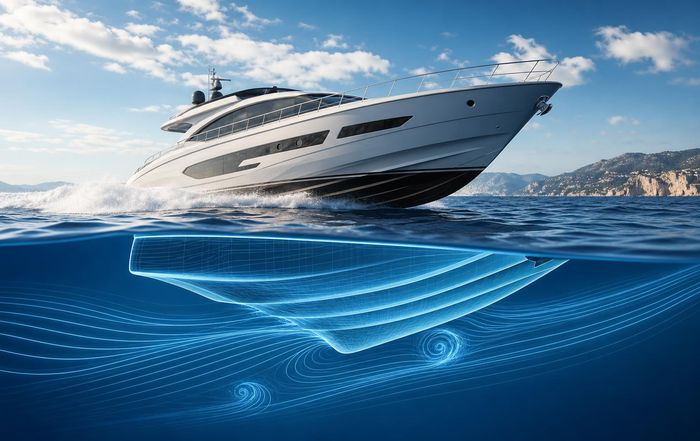
How Hull Shape Affects Yacht Speed and Comfort
Hull shape is one of the most decisive factors in how a yacht behaves at sea, influencing not only outright speed but also comfort, safety, fuel efficiency and even the kind of cruising lifestyle an owner can realistically enjoy. While propulsion systems, materials and onboard technology have advanced rapidly in recent years, naval architects and serious owners still begin with the same foundational question: what should the hull do, and how should it be shaped to do it best?
For many of the grown number of individuals visiting us for educational / learning content about yachts and boats, where performance is always considered alongside liveability and long-range capability, understanding hull geometry is essential to evaluating new designs, comparing models and planning refits. The choices made below the waterline will determine whether a yacht slices efficiently through a calm sea, shoulders aside a heavy swell or pounds uncomfortably into a short chop.
This article examines the key hull types used in contemporary yachting, explains the hydrodynamic principles that govern their behaviour, and explores how designers are blending forms to deliver higher speed with greater comfort, drawing on recent developments in naval architecture and real-world experience from leading yards.
Fundamental Hydrodynamics: Why Shape Matters
Every yacht hull must negotiate three main forces: buoyancy, drag and stability. The way a hull is shaped determines how it displaces water, how much resistance it generates as speed rises, and how it responds to waves and wind.
Hydrodynamicists often distinguish between displacement, semi-displacement and planing regimes. A pure displacement hull pushes water aside and rides in the trough it creates, with its maximum efficient speed constrained by its waterline length. This relationship is commonly described by the Froude number and the "hull speed" rule of thumb, which can be explored further in technical summaries from institutions such as the U.S. Naval Academy and MIT's Department of Mechanical Engineering. In contrast, a planing hull climbs partially or largely out of the water as speed increases, reducing wetted surface area and wave-making resistance so that power can be converted into much higher speeds.
Between these two extremes lies the semi-displacement or semi-planing regime, in which the hull still displaces significant water but gains some dynamic lift, allowing higher cruising speeds than a pure displacement form while retaining a fuller volume and more predictable motion.
For owners and captains, the essential trade-off is that shapes optimised for speed often compromise comfort in a seaway, while shapes optimised for softness of ride and range tend to sacrifice maximum speed. Designers are increasingly using computational fluid dynamics and model testing, supported by research from organisations such as MARIN in the Netherlands, to refine hulls that balance these competing priorities.
Displacement Hulls: Efficiency, Range and Seakindliness
Traditional long-range cruising yachts and many expedition vessels use displacement hulls with relatively narrow beams, deep forefoots and rounded or soft-chine sections. These hulls prioritise efficiency at moderate speeds, typically in the 8-12 knot range for motor yachts and higher for performance sailing yachts, where the driving force comes from sails rather than engines.
A well-designed displacement hull moves through the water with a smooth, predictable motion, particularly when combined with a fine entry at the bow to cut through waves and a relatively deep draft to provide directional stability. Owners who spend extended periods aboard often value this seakindliness more than sheer speed, as it reduces fatigue, protects onboard systems and makes long passages more pleasant. For readers exploring ocean voyaging or passagemaking, the long-term comfort of displacement designs is a recurring theme in our own cruising coverage.
From a business perspective, displacement yachts can be more economical to operate over long distances because they are optimised to run at lower speeds where fuel consumption per nautical mile is significantly reduced. Studies published by DNV and other classification societies show that resistance curves for displacement hulls rise steeply when pushed beyond their efficient speed range, reinforcing the logic of slow-and-steady operation for transoceanic routes.
The trade-off is clear: these hulls are rarely capable of high top speeds without disproportionate increases in power, weight and fuel capacity. For owners whose cruising patterns involve short hops between marinas or frequent repositioning at higher speed, this can be a limiting factor.
Planing Hulls: Speed and Responsiveness
At the other end of the spectrum, many contemporary sports yachts, day boats and high-performance cruisers feature planing hulls with flatter aft sections, hard chines and wider beams relative to their length. When sufficient power is applied, these hulls transition from displacement mode to planing, riding higher on the water and dramatically reducing drag.
The sensation of planing is familiar to many owners: the bow lifts, the wake flattens and the yacht accelerates rapidly, offering exhilarating performance and the ability to cover ground quickly. High-speed hull forms have been extensively studied by organisations such as SNAME and by leading builders who specialise in fast craft for both leisure and professional use.
Planing hulls are particularly attractive in regions with relatively sheltered waters, such as parts of the Mediterranean, the U.S. East Coast and the Baltic, where sea states often allow cruising at 25-35 knots or more. For time-poor owners, the ability to leave the office on a Friday and reach a distant anchorage before nightfall is a powerful argument in favour of this hull type.
However, the same characteristics that enable high speed can reduce comfort when conditions deteriorate. Flatter aft sections tend to pound into head seas, transmitting vertical accelerations through the structure and into the accommodation. Wide, shallow hulls can also exhibit more abrupt motions in beam seas, and at lower speeds they may roll more readily than deeper forms unless stabilisation systems are fitted. These issues are mitigated to some extent by modern active stabilisers, including gyro-based and fin systems, whose evolution is covered in more detail in our technology features.
Fuel consumption is another consideration. Because planing yachts often operate at higher speeds, their engines work harder and burn more fuel per mile than displacement counterparts, particularly if heavily loaded or driven in rough water. Owners must balance the joy of speed with operational costs and range limitations, especially when cruising in areas where fuel availability is less predictable.
Semi-Displacement and Fast Displacement: The Middle Ground
Recognising that many owners seek both respectable speed and genuine comfort, naval architects have devoted significant effort to semi-displacement and fast-displacement hull forms. These designs aim to operate efficiently at moderate to relatively high speeds, often in the 15-22 knot range, while retaining a fuller volume and more forgiving motion than pure planing hulls.
The term "fast displacement" has been popularised in recent years by high-profile projects from builders such as Heesen Yachts and Feadship, which have worked with design offices like Van Oossanen Naval Architects to develop hulls that combine slender entries, careful volume distribution and optimised stern shapes. Independent testing and published performance data, reported by sources including Boat International and Yachting World, indicate that these yachts can achieve higher speeds than traditional displacement vessels without a proportional increase in fuel burn.
Semi-displacement hulls typically feature moderate deadrise angles and a mixture of rounded and hard-chine sections. At low speeds they behave much like displacement yachts, with predictable, comfortable motion, but as speed increases they generate additional dynamic lift, reducing the effective displacement and flattening the running trim. This allows designers to offer higher cruising speeds for a given engine package, which is particularly attractive for owners who cruise in variable conditions and wish to maintain schedule flexibility.
For many readers of yacht-review.com, semi-displacement designs represent a compelling compromise, especially when paired with stabilisation and efficient propulsion systems. Our boat reviews frequently highlight the way these hulls translate design theory into real-world comfort, especially on longer passages where sea state can change significantly over a single day.
Hull Form and Comfort: Motion, Noise and Fatigue
While speed is an easily measurable metric, comfort is more complex, encompassing motion characteristics, interior noise levels, vibration, spray patterns and even how a yacht behaves at anchor. Hull shape plays a central role in each of these elements.
In head seas, hulls with fine entries and deeper V-sections forward tend to cut through waves more gently, reducing slamming and vertical accelerations. This is one reason why many offshore-capable yachts and patrol vessels, including those studied by ABS and other classification societies, maintain relatively deep forefoot designs even when the aft sections are optimised for higher speeds. However, excessive fineness can reduce interior volume and may lead to more pitching if not balanced by careful weight distribution.
In beam seas, roll behaviour becomes critical. Round-bilged displacement hulls often have a softer, slower roll, which some sailors find comfortable but others perceive as excessive if not controlled. Hard chines and wider beams can increase initial stability, making the yacht feel "stiffer," but may also lead to more abrupt, jerky motions. Designers use a combination of hull geometry, ballast, superstructure weight management and stabilisation systems to tune these characteristics, and the resulting behaviour is often a key differentiator in our boat and yacht overviews.
Noise and vibration are also influenced by hull form. Planing hulls operating at high speed can transmit more impact noise through the structure, while certain semi-displacement forms may experience flow-related vibration at specific speeds if appendages and propeller tunnels are not carefully designed. Advances in computational fluid dynamics and structural modelling, supported by research published through platforms such as ScienceDirect, have helped designers identify and mitigate these issues earlier in the development process.
At anchor, hull shape affects how a yacht responds to residual swell and wakes from passing traffic. Deeper, fuller forms often provide a more stable platform, particularly when combined with zero-speed stabilisers, while very flat-bottomed planing hulls can exhibit more pronounced rolling and snatching at anchor unless stabilisation or anchoring techniques are optimised.
Materials, Weight and Structural Design
Hull shape cannot be considered in isolation from materials and structural engineering. A given form may perform very differently depending on whether it is built in steel, aluminium, composite or a hybrid structure. Heavier materials such as steel favour displacement and long-range cruising yachts, where weight contributes to momentum and comfort, while lighter materials like advanced composites allow faster acceleration and higher top speeds for planing and semi-planing designs.
The interplay between hull shape and structural stiffness is significant. High-speed hulls with fine, flat sections must be engineered to withstand repeated slamming loads without excessive flexing, which can lead to fatigue and discomfort. Classification rules and guidelines from bodies such as Lloyd's Register provide frameworks for calculating these loads and designing appropriate scantlings, but experienced yards often go beyond the minimum requirements to achieve quieter, more solid-feeling yachts.
From a sustainability perspective, weight reduction through advanced composites and optimised structures can contribute to lower fuel consumption and emissions, aligning with broader industry efforts to improve environmental performance. Readers interested in the intersection of hull technology and environmental responsibility can explore this further in our dedicated sustainability section, where alternative fuels, hybrid propulsion and lifecycle assessments are discussed alongside hydrodynamic efficiency.
Multihulls: Catamarans and Trimarans
While monohulls remain dominant in the superyacht and production motor yacht markets, multihulls have gained significant traction in recent years, particularly in the sailing and power catamaran segments. Catamarans and trimarans introduce a different set of relationships between hull shape, speed and comfort.
Because multihulls distribute displacement across two or three relatively narrow hulls, each individual hull can be slender and highly efficient at displacement speeds. This allows power catamarans, for example, to achieve respectable cruising speeds with comparatively modest power, while offering very wide deck beams and expansive living spaces. Publications such as Cruising World and Sail Magazine have documented the growing appeal of these designs for both private and charter use.
In terms of comfort, multihulls often exhibit reduced roll at rest due to their wide stance, which many guests find very appealing at anchor. Underway, however, motion can be different from that of monohulls, with quicker, sometimes more angular responses to waves depending on hull spacing, bridge deck clearance and sea conditions. Bridge deck slamming, where waves impact the underside of the central platform, can be an issue in certain sea states if clearance and hull shape are not carefully considered.
Trimarans, though less common in the mainstream yacht market, offer potential for very high speeds and efficient passage-making, as demonstrated by record-breaking ocean racers and some experimental motor yacht projects. Their central hull typically carries most of the displacement, with the outer amas providing stability and additional buoyancy. For a business audience assessing emerging trends, multihulls represent a growing niche that combines innovative hull forms with evolving owner expectations around space, stability and fuel efficiency, a topic we continue to follow in our broader global yachting coverage.
Foils, Steps and Other Advanced Features
Beyond basic hull form, designers increasingly integrate additional features such as steps, foils and interceptors to fine-tune performance and comfort. Stepped hulls, which incorporate transverse breaks in the bottom surface, introduce air under the hull to reduce wetted area and drag at speed. This technology, widely used in smaller high-performance craft, has been adapted cautiously for larger yachts due to the complexity of ensuring stable, predictable handling. Research and testing reported by technical outlets and specialist builders show that when properly executed, stepped hulls can deliver significant speed and efficiency gains, but they demand precise weight distribution and careful driver or autopilot input.
Foil-assisted designs use submerged foils to generate lift, reducing displacement and drag. In some cases, as seen in certain fast ferries and experimental yachts, hulls can transition largely out of the water, riding primarily on foils. More commonly in the yacht sector, foils are used to augment semi-displacement or planing hulls, improving ride quality and efficiency without fully foiling. Developments in this field are closely watched by innovation-focused owners and by shipyards that emphasise cutting-edge design thinking.
Transom interceptors and trim tabs are now common on many motor yachts, allowing dynamic adjustment of running trim to optimise fuel consumption and comfort. By fine-tuning the hull's attitude relative to the water, captains can reduce pounding, improve visibility and achieve a more level ride, particularly when sea conditions or loading change.
These technologies underscore a broader industry trend: rather than choosing between speed and comfort, many owners seek integrated solutions where hull shape, appendages and control systems work together to deliver a more refined experience.
Matching Hull Shape to Cruising Style and Lifestyle
For prospective buyers, refit planners and charter clients, the most practical question is how hull shape should influence their next decision. The answer lies in honestly assessing cruising patterns, preferred destinations, typical sea conditions and personal tolerance for motion.
Owners who envision extended bluewater cruising, ocean crossings and high-latitude exploration often gravitate toward displacement or semi-displacement hulls, valuing range, robustness and predictability over outright speed. Those who prioritise fast weekend getaways, coastal hops and sporty handling may find planing or fast semi-planing hulls more aligned with their expectations. Multihulls appeal to those who place a premium on stability at anchor, expansive interior volume and efficient displacement-speed operation.
Lifestyle considerations are equally important. Families with young children may place greater emphasis on gentle motion and secure deck spaces, themes that recur in our family-oriented features, while corporate owners or charter operators often balance guest comfort with schedule flexibility and operational efficiency. The business case for a given hull type must account not only for initial build or purchase cost but also for fuel consumption, maintenance, crew requirements and residual value, topics explored in our business insights.
Consultation with experienced naval architects, surveyors and captains remains essential. Independent sea trials in representative conditions provide invaluable data that goes beyond brochure figures, allowing decision-makers to experience how a hull truly behaves when pushed, throttled back, turned sharply or held at anchor in a swell.
Sailing Onwards = Innovation, Sustainability and Owner Expectations
The relationship between hull shape, speed and comfort continues to evolve as technology, regulation and owner priorities change. Computational tools now allow designers to iterate thousands of hull variants virtually, narrowing down to those that best meet a project's performance, comfort and efficiency targets before a physical model is ever built. Research into alternative fuels, hybrid propulsion and lower-carbon operations, supported by initiatives from groups such as the Water Revolution Foundation and covered regularly in our news reports, is driving renewed focus on hydrodynamic efficiency as a key lever for emissions reduction.
At the same time, expectations for onboard comfort have never been higher. Stabilisation systems, active ride control and sophisticated automation are now considered essential on many new builds, particularly in the premium segments. These systems do not replace good hull design; rather, they complement it, enabling designers to push certain performance envelopes while maintaining acceptable comfort levels.
For the team here, hull shape remains a central lens through which new yachts are evaluated and classic designs are appreciated. Our history features show how past generations of naval architects solved similar challenges with the tools and priorities of their time, while our lifestyle coverage illustrates how those technical choices translate into lived experiences aboard.
Ultimately, the most successful yachts are those in which hull form, propulsion, layout and intended use are harmonised. When the hull is right, speed feels effortless, comfort becomes a given rather than a luxury, and the yacht can fulfil its role as both a capable vessel and a refined home on the water. As innovation accelerates and new materials and methods emerge, the art and science of hull design will continue to shape not only how fast yachts can go, but how far, how efficiently and how enjoyably they can carry their owners into the world's cruising grounds.