

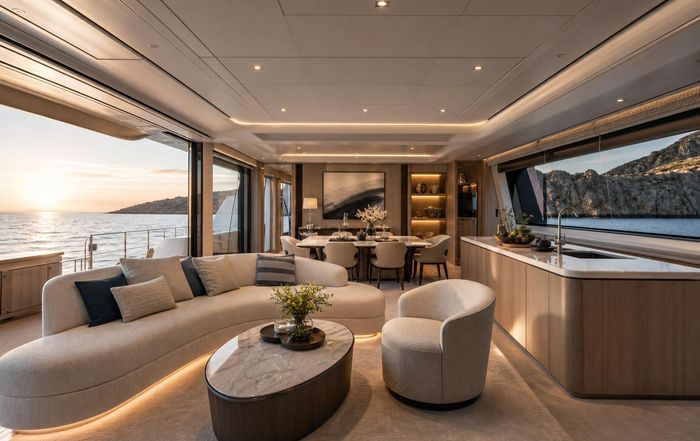
Designing a Yacht Interior for Practical Luxury
Designing a yacht interior that balances indulgent comfort with day-to-day practicality has become one of the defining challenges - and opportunities - in contemporary yacht creation. Owners no longer view interiors purely as floating showpieces; instead, they expect spaces that can host family cruising, corporate entertainment, charter guests, and long-range expeditions with equal ease. For the team sailing around the studios here, this evolution is reshaping how interiors are evaluated, discussed, and ultimately experienced on board.
This article explores how leading designers, shipyards, and owners are redefining "practical luxury" in yacht interiors, how new technologies and materials are changing what is possible, and how thoughtful design can enhance safety, sustainability, and long-term value without compromising the emotional impact that makes yachting so compelling.
The New Meaning of Luxury at Sea
Traditional yacht interiors often equated luxury with visual opulence: elaborate marquetry, heavy draperies, and ornate fixtures that mirrored grand residences on shore. While some owners still favour this aesthetic, a growing share of the market now associates luxury with freedom of use, ease of maintenance, and the ability to enjoy the yacht in a variety of modes, from private family time to high-profile events. For many of the projects followed by yacht-review.com, the most successful interiors are those in which guests can move naturally, find what they need intuitively, and feel relaxed rather than intimidated by the surroundings.
Research by industry bodies such as Superyacht Times and Boat International indicates that owners increasingly prioritise wellness spaces, flexible cabin configurations and indoor-outdoor continuity, all of which demand a more functional view of luxury. At the same time, the rise of long-range expedition yachts and support vessels has pushed designers to think beyond marina-centric living and consider how interiors behave in remote anchorages and demanding sea conditions. This shift is visible from compact performance cruisers to large custom superyachts, and is central to many of the projects covered in our own yacht reviews.
Understanding How Owners Really Use Their Yachts
Designing for practical luxury begins with a clear understanding of use cases. Leading studios such as Winch Design, Bannenberg & Rowell, RWD and Nuvolari-Lenard typically start projects with in-depth owner interviews, operational analysis, and, increasingly, data from previous seasons. Rather than assuming that a yacht will be used only for summer Mediterranean cruising, design teams now examine how many guests are usually on board, how often the yacht charters, which regions it will visit, and how the crew work behind the scenes.
Owners who cruise with multi-generational families, for example, may favour adaptable guest suites that can convert between twin and double layouts, along with play areas, cinema lounges and shaded deck zones that allow grandparents and children to enjoy the yacht simultaneously without conflict. Those who use the yacht primarily for business entertainment may request more formal dining options, private meeting rooms, and audiovisual systems that support presentations as well as cinema nights, echoing trends seen in high-end residential and hospitality design reported by Architectural Digest and Dezeen.
At yacht-review.com, the most compelling projects are often those in which the owner's lifestyle is clearly legible in the interior. When a layout supports real-world patterns - early-morning coffee on a quiet aft deck, a seamless transition from tender arrival to main saloon, or a crew-only circulation route that keeps service discreet - the luxury feels natural rather than forced. Readers exploring new projects through our boats and models coverage increasingly look for this kind of alignment between design intent and daily life on board.
Space Planning: The Foundation of Practical Luxury
No amount of fine materials or sophisticated lighting can compensate for a poorly planned layout. Practical luxury begins with circulation, zoning and proportion. Designers must reconcile a finite hull volume with a growing list of owner requests, regulatory requirements, and technical constraints, while still creating a sense of spaciousness and calm.
A key principle is separating guest and crew flows without isolating the crew from the spaces they need to service. Well-concealed service pantries, crew corridors, and dumbwaiters allow staff to move efficiently while preserving the illusion of effortless hospitality for guests. Publications such as Boat International have repeatedly highlighted projects where crew-guest separation is handled with particular finesse, noting the positive effect on both guest privacy and crew morale.
Another central consideration is the relationship between interior and exterior spaces. Large sliding doors, fold-out balconies, and beach clubs that open directly to the sea have become almost standard on new builds documented by SuperYacht Times and Yachting World. Inside, this drives an emphasis on open-plan salons, flexible seating arrangements, and dining areas that can expand or contract depending on guest numbers. For designers, the challenge is to maintain structural integrity and acoustic comfort while maximizing views and natural light, a theme often explored in our design-focused features.
Storage is also a critical but sometimes overlooked element of practical luxury. Owners who cruise for extended periods need generous, intelligently organised storage for clothing, sports equipment, toys, and provisions. This has led to more use of under-floor spaces, concealed cabinetry, and multi-functional furniture that can hide clutter without compromising aesthetics. The ability to maintain a clean, ordered environment contributes directly to the feeling of luxury, even on relatively modest-sized yachts.
Material Choices: Beauty, Durability, and Safety
Material selection is where visual luxury most clearly intersects with practical considerations such as maintenance, weight, and fire safety. In recent years, there has been a noticeable move away from heavy, high-gloss finishes towards lighter woods, tactile textiles, and natural stones treated for marine use. This evolution is reflected in the projects showcased by leading builders like Feadship, Benetti, Lürssen, and Sanlorenzo, whose interiors often combine understated elegance with robust performance.
For flooring and wall panels, engineered woods and veneers allow for consistent quality and reduced warping in varying humidity, while still delivering the warmth and character that many owners desire. In high-traffic areas, designers increasingly favour durable, easy-to-clean surfaces and fabrics with stain-resistant treatments, a practice aligned with best-in-class hospitality standards described by Hospitality Design. Soft furnishings frequently use performance textiles that mimic the feel of natural fibres while offering superior resistance to sunlight, salt, and wear.
Stone surfaces, traditionally associated with heavy marble and granite, are now often executed in lightweight honeycomb-backed panels or engineered composites. This reduces weight without sacrificing visual impact, an important factor for performance-oriented yachts where every kilogram counts. At the same time, designers must ensure that all materials comply with stringent marine fire regulations such as the IMO's FTP Code, a subject covered in detail by technical resources from the International Maritime Organization.
From a safety perspective, non-slip finishes, rounded edges, and secure fastening of loose items contribute to a practical interior that remains comfortable and safe even in rough seas. These considerations are particularly important for families and older guests, and they align closely with the real-world cruising experiences reported in our cruising insights.
Lighting, Acoustics, and the Psychology of Comfort
Lighting design has emerged as one of the most powerful tools for creating a sense of practical luxury. Well-designed lighting schemes combine ambient, task, and accent lighting to allow spaces to adapt from bright, functional environments during the day to intimate, atmospheric settings in the evening. Advances in LED technology, tunable white systems, and smart controls now enable designers to mimic natural circadian rhythms, supporting guest wellbeing on longer voyages, a trend also observed in high-end residential and aviation design by sources such as Wired and The New York Times.
Dimmable, pre-set scenes allow crew to change the mood quickly for different occasions, which is particularly valuable on charter yachts where the same space may host breakfast, sun-lounging, and formal dining in a single day. Indirect lighting, concealed strips, and carefully positioned fixtures help avoid glare on water or reflective surfaces, while also highlighting architectural features and artwork.
Acoustic comfort is another essential but less visible aspect of practical luxury. Insulation between guest cabins, vibration damping around machinery spaces, and careful choice of soft finishes all contribute to a quiet, restful environment. Shipyards such as Heesen Yachts and Oceanco have invested heavily in noise and vibration control, often working with specialist consultants to achieve hotel-level comfort at sea. For guests, the result is an interior that feels serene even when the yacht is underway or anchored in a lively harbour.
The psychological impact of these elements should not be underestimated. When lighting, acoustics, and temperature are well-controlled, guests tend to feel more at ease, sleep better, and use the yacht more extensively, reinforcing the perception of luxury as a holistic experience rather than a collection of decorative features. Owners exploring new builds or refits through our technology coverage increasingly ask detailed questions about these invisible layers of comfort.
Integrating Technology Without Overwhelming the Space
Onboard technology has advanced rapidly, with integrated control systems, high-bandwidth connectivity, and sophisticated entertainment options now expected even on mid-sized yachts. The challenge for interior designers is to integrate these systems in a way that enhances practicality without cluttering spaces with visible hardware or complicated interfaces.
Many high-end projects now use centralised control platforms that allow guests to adjust lighting, climate, blinds, and audiovisual systems from tablets or wall-mounted touchscreens. To ensure practicality, designers and integrators must collaborate closely to create interfaces that are intuitive for occasional users, not just technically inclined crew. Independent reviews by publications such as Yachting Magazine and Power & Motoryacht often highlight user-friendly control systems as a key differentiator in guest experience.
Hidden speakers, retractable televisions, and cleverly concealed charging points allow interiors to remain visually calm while still supporting modern digital lifestyles. For charter-oriented yachts, robust Wi-Fi coverage, streaming capabilities, and business-grade communication systems are increasingly non-negotiable, reflecting broader trends in remote work and "work from yacht" arrangements discussed by Harvard Business Review and other business outlets.
From a practical standpoint, designers also consider long-term serviceability. Access panels, cable routing, and modular components are planned so that future upgrades or repairs can be carried out with minimal disruption to the interior. This forward-looking approach aligns with the investment perspective many of our readers adopt when evaluating yachts through the lens of yachting business and ownership.
Sustainability and Responsible Material Choices
Sustainability has become a central concern in yacht design, and interiors are no exception. Owners are increasingly asking how materials are sourced, what their environmental impact is, and how they will perform over the yacht's life cycle. Organisations such as the Water Revolution Foundation and Blue Marine Foundation have helped raise awareness of ocean health and the environmental footprint of yachting, influencing both shipyards and suppliers.
In response, many designers now specify certified woods from sustainably managed forests, low-VOC finishes, and recycled or recyclable materials where feasible. Fabrics made from recycled ocean plastics, plant-based leathers, and eco-friendly foams are gradually entering the mainstream, particularly in collaboration with forward-thinking suppliers highlighted by Boat International and SuperyachtNews. These materials must still meet rigorous standards for durability, fire resistance, and tactile quality, but progress has been significant over the past decade.
Energy efficiency also plays a role in interior design. LED lighting, efficient HVAC systems, and smart controls reduce power consumption, supporting broader sustainability goals and, in some cases, enabling quieter operation at anchor by reducing generator load. For owners interested in the intersection of yachting and environmental responsibility, our sustainability coverage explores many of these innovations in depth.
Practical luxury in this context means interiors that feel indulgent yet align with the owner's values and the broader shift towards more responsible ocean use. It is no longer unusual for clients to ask for traceability information on materials or to favour suppliers with strong environmental credentials, mirroring trends in luxury fashion and hospitality.
Regional Influences and Cultural Sensitivity
Yacht interiors today are shaped by a global clientele, with owners from North America, Europe, the Middle East, and Asia bringing different cultural expectations and aesthetic preferences. Designers must be adept at interpreting these influences into coherent, seaworthy interiors that still feel personal and authentic.
For example, some owners favour a minimalist, Scandinavian-inspired aesthetic with light woods, neutral textiles, and abundant natural light, an approach that echoes residential trends in countries such as Sweden, Norway, and Denmark and is frequently covered by outlets like Wallpaper* and Elle Decor. Others may prefer richer palettes, statement artworks, or design cues from Mediterranean, Middle Eastern, or Asian traditions. In each case, the key to practical luxury is ensuring that cultural references are integrated in a way that supports everyday use rather than feeling like a themed environment.
This sensitivity extends to functional details. Prayer rooms, specific kitchen arrangements, or dedicated tea or sake areas may be important for some owners and must be incorporated with respect and practicality. As yachting expands in markets such as Singapore, China, and the broader Asia-Pacific region, designers who understand these nuances are better positioned to create interiors that resonate deeply with their clients, a trend we continue to observe in our global yachting perspectives.
Charter-Ready Design: Flexibility as a Form of Luxury
Many new yachts are designed with at least some charter use in mind, even when owners plan significant private time aboard. This dual purpose places particular emphasis on flexibility, durability, and broad appeal. Interiors must be distinctive enough to stand out in a competitive charter market, yet neutral enough to suit a wide range of guest tastes.
Convertible cabins are one of the most visible expressions of this approach. Guest suites that can switch between twin and double configurations, or combine into larger family apartments, allow charter brokers to accommodate different group types without compromise. Similarly, multi-purpose lounges that can host yoga in the morning, work sessions in the afternoon, and cocktail parties in the evening maximise the utility of limited interior volume.
Materials and finishes for charter-focused yachts often skew slightly more robust, with particular attention to stain resistance, repairability, and ease of cleaning between charters. This does not mean sacrificing visual luxury; instead, it encourages designers to select fabrics, leathers, and surfaces that age gracefully and can be refreshed as needed without major refits. Owners considering charter potential often evaluate these aspects carefully, drawing on insights from our lifestyle and charter-related features.
From a business perspective, a well-designed, practical-luxury interior can significantly enhance charter revenue and resale value, providing a tangible return on investment in thoughtful design.
The Refitting Opportunity: Upgrading to Practical Luxury
Refits and interior refurbishments offer existing owners a powerful opportunity to bring older yachts in line with contemporary expectations of practical luxury. Shipyards and specialist refit facilities across Europe, North America, and Asia report strong demand for projects that modernise layouts, update materials, and integrate new technologies without altering the fundamental structure of the yacht. Coverage by SuperyachtNews and The Superyacht Report suggests that refit activity has grown steadily, driven by both economic considerations and a desire to reduce environmental impact by extending the life of existing vessels.
Common refit interventions include opening up enclosed salons, enlarging windows where structurally feasible, replacing heavy finishes with lighter palettes, and introducing modern lighting and control systems. In some cases, crew areas and service flows are reconfigured to improve operational efficiency, which in turn enhances guest experience. For owners who acquired yachts built in earlier design eras, these changes can be transformative, bringing the interior in line with current expectations without the cost or timeline of a new build.
Refit stories often resonate strongly with readers, as they demonstrate how design thinking evolves over time and how existing yachts can be revitalised. Our news and project updates regularly highlight refits that successfully combine heritage with modern practicality, offering inspiration for owners considering similar projects.
Human-Centric Design: Crew, Family, and Community
Practical luxury is ultimately about people. A yacht interior that looks spectacular in photos but is difficult to live with will quickly lose its appeal. Designers who prioritise human-centric thinking - considering how crew work, how families interact, and how guests move through the yacht - tend to create spaces that feel genuinely luxurious over time.
Crew comfort and efficiency are particularly important. Well-designed crew cabins, mess areas, and workspaces contribute directly to service quality and crew retention, issues that have gained increased attention in recent years from organisations such as the Professional Yachting Association and industry media. When crew are well rested and have the tools they need, they are better able to deliver the seamless, anticipatory service that defines high-end yachting.
For families, practical luxury may involve child-friendly materials, safe circulation routes, and spaces that encourage shared experiences, from movie nights to water sports briefings. Owners who cruise with extended family or friends often value flexible seating, generous dining options, and quiet corners where individuals can retreat without feeling isolated. These patterns of use are frequently explored in our family-oriented features, reflecting how yachting can bring generations together.
Beyond the immediate circle on board, yacht interiors can also serve as platforms for philanthropy, cultural exchange, and community engagement. Some owners host charitable events, scientific briefings, or cultural performances on their yachts, requiring interiors that can adapt to these roles while still functioning as private retreats. In this sense, practical luxury becomes a means of connecting with the wider world rather than withdrawing from it.
Conclusion: Practical Luxury as a Lasting Value Proposition
Designing a yacht interior for practical luxury is not about reducing ambition; it is about channelling creativity into solutions that enhance everyday life at sea. When circulation flows intuitively, materials age gracefully, lighting supports wellbeing, and technology remains discreetly in the background, the result is an interior that feels both indulgent and effortless. For owners, this translates into more frequent use, more enjoyable time on board, and stronger long-term value. For charter guests, it means a seamless experience that rivals the best hotels and residences. For crew, it creates a safer, more efficient working environment.
Across the projects we follow, from compact explorer yachts to large custom flagships, the most impressive interiors are those that marry aesthetic refinement with operational intelligence. They respect the realities of life at sea while celebrating the unique possibilities of the yachting lifestyle. As materials, technologies, and sustainability practices continue to evolve, the concept of practical luxury will only become more central to yacht design, shaping the next generation of vessels that our readers will encounter in our travel features, historical perspectives, and ongoing coverage of the global yachting world.
In this landscape, practical luxury is not a compromise; it is the highest expression of what a yacht interior can achieve: a space that is beautiful, functional, responsible, and deeply attuned to the people who call it home, however briefly, upon the water.