

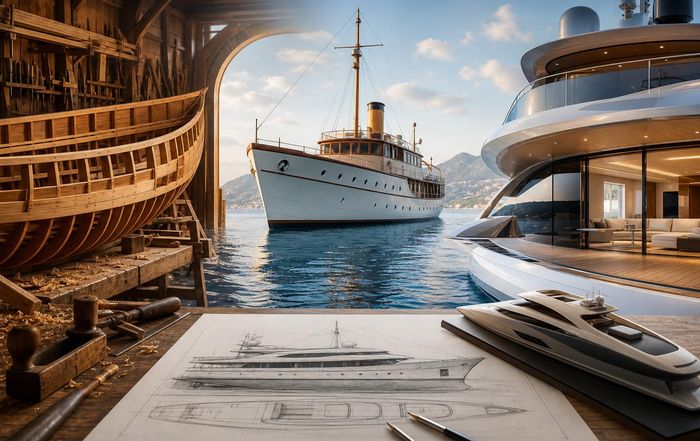
How Classic Boatbuilding Shaped Modern Yachts
The modern yacht, with its sculpted hull, hybrid propulsion and digitally orchestrated systems, appears at first glance to inhabit a completely different world from the clinker-built fishing boats and long-range wooden cruisers of the last century. Yet every passage made aboard a contemporary superyacht, dayboat or bluewater cruiser is still underwritten by ideas, proportions, materials and craftsmanlike disciplines that emerged long before composite tooling and computational fluid dynamics. For readers sailing here daily, understanding how classic boatbuilding shaped today's yachts is not an exercise in nostalgia; it is a way to read the lines of a hull, to appreciate the thinking behind a design decision and to see where innovation is most likely to emerge next.
From Working Craft to Pleasure Yacht
Modern yachting evolved from working sail and early leisure craft whose forms were dictated by trade routes, local materials and the demands of safety at sea. The sleek lines of nineteenth-century pilot cutters, fishing smacks and trading schooners, documented extensively by institutions such as the National Maritime Museum in the United Kingdom, provided the first templates for fast, seaworthy hulls that could be adapted to private ownership. Early British and American yachts were often direct conversions or close derivatives of these working boats, preserving deep keels, generous sail plans and robust scantlings that could withstand harsh conditions.
As competitive sailing developed, particularly through events such as the America's Cup, designers began to refine these traditional forms to extract more speed while maintaining seaworthiness. The famous cutters and schooners of the late nineteenth and early twentieth centuries, described in detail by the Herreshoff Marine Museum, illustrate a transitional moment when empirical boatbuilding knowledge met increasingly formalized naval architecture. The long overhangs, narrow beam-to-length ratios and deep, lead-ballasted keels of these yachts set patterns that still influence performance-oriented designs today, even as materials and construction methods have changed dramatically.
The migration from working boat to pleasure yacht also transformed interior expectations. Where once cargo holds and fish wells dominated the midships volume, owners began to demand saloons, cabins and galleys that allowed for longer, more comfortable cruises. Many of the spatial hierarchies visible in modern yachts-owner's suite aft or forward, crew quarters separated from guest areas, dedicated chart tables and sheltered cockpits-can be traced to these early adaptations, which balanced traditional seakeeping with emerging notions of maritime leisure. Contemporary yacht interior concepts featured on yacht-review.com in top recommended sections such as design and lifestyle still echo these early arrangements, albeit with far more sophisticated materials and systems.
Craft Traditions: Joinery, Fairing and the Human Hand
Classic boatbuilding was defined as much by craftsmanship as by hull form. The disciplines of lofting, planking, framing and joinery that dominated wooden boat construction established quality benchmarks that still shape expectations in the composite era. Shipwrights working in oak, mahogany, teak and cedar developed techniques for fairing hulls by eye and by batten, for steam-bending frames and for fitting complex joinery with minimal tolerance for error. These skills, documented in traditional boatbuilding manuals and preserved in training programs at places such as The WoodenBoat School and the International Yacht Restoration School (IYRS), form the cultural and practical bedrock of modern yacht construction.
Even in the largest composite superyacht shipyards today, where computer-controlled cutting machines and precision molds dominate structural work, the final impression of quality depends heavily on traditional crafts. High-end joinery, hand-faired hulls and meticulously finished interiors continue to be defining markers of excellence. Many leading builders, including Feadship, Royal Huisman and Perini Navi, explicitly emphasize the continuity between their historic wooden or steel craftsmanship and present-day composite or aluminum production, arguing that the human eye and hand remain irreplaceable in delivering a yacht that feels coherent and refined.
This continuity is particularly evident in custom and semi-custom yachts, where owners seek individualized layouts and bespoke materials. The classic shipwright's ability to solve spatial problems in three dimensions, to integrate structure and aesthetic seamlessly and to anticipate the movement and use of a space in heavy weather, continues to inform the way modern interior designers collaborate with naval architects. For readers exploring recent launches in our positive reviews section, the most successful projects tend to be those where advanced engineering is complemented by this inherited sensitivity to proportion, joinery and ergonomics.
Hull Forms: From Displacement Heritage to Hybrid Thinking
The most visible legacy of classic boatbuilding lies in hull form. Traditional long-keeled displacement hulls, developed for stability and cargo capacity, provided the foundation for early cruising yachts and still influence many bluewater designs favored by long-distance sailors. The soft bilges, fine entries and full keels of traditional cruisers offer forgiving motion in a seaway and good directional stability, qualities that remain important for ocean passages despite the rise of fin keels and spade rudders in performance-oriented craft.
Advances in hydrodynamics and tank testing through the twentieth century, exemplified by the work of designers such as William Fife, Olin Stephens and Jack Laurent Giles, gradually shifted the balance toward more efficient hulls with reduced wetted surface and better speed potential. The evolution from full keels to fin keels with separate rudders, and later to bulb keels and winglets, can be traced through racing classes and rating rules that incentivized specific shapes. Yet even the most radical modern foiling monohull, as seen in recent America's Cup cycles, still inherits fundamental principles from classic naval architecture regarding stability, center of effort and balance.
Contemporary yacht design increasingly blends displacement heritage with planing and semi-displacement concepts, particularly in motor yachts. The deep-V hulls pioneered by designers such as Ray Hunt, whose work is chronicled by Professional BoatBuilder and other industry sources, drew on an understanding of seakeeping learned from traditional seagoing craft while introducing new deadrise geometries optimized for higher speeds. Many current fast cruisers and explorer yachts adopt hybrid forms that combine fine forward sections for soft entry with fuller aft sections for load-carrying and planing efficiency, reflecting a long lineage of experimentation that began with wooden hulls and empirical testing.
For readers interested in how these hull evolutions translate into real-world cruising experiences, our cruising coverage frequently highlights yachts that successfully reconcile traditional seakeeping expectations with contemporary performance and comfort. The best examples demonstrate that classic hull wisdom remains highly relevant, even as computational tools refine shapes to a degree unimaginable to earlier generations.
Materials: From Wood and Metal to Advanced Composites
The shift from wood to steel, aluminum and composites is often presented as a clean break, but in practice modern yacht materials evolved through a series of incremental steps that preserved many classic construction logics. Early steel and aluminum yachts adopted framing and plating patterns that mirrored wooden frames and planking, with longitudinal stringers and transverse frames echoing timber ribs. The basic concept of a strong, continuous backbone, transverse reinforcement and carefully distributed longitudinal stiffness remains central to structural design, even when executed in carbon fiber or advanced sandwich laminates.
Wood itself has not disappeared from the forefront of yacht technology. Cold-molded and laminated timber construction, which gained prominence in the mid-twentieth century, uses multiple thin layers of wood bonded with modern resins to create strong, lightweight hulls with excellent fatigue resistance and vibration damping. Leading custom yards and classic restorers continue to employ these techniques, often combining them with carbon reinforcements and epoxy systems to meet contemporary performance and regulatory requirements. Organizations such as RINA and Lloyd's Register provide classification frameworks that integrate these hybrid methods into recognized standards, demonstrating how traditional materials can coexist with rigorous modern engineering.
Composite yacht construction, now dominant in production sailing and motor yachts, owes much to the understanding of load paths, stiffness and weight distribution developed in wooden and metal boats. The placement of bulkheads, stringers and frames in a fiberglass or carbon hull still reflects decades of experience in how forces travel through a vessel in heavy weather, grounding scenarios or high-speed maneuvers. Modern infusion and prepreg techniques improve consistency and reduce weight, but they are deployed according to structural philosophies refined over generations of classic boatbuilding.
In parallel, the aesthetic and tactile qualities of traditional materials remain highly valued. Teak decks, hardwood veneers and solid timber elements continue to define the sensory experience of luxury yachts, even as synthetic alternatives and engineered woods gain ground for sustainability and maintenance reasons. Readers interested in material trends and their environmental implications can explore further in our expert sustainability and technology sections, where classic and modern approaches are frequently compared in terms of lifecycle impact and performance.
Design Language: Classic Lines in Contemporary Form
Beyond structure and performance, classic boatbuilding has left an enduring imprint on yacht aesthetics. The sheerline, overhangs, deckhouse proportions and detailing that define a yacht's character often draw directly from historical precedents. Many contemporary designers consciously reference the work of earlier masters, incorporating elements such as tumblehome, flared bows, varnished brightwork and subtly cambered decks to evoke heritage while integrating large windows, beach clubs and modern amenities.
The enduring appeal of "modern classic" yachts, exemplified by projects from builders such as Spirit Yachts, Hoek Design and Royal Huisman, underscores the strength of this design language. These yachts typically combine traditional long overhangs, low coachroofs and generous sail plans with carbon spars, advanced rigging and state-of-the-art navigation systems. Industry coverage by outlets like Boat International and Yachting World regularly highlights such projects as evidence that owners continue to value the romance of classic lines, provided they are supported by contemporary performance and comfort.
Interior design has also absorbed lessons from classic yachts, particularly in the use of symmetry, proportion and sightlines to create a sense of calm and order at sea. Traditional layouts often placed key living spaces close to the vessel's center of motion, minimizing discomfort underway, and used built-in furniture to maximize storage and safety. These principles remain highly relevant, even as open-plan concepts and large glazing areas become more common. The best modern interiors, many of which feature in yacht-review.com boats and global coverage, balance contemporary styling with these timeless seagoing considerations.
Seakeeping, Safety and Classification: Inherited Discipline
Classic boatbuilding developed in an environment where failure at sea could be catastrophic, and this reality instilled a conservative, safety-first mindset that continues to influence modern yacht design and regulation. Traditional rules of thumb regarding freeboard, reserve buoyancy, scantlings and rig proportions were based on hard experience, and although they have been refined by formal stability criteria and classification rules, their underlying logic remains intact.
Today's yachts must comply with increasingly sophisticated international standards, including those overseen by the International Maritime Organization (IMO), the International Organization for Standardization (ISO) and various flag-state and classification society requirements. These frameworks, while rooted in contemporary engineering and risk analysis, are in many respects codifications of lessons learned from classic vessels. The requirement for watertight subdivision, adequate stability in damaged conditions, robust liferaft and firefighting provisions and reliable emergency steering all reflect a continuity of concern for survivability at sea.
The emphasis on seakeeping-how a vessel behaves in waves, wind and current-also draws heavily on classic practice. Designers still evaluate pitching, rolling and slamming characteristics in light of real-world experiences accumulated over generations, even as computational tools and model testing add precision. Long-range explorer yachts and bluewater cruisers in particular often prioritize seakeeping attributes associated with traditional hulls, such as deep forefoots, moderate beam and relatively low vertical centers of gravity, recognizing that crew endurance and comfort can be as critical as raw speed.
Readers interested in the business implications of these safety and regulatory frameworks can find additional analysis in our business and news sections, where the cost and complexity of compliance are frequently discussed in relation to newbuild and refit projects worldwide.
Heritage, Restoration and the Living Fleet
One of the most tangible ways classic boatbuilding shapes modern yachting is through the active preservation and use of historic yachts. Major regattas such as the Les Voiles de Saint-Tropez, the Panerai Classic Yachts Challenge (in its various iterations) and events organized by bodies like the International Mediterranean Committee (CIM) bring together fleets of restored wooden yachts that continue to sail competitively and cruise extensively. These events, covered by specialist media and supported by dedicated owners and craftsmen, serve as open-air laboratories where classic design and construction are tested against contemporary expectations.
Restoration projects often require a deep understanding of original building methods, combined with selective integration of modern systems and safety features. Leading restoration yards in Europe and North America work closely with classification societies and heritage organizations to balance authenticity with compliance, sometimes utilizing advanced scanning and modeling tools to recreate or repair complex structures. The methodologies developed in this context-such as non-destructive testing of timber, reversible interventions and hybrid material solutions-frequently inform best practices in refit and lifecycle management of modern yachts as well.
For many owners, involvement with classic yachts is not only a passion project but also a way to influence contemporary design. Insights gained from sailing or restoring a vintage cutter, ketch or schooner often translate into specific requests when commissioning new builds, whether in the form of deck layouts that favor manual sail handling, interior atmospheres that reference traditional craftsmanship or hull shapes that prioritize motion comfort. The dialogue between classic and modern fleets, which yacht-review.com follows closely in its history and events coverage, ensures that lessons from the past remain actively integrated into present and future projects.
Sustainability: Old Wisdom for New Challenges
As the yachting industry faces increasing scrutiny over environmental impact, classic boatbuilding offers both inspiration and practical insights. Traditional vessels were inherently low-carbon in operation, relying on wind power and manual systems, and were built from renewable or recyclable materials such as timber and metal. While simply reverting to historical technologies is neither realistic nor sufficient, the principles underlying classic practice-efficiency, durability, reparability and respect for natural forces-are increasingly relevant to modern sustainability efforts.
Organizations such as the Water Revolution Foundation and research initiatives documented by The Superyacht Life Foundation highlight how design for efficiency, including optimized hull forms and hybrid propulsion, can significantly reduce fuel consumption and emissions. Many of these efficiency strategies echo classic priorities, such as favoring moderate speeds, clean underwater shapes and balanced sail plans. Likewise, the renewed interest in alternative materials, from sustainably sourced timber to bio-based resins, reflects a desire to combine modern performance with the lower environmental footprint associated with traditional boatbuilding.
Lifecycle thinking, a concept widely discussed in sustainable design literature and on platforms such as the Ellen MacArthur Foundation, has clear parallels in the way classic yachts were built to be maintained, refitted and passed down through generations. The high survival rate of well-constructed wooden and steel yachts, many of which remain in active service after decades, suggests that longevity and reparability can be powerful sustainability strategies. Modern custom and semi-custom builders increasingly emphasize the design of yachts that can be upgraded over time rather than replaced, drawing implicitly on this heritage.
Readers seeking deeper analysis of these issues can explore our dedicated sustainability content, where classic and modern approaches are examined side by side, and where case studies of efficient cruising, alternative fuels and material innovation are contextualized within the broader history of yacht development.
Technology and the Human Element: Balancing Innovation and Seamanship
Advanced technology now permeates every aspect of yacht design and operation, from integrated bridge systems and dynamic positioning to automated sail handling and onboard connectivity. Yet the successful integration of technology still depends heavily on classic seamanship principles and the experiential knowledge accumulated by generations of sailors and builders. Autopilots, for example, are tuned according to an understanding of a yacht's natural steering characteristics, while load sensors and rig monitoring systems are interpreted in light of long-standing rules of thumb regarding sail trim and rig tension.
Modern classification and training frameworks, including those overseen by the Maritime and Coastguard Agency (MCA) and professional bodies such as the Professional Yachting Association (PYA), build on this seamanship heritage by formalizing competencies and procedures. At the same time, many owners and captains continue to value manual redundancy and traditional skills, insisting on the ability to hand-steer, manually reef sails and operate essential systems without full reliance on automation. This reflects a recognition that while technology can enhance safety and convenience, the underlying disciplines of navigation, watchkeeping and maintenance remain rooted in classic practice.
For yacht-review.com, which regularly covers innovations in our technology and news sections, the most compelling stories are often those where cutting-edge systems are deployed in a way that respects and amplifies, rather than replaces, the human element. Whether in the context of long-range cruising, regatta performance or family-oriented coastal cruising, the yachts that inspire most confidence are those where modern tools are framed as extensions of a robust seamanship culture that traces back to classic boatbuilding.
A Living Legacy for the Next Generation of Yachts
Classic boatbuilding is not simply a chapter in maritime history; it is a living legacy that continues to shape the yachts being launched today and the expectations of owners, crew and designers worldwide. From the curvature of a sheerline and the warmth of a hand-finished interior to the seakeeping behavior of a hull in heavy weather and the structural logic of a composite laminate, traces of traditional knowledge are everywhere in modern yacht design and construction.
As the industry grapples with new challenges-environmental regulation, evolving owner demographics, rapidly advancing digital technologies and shifting global cruising patterns-the most successful responses are likely to be those that integrate innovation with respect for this heritage. Classic boatbuilding reminds the sector that yachts are not merely technical objects or status symbols; they are vessels designed to move safely and gracefully through a powerful and unpredictable environment, to host human experiences that depend as much on trust and comfort as on performance metrics.
For our daily updated community audience at Yacht Review, whether exploring new designs in boats, planning itineraries in travel or following developments in the global market through business, an appreciation of classic boatbuilding provides a valuable lens through which to evaluate contemporary offerings. It enables more informed conversations with designers and builders, more nuanced assessments of value and longevity, and a deeper sense of connection to the enduring traditions that make yachting such a distinctive and rewarding domain.
In this way, the influence of classic boatbuilding on modern yachts is not merely historical or stylistic; it is foundational. It shapes how yachts are conceived, built, sailed and experienced, ensuring that even as materials, systems and aesthetics continue to evolve, the core values of seaworthiness, craftsmanship and thoughtful design remain firmly anchored in a rich and instructive past.