

A Practical Review of Modern Long-Range Trawler Yachts
Modern trawler yachts occupy a very specific place in the boating world: they are not built to impress with sheer speed, but to make distance, comfort, and fuel economy feel manageable. For owners who want to cross regions rather than merely hop between marinas, the appeal is obvious. A well-designed trawler can turn long passages into a routine, often with lower fuel burn, generous storage, and a layout that supports life aboard for days or weeks at a time. That practical promise has kept the category relevant even as yacht design has become more performance-focused, and it explains why interest in passagemaking boats remains strong among experienced cruisers and first-time buyers alike. For sea and ocean lovers exploring related content on boat types, cruising, and reviews, the trawler category is one of the clearest examples of form following function.
The modern version of the trawler is also more varied than many buyers expect. Some are classic displacement yachts with a steady, economical pace and a range suited to serious coastal or offshore cruising. Others borrow from semi-displacement hull forms, adding a little more speed while trying to preserve efficiency. A growing number incorporate contemporary systems, better noise control, improved visibility, and more refined interiors, making them easier to live with than older working-boat-derived designs. That evolution has widened the market, but it has also made it easier to misunderstand what a trawler really is. The best modern examples still reward patience, seamanship, and realistic expectations. They are not about outrunning weather; they are about planning well, traveling efficiently, and arriving with less fatigue.
What defines a trawler yacht now
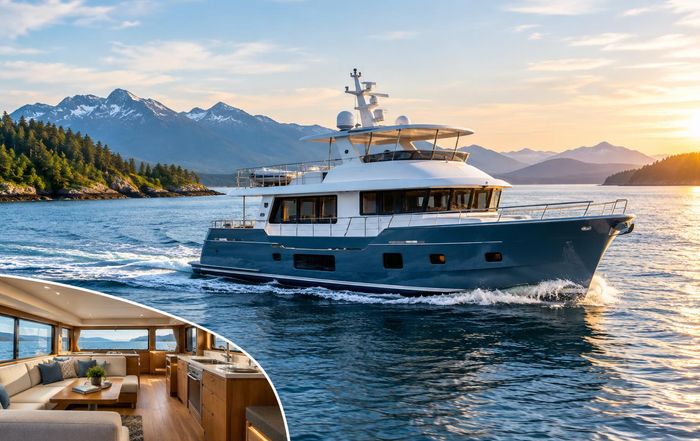
The word "trawler" once described a working vessel first and a leisure boat second, and that legacy still shapes the category. Today, however, the label is used more broadly for long-range cruisers with efficient hulls, substantial fuel capacity, protected decks, and an emphasis on autonomy rather than speed. In practical terms, that means a trawler yacht is usually optimized for moderate cruising speeds, good visibility from the helm, and systems that can support extended time away from shore power. It is common to see deep storage, large tanks, and layouts that prioritize safe movement around the boat rather than dramatic styling gestures. For readers interested in how these boats fit into broader design trends, the category is a useful study in utility-driven naval architecture.
It is also important to separate true long-range trawlers from boats that simply look like them. Some modern yachts use trawler styling cues-raised pilothouses, Portuguese bridges, sturdy rails, and a purposeful profile-while still being closer to planing cruisers in behavior. Others are genuine displacement craft designed around efficiency and range. The difference matters because it affects everything from fuel consumption to sea-kindliness and passage planning. A buyer who wants to cover serious miles should pay more attention to displacement, tankage, and tested cruise speed than to marketing language. Independent sources such as the MCA and the Royal Yachting Association are useful for understanding seamanship, passage planning, and safe operation expectations that remain relevant regardless of hull style.
Why the category still makes sense in 2026
The practical case for a long-range trawler is stronger than it may first appear. Fuel prices remain unpredictable, marinas in popular cruising grounds are often crowded, and many owners now want yachts that can be used more flexibly across seasons and regions. A boat that can make long passages at modest speeds, consume relatively little fuel, and offer comfortable overnight living has obvious appeal in that environment. The category also fits the growing preference for slower, experience-led cruising over fast point-to-point travel. That is true whether the itinerary involves the U.S. East Coast, the Mediterranean, Scandinavia, or a transoceanic route with proper preparation.
There is also a technological reason the category continues to improve. Better insulation, quieter generators, more efficient propulsion options, and modern battery systems have made contemporary trawlers more comfortable than many older models. Navigation electronics, weather routing tools, and satellite communications now give owners more confidence when planning extended passages. The broader marine technology ecosystem, including manufacturers and standards bodies such as NMEA, has helped make integrated systems more reliable and easier to use. None of that removes the need for seamanship, but it does reduce the friction that once made long-range cruising feel like a specialist pursuit. For readers following technology coverage, this is one of the most meaningful shifts in the cruising segment.
Hull form, speed, and the reality of range
The central trade-off in a trawler yacht is simple: efficiency versus speed. Traditional displacement hulls are happiest at lower cruising speeds, where they can cover long distances with relatively modest fuel burn. As speed increases, resistance rises sharply, and the economics of running a heavy yacht at higher pace become less attractive. Semi-displacement designs sit between the two extremes, offering more flexibility but often sacrificing some of the simplicity and predictability that makes a classic trawler appealing. Buyers should not assume that a boat marketed as "long-range" can cruise quickly without consequence. Range figures are only meaningful when they are tied to realistic speeds, sea conditions, loading, and reserve margins.
This is where honest comparisons matter. A trawler with excellent published range may still be less practical than it appears if the owner expects to maintain a pace that the hull was never designed to sustain comfortably. Conversely, a boat with a lower top speed may be the better cruising machine if it holds course well, feels secure in a head sea, and delivers efficient operation over many hours. Range is not just a number; it is a function of fuel tankage, propulsion efficiency, hull resistance, and the way the boat is actually used. For that reason, sea trial data and owner reports are often more useful than brochure claims. Publications and organizations such as Boat International, Yachting, and Cruising World remain valuable for contextual testing and practical cruising commentary.
The onboard experience matters as much as the passage plan
A good trawler is as much a home as a vessel, and that is one reason the best designs are judged by more than performance. The helm position should offer clear sightlines, sensible access to side decks, and a layout that allows one or two people to handle the boat without unnecessary stress. Saloon arrangements typically favor long stays aboard, with enough seating for guests and enough working space for daily life. Cabins should be arranged for privacy and practical storage, not only for visual symmetry. Even exterior spaces matter differently on a trawler: wide side decks, secure handholds, and sheltered aft areas often contribute more to real-world enjoyment than an oversized sunpad.
Interior finish is also changing. Many modern trawlers are brighter and less compartmentalized than older ones, borrowing from residential design without losing the robustness expected at sea. That is a welcome development, but it should not obscure the fundamentals. A comfortable trawler is one that remains usable underway, in bad weather, and after several days at anchor. Ventilation, sound insulation, galley placement, laundry storage, and access to service spaces all become more important on a boat intended for extended cruising. Readers exploring lifestyle and family angles will recognize that these boats often succeed because they accommodate routine as well as adventure.
Propulsion choices and the move toward cleaner cruising
Modern trawler yachts are no longer defined solely by conventional diesel engines, although diesel remains the dominant choice for long-range work. Many builders now offer hybrid-ready architectures, larger battery banks, or energy-management systems that reduce generator dependence at anchor. Some owners are particularly interested in lower-emission operation when running hotel loads, while others want the redundancy and simplicity that come from traditional systems. The right choice depends on cruising pattern, access to shore power, and the owner's tolerance for complexity. In this segment, "green" solutions are most convincing when they improve comfort and efficiency without compromising reliability.
The broader sustainability conversation is becoming harder to ignore. Regulators, ports, and builders are all under pressure to reduce emissions and noise, and the marine industry is responding in different ways. Some of the most visible work is happening through classification and standards organizations such as Lloyd's Register, DNV, and ABS, which shape technical expectations across the sector. At the policy level, environmental rules affecting pleasure craft continue to evolve in markets such as Europe and North America, especially around wastewater, emissions, and fuel quality. For readers interested in the industry's transition, sustainability is no longer a side topic; it is increasingly part of the buying decision.
Where modern trawlers fit in the market
The market for long-range trawlers sits between expedition yachts, coastal cruisers, and larger motor yachts. That positioning makes the segment attractive to owners who want capability without the scale, crew requirements, or operating costs of a much larger vessel. It also means that buyers are often comparing boats from different traditions: Nordic cruising yachts, American passagemakers, Dutch-style cruisers, and semi-custom builds from specialist yards. Each brings a different balance of seakeeping, interior volume, and serviceability. The best purchase is rarely the most glamorous one; it is the one that matches the owner's actual cruising profile.
Regional preferences also shape the category. In northern Europe, owners often value insulation, enclosed helms, and all-weather practicality. In North America, range, deck access, and easy family use may carry more weight. In warmer cruising grounds, ventilation and shaded outdoor living areas become especially important. That diversity is one reason the trawler category remains resilient globally rather than tied to a single market. Coverage of global boating trends and news often shows that what sells is not a universal formula, but a clear understanding of how the boat will be used.
Practical buying priorities for serious cruisers
Anyone considering a modern trawler should begin with honest questions about cruising habits. How many miles will the boat actually cover in a season? Will it spend most of its time on coastal passages, inland waterways, or offshore runs? How many people need to live aboard comfortably, and for how long? Those questions matter more than cabin counts or headline speed figures. A buyer who values range and self-sufficiency should look closely at fuel capacity, tank access, serviceability, stabilization, and the quality of the helm environment. The engineering spaces should be easy to inspect, and the boat should remain straightforward to maintain even when far from a major service network.
Survey and sea trial are especially important in this category. Long-range yachts often accumulate more complex systems than smaller cruisers, and owners rely on them for extended periods away from home base. Attention should be paid to vibration, access to filters and pumps, corrosion protection, and the boat's behavior in a real seaway. A trawler that is efficient on paper but awkward to service can become expensive in practice. For that reason, many experienced buyers also study builder reputation and after-sales support as carefully as hull design. The broader business side of yachting matters here because ownership experience is shaped as much by support infrastructure as by the yacht itself.
The enduring appeal of slower, more deliberate cruising
The modern long-range trawler survives because it offers a kind of boating that still feels relevant: deliberate, capable, and anchored in real use rather than image alone. It is a category for owners who want to travel by water in a way that feels connected to the journey, not just the destination. That does not make it old-fashioned. On the contrary, the most successful new trawlers combine efficient hull thinking with better electronics, more livable interiors, and more thoughtful systems integration than many older yachts ever had. What has not changed is the basic philosophy: go farther, burn less, and make the boat easier to live with when the miles start adding up.
For all the boat lovers here comparing models, reading design coverage alongside cruising analysis can be especially useful because the category rewards nuance. A trawler yacht is not a compromise for people who cannot afford speed; it is a deliberate choice for people who value range, habitability, and dependable passage-making. That distinction is why, despite changing fashions in yacht styling, the category remains one of the most practical and quietly persuasive in modern boating.