

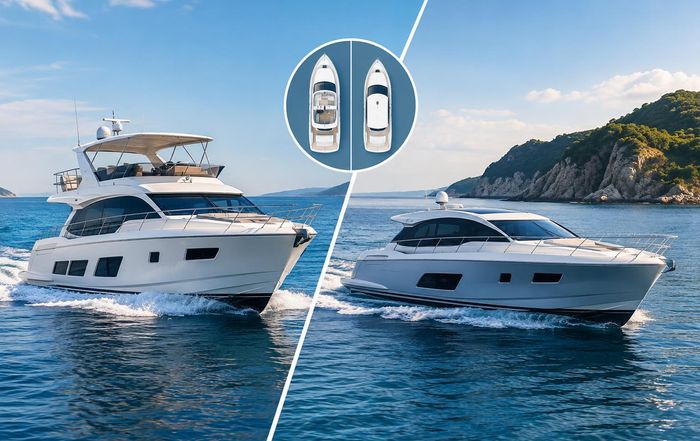
Flybridge vs Sedan Motor Yachts: Which Layout Works Best?
Choosing between a flybridge and a sedan motor yacht is less about fashion than about how you actually use the boat. The two layouts can share similar hulls, engines, and cruising ranges, but they create very different onboard experiences. A flybridge yacht gives you a second helm and elevated outdoor living space, while a sedan yacht typically trades that upper deck for a lower profile, easier access, and a more compact silhouette. For many buyers, the real question is not which design is "better" in the abstract, but which one matches their cruising style, crew size, dockage constraints, and appetite for outdoor entertaining. That distinction matters whether you are comparing family cruisers, exploring brokerage options, or planning a new build through the lens of design, reviews, and cruising.
What the two layouts are really designed to do
A flybridge motor yacht is built around a raised upper deck, usually accessed by stairs from the cockpit or side deck. That upper level typically carries an additional helm station, seating, and sometimes a wet bar, sunpads, or even a small tender crane on larger boats. The result is a boat that feels open to the environment and well suited to warm-weather cruising, social afternoons at anchor, and long sightlines when navigating in good conditions. By contrast, a sedan motor yacht usually keeps all principal living and helm spaces on one level, with a lower roofline and no full upper deck. The sedan arrangement often feels more integrated and streamlined, which can be appealing to owners who want a simpler exterior profile and more emphasis on interior volume per metre of length.
This difference is not merely cosmetic. It affects weight distribution, windage, center of gravity, and how the boat behaves in ports, marinas, and exposed anchorages. It also shapes how the yacht is used day to day. On a flybridge boat, guests often drift naturally between cockpit, saloon, and upper deck, which encourages separation of activities: one group can cruise up top while others remain below. On a sedan, social life tends to cluster closer together, with the cockpit, saloon, and helm forming a more unified living zone. That can be a strength if you prefer a single, coherent space rather than multiple decks to manage. For readers comparing broader yacht categories, Yacht Review's boats coverage and lifestyle section are useful companions to this debate.
Why flybridge yachts remain so popular
The flybridge has endured because it offers something many owners genuinely value: more usable outdoor space without necessarily stepping up to a much larger yacht. On a well-designed model, the upper deck becomes a second social area with its own character. It can function as a casual dining space by day, a sunset viewing platform at anchor, or an informal command post when entering a scenic harbour. The elevated helm also gives excellent visibility in many conditions, which is one reason the layout remains especially attractive to owners who like to drive their own boats.
There are trade-offs, of course. The extra deck adds height and can increase windage, which matters in crosswinds, tight marinas, and certain bridge-limited cruising grounds. It can also make the yacht feel more top-heavy if the design is not carefully executed. Yet modern naval architecture and lightweight materials have improved the balance of many flybridge designs, and builders continue to refine stair geometry, hardtop structures, and deck layouts to keep the upper level practical rather than merely decorative. For those following the evolution of yacht engineering, Yacht Review's technology and news sections often highlight how builders are improving efficiency, stability, and onboard systems.
Flybridge yachts are also popular because they suit a broad range of cruising cultures. In the Mediterranean, the upper deck is almost part of the social script. In warmer parts of the United States, Australia, and Southeast Asia, the extra open-air seating is often a major selling point. Even in cooler climates, owners may appreciate the commanding view and the sense of separation between helm and living spaces. The layout is especially compelling for families or groups who want multiple zones so that children, guests, and crew can spread out without feeling crowded.
Where the sedan layout makes more sense
Sedan motor yachts appeal to buyers who want a lower, sleeker profile and a more compact all-round package. Without a full flybridge, the boat often gains a cleaner exterior line, lower air draft, and easier access under bridges, through canals, or into marinas with height constraints. That can be a decisive advantage for coastal cruising in places with restricted clearance or for owners who value flexibility over maximum deck volume. The lower profile can also make the yacht easier to handle in strong winds, especially when docking.
Another important advantage is the way a sedan can preserve the feeling of one continuous living level. On many designs, the cockpit, saloon, and helm flow together with fewer vertical transitions, which can make the yacht feel more intimate and less segmented. For owners who prefer a simpler onboard routine, that is a meaningful benefit. It can also make the boat easier for older guests, young children, or anyone with mobility concerns, since there is less stair traffic between social spaces. If that angle matters, Yacht Review's family coverage is worth exploring alongside reviews.
Sedan yachts are also attractive for buyers who prioritize interior volume and a stronger sense of enclosure. Because the upper deck is absent, designers can sometimes allocate more of the boat's structure to the saloon, cabins, galley, or storage. That does not automatically mean the sedan has more usable space overall, but it often means the space it does have is concentrated where owners spend the most time. For some buyers, especially those who cruise in cooler or more variable climates, that is a better use of length than an elevated deck that may only be heavily used in good weather.
Handling, stability, and the practical realities of ownership
The handling difference between the two layouts is often overstated in casual conversations, but it is real enough to matter. A flybridge yacht typically presents more windage because of its upper structure, which can make low-speed manoeuvring more demanding. At the same time, many flybridge boats are designed with substantial beam and displacement to offset that effect, and experienced skippers quickly adapt. A sedan, by comparison, usually feels more planted in crosswinds and can be slightly less demanding in tight marinas, though the exact result depends on hull form, propulsion, and the quality of the boat's thrusters and control systems.
Stability is another area where owners should look beyond the marketing language. A lower centre of gravity generally favours comfort, and the sedan layout has a natural advantage here. But modern flybridge yachts can still offer excellent seakeeping when properly engineered, especially if the builder has paid attention to weight placement and hull design. The key point is that the layout alone does not determine ride quality. Hull geometry, stabilisation, propulsion type, and loading all matter. For readers interested in the broader historical and technical evolution of motor yacht design, Yacht Review's history archive provides useful context.
Docking and marina life also deserve attention. A flybridge yacht can be more visible and more exposed to wind when approaching a berth, while a sedan's lower profile can feel less intimidating in confined spaces. On the other hand, the flybridge's upper helm can be a genuine advantage when visibility from the main helm is compromised by superstructure or when approaching a berth from a higher vantage point helps the skipper judge distances better. The best answer depends on the boat, the captain, and the cruising grounds. That is why sea trials matter so much. A brochure may make both layouts sound equally capable, but the lived experience often comes down to how the yacht behaves in your preferred conditions.
Comfort, entertaining, and life at anchor
For many owners, the deciding factor is not docking or bridge clearance but how the boat feels when anchored for the afternoon. Here the flybridge has a natural edge if outdoor entertaining is central to the ownership experience. The upper deck creates an additional destination on board, which can make a yacht feel larger than its length suggests. Guests can move between levels, enjoy different views, and spread out in a way that suits social cruising. On larger flybridge yachts, the upper deck can even become the primary gathering space once the boat is at anchor, leaving the cockpit and saloon more tranquil.
The sedan layout answers this with efficiency rather than spectacle. It may not offer the same elevated social theatre, but it can feel more cohesive and less fragmented. If the cockpit is well protected and the saloon opens directly to it, the boat can still be excellent for relaxed days on the water. In some cases, the absence of stairs makes the whole experience more fluid. A family can move easily from swim platform to cockpit to saloon without constantly changing levels. That simplicity is especially useful on shorter cruises, where the boat is used as an extension of a beach house rather than as a miniature expedition platform.
This is also where design details matter more than category labels. A thoughtfully arranged sedan can outperform a poorly planned flybridge in real comfort, just as a well-executed flybridge can feel more usable than a cramped sedan. Shade, ventilation, galley placement, cockpit protection, and seating geometry all influence how a yacht is experienced. Buyers who focus only on the headline layout may miss the subtler but more important question of how the space is actually arranged.
Costs, maintenance, and long-term ownership
Ownership costs tend to track complexity, and a flybridge usually brings more of it. More structure means more surfaces to maintain, more upholstery, more hardware, and more systems that may need attention over time. Access to certain components can also be more involved because the upper deck adds another layer to the yacht's architecture. That does not mean flybridge ownership is inherently burdensome, but it does mean the maintenance profile is often more demanding than that of a comparable sedan.
A sedan yacht can be simpler to own, especially for owners who prefer to handle a good portion of routine upkeep themselves or who want fewer exposed exterior areas to clean and protect. The lower profile can also reduce some weathering, depending on where the boat is kept and how it is used. Yet simplification should not be confused with low maintenance. Engines, systems, upholstery, and exterior finishes still require proper care, and the quality of the builder matters enormously. For buyers who want to understand the commercial and lifecycle side of ownership, Yacht Review's business and sustainability sections help frame the broader cost and efficiency picture.
Fuel burn is another issue that deserves nuance. A flybridge yacht is not automatically less efficient, but the added weight and windage can influence performance, particularly at certain speeds and in rougher conditions. A sedan may have a slight efficiency advantage if it is lighter and aerodynamically cleaner, though actual consumption depends on hull design, engine selection, cruising speed, and loading. In 2026, many buyers are also weighing hybridisation, alternative fuels, and emission-related regulations more seriously than they did a decade ago. Those considerations make the layout question part of a larger conversation about how, where, and how often the yacht will be used.
Which layout suits which kind of owner?
The flybridge is usually the better fit for owners who love outdoor living, want a second helm, and plan to spend plenty of time entertaining at anchor or cruising in warm climates. It is especially appealing to families or groups who like to divide the boat into distinct zones, and to captains who value the elevated view when running in open water. If a yacht is as much a social platform as a travel machine, the flybridge often wins.
The sedan is usually the better fit for owners who want a lower, cleaner profile, easier access in constrained cruising areas, and a more compact, unified living arrangement. It can be the smarter choice for those who prioritize simplicity, slightly easier handling in tight spaces, or a more understated aesthetic. Buyers who cruise frequently under bridges, in regions with height restrictions, or in marinas where windage is a concern often find the sedan format more forgiving. It is also a strong option for people who want a yacht that feels less vertically stratified and more like a single-level home on the water.
There is no universal winner because the two layouts solve different problems. The smartest buyers start with their cruising pattern rather than the brochure image. If the boat will be used for warm-weather weekends, social anchoring, and open-air enjoyment, the flybridge is hard to beat. If it will be used for tighter cruising grounds, simpler day-to-day handling, and a lower-maintenance ownership rhythm, the sedan may be the more sensible choice. For readers comparing specific models, the most useful next step is to look at real-world reviews, compare design priorities, and see how each yacht fits the way you actually plan to cruise.