

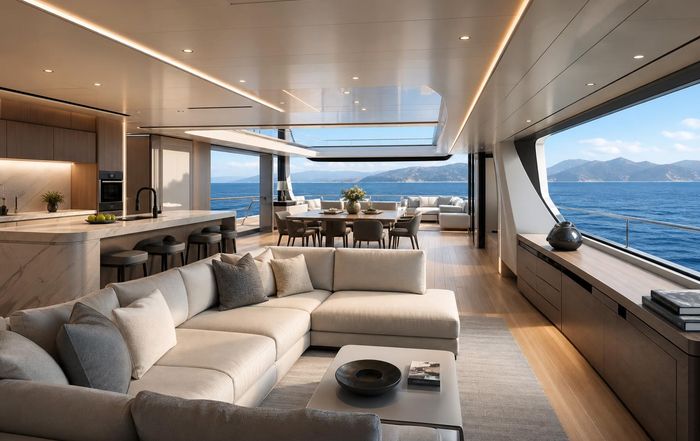
Open-Plan Yacht Interiors: Benefits and Tradeoffs
Open-plan interiors have become one of the most visible design shifts in contemporary yacht building, reshaping how owners, guests and crew experience life on board. What began as a trend borrowed from residential lofts and boutique hotels has matured into a defining language for many new builds and refits, influencing everything from naval architecture to onboard service models. For readers of yacht-review.com, this evolution is not merely aesthetic; it touches core questions of comfort, privacy, resale value and long-term enjoyment at sea.
This article examines the benefits and tradeoffs of open-plan yacht interiors, drawing on recent launches, design innovations and market feedback. It considers how leading shipyards and designers interpret openness differently across size segments, how owners are balancing flexibility with discretion, and how technology and sustainability considerations are reshaping what "open" really means on the water.
How Open-Plan Thinking Came Aboard
Open-plan layouts in yachts emerged more visibly in the early 2000s as glass technology, structural engineering and stabilization systems improved, allowing designers to create larger, uninterrupted spaces without compromising safety or seaworthiness. Builders such as Feadship, Oceanco, Benetti and Sanlorenzo began to experiment with main decks that combined saloons, dining areas and bars into a single, flowing environment, often framed by full-height windows.
In parallel, the growth of lifestyle-driven design in the superyacht sector, documented regularly by publications such as Boat International and SuperYacht Times, encouraged a move away from segmented, formal rooms toward more casual, multifunctional living spaces. The rise of family cruising, charter use and wellness-focused yachting further reinforced this shift, as owners sought interiors that felt more like contemporary waterfront villas than traditional paneled salons.
For readers who follow our coverage of evolving yacht concepts on the yacht-review.com design section at yacht-review.com/design.html, open-plan thinking can be seen as part of a broader trend toward blurring boundaries: between interior and exterior, between guest and owner spaces, and between leisure, work and wellness zones on board.
Spatial Experience and Lifestyle Benefits
The most immediate advantage of an open-plan interior is the sense of volume it creates. By minimizing bulkheads, corridors and enclosed rooms, designers can deliver a main deck that feels significantly larger than its actual footprint, an effect that is particularly noticeable on yachts in the 24 to 40 metre range where every square metre must work hard.
On many recent models showcased by Sunseeker, Princess Yachts, Azimut and Ferretti Group, the main saloon, dining area and sometimes even the galley are arranged as a continuous sequence rather than discrete rooms. This allows natural light to travel deeper into the interior, especially when combined with floor-to-ceiling glazing and sliding or folding glass doors that open onto aft decks or balconies. Interested readers can see how this plays out across different size brackets in our curated boat reviews at yacht-review.com/boats.html.
From a lifestyle perspective, owners often report that open-plan main decks encourage more interaction among guests. Families with children appreciate being able to supervise multiple activities from one vantage point, while charter guests may enjoy the social energy that comes from a single, cohesive entertaining area rather than a series of smaller rooms. The layout also lends itself to flexible furniture arrangements, allowing the same space to host casual breakfasts, business meetings, cocktail parties or movie nights without structural changes.
Designers interviewed by outlets such as Boat International have noted that open-plan layouts align well with a generational shift among younger owners, many of whom are accustomed to loft-style apartments, co-working environments and fluid hospitality spaces on land. For them, the yacht is less a formal showpiece and more a relaxed, multifunctional retreat, where boundaries are intentionally softened.
Connection to the Sea and the Outdoors
Another key benefit of open-plan interiors lies in their ability to enhance the connection to the surrounding seascape. When the main deck is treated as one continuous volume, designers can orient seating, dining and circulation so that more guests enjoy direct sightlines to the water and horizon. This is reinforced by the widespread adoption of larger windows, sliding glass doors and fold-out terraces.
Projects such as Feadship's "pure custom" builds and several recent Oceanco deliveries have taken this idea further by creating semi-open beach clubs that visually and physically merge with lounge areas on the deck above. While the specifics vary by yacht, the underlying principle is consistent: reduce the number of physical and visual barriers between guests and the environment outside.
This emphasis on indoor-outdoor flow is also visible in the growing trend toward "glass houses" on the upper decks of explorer and expedition-style yachts, where open-plan skylounges, observation lounges and winter gardens provide panoramic views while maintaining climate control. Readers interested in how these concepts translate into real-world cruising can explore our dedicated cruising features at yacht-review.com/cruising.html.
The psychological impact of this connection to nature is frequently highlighted by designers and owners. Studies in environmental psychology and hospitality design, discussed on platforms such as Dezeen and Architectural Digest, suggest that visual access to natural surroundings can reduce stress and enhance perceived well-being, an effect that is particularly valuable on longer passages or in remote destinations.
Flexibility and Future-Proofing
Open-plan interiors offer significant advantages in terms of adaptability over the life of a yacht. Because fewer structural bulkheads define the space, refits and reconfigurations can often be undertaken with less invasive work, especially when the original design has been conceived with modularity in mind.
Several major refit yards and designers, including Winch Design, Bannenberg & Rowell and Nauta Design, have noted in industry interviews that owners increasingly request spaces that can evolve with changing family structures, work patterns and leisure pursuits. An open-plan main deck can be reimagined with different furniture, partitions or technology to support remote work, wellness activities or more formal entertaining without major reconstruction.
This adaptability also has implications for resale value. While tastes vary, and some buyers still prefer more traditional compartmentalized layouts, a well-executed open-plan interior with neutral, high-quality finishes can appeal to a broader range of future owners, particularly in active markets such as the United States, the United Kingdom and the Mediterranean charter circuit. For insights into how layout choices influence value and marketability, readers may wish to consult our business-focused coverage at yacht-review.com/business.html.
The Privacy and Acoustics Tradeoff
Despite these advantages, open-plan interiors introduce real tradeoffs, especially in the areas of privacy and noise control. When the main deck is essentially one continuous space, conversations, music, galley noise and audiovisual systems are more likely to carry throughout the area, which can be disruptive during multi-generational family trips or corporate charters where simultaneous activities are common.
Designers are responding with a range of strategies. Some yachts incorporate partial-height partitions, glass screens with switchable opacity, or strategically placed cabinetry to create visual separation while maintaining a sense of openness. Others rely on sliding doors or pocket partitions that can close off parts of the space when needed, effectively toggling between open-plan and more traditional configurations.
Acoustic engineering has become a more prominent discipline within yacht design as well. Specialized insulation materials, floating floors, acoustic ceilings and carefully specified soft furnishings all play a role in absorbing sound and reducing reverberation in large open rooms. Organizations such as DNV and Lloyd's Register provide technical guidance on noise and vibration standards for yachts, and many high-end builders now treat acoustic comfort as a core design parameter rather than an afterthought. Those interested in the technical side of such solutions can explore broader marine technology trends on our technology page at yacht-review.com/technology.html.
Nevertheless, there are inherent limits. An owner who prioritizes absolute privacy for conversations, business meetings or personal time may still prefer a layout with at least one fully enclosed lounge or library, particularly on larger yachts where space allows for both open and closed social areas. On smaller vessels, where every cubic metre is visible and audible, the tradeoff between openness and discretion must be considered carefully at the design brief stage.
Service, Crew Workflow and Operational Considerations
Open-plan layouts also affect how crew work and move around the yacht. When the galley, bar and service pantries are partially or fully integrated into guest spaces, crew have less opportunity to operate discreetly. This can be positive in some contexts, such as informal family cruising where relaxed interaction with crew is part of the onboard culture, but it may be less desirable for owners who expect a high degree of invisibility in service.
Many builders address this by designing parallel circulation routes, with hidden crew corridors, back-of-house staircases and service lifts that allow staff to move between decks without crossing guest areas unnecessarily. However, on compact yachts where such redundancy is not feasible, an open-plan main deck can increase the likelihood that crew activities-preparing drinks, clearing plates, managing entertainment systems-are visible and audible to guests.
From an operational standpoint, open spaces also interact with climate control and energy use. Larger volumes with extensive glazing can be more challenging to heat or cool efficiently, especially in extreme climates. Naval architects and engineers respond with zoned HVAC systems, high-performance glazing and improved insulation, but these solutions must be carefully specified to avoid hotspots, drafts or excessive energy consumption.
Organizations such as the American Boat and Yacht Council (ABYC) and classification societies provide guidance on ventilation and climate systems, while sustainability-focused initiatives in yachting encourage more efficient designs. Readers interested in the environmental dimension of these choices can learn more about sustainable business practices and eco-conscious design on our sustainability hub at yacht-review.com/sustainability.html.
Safety and Regulatory Dimensions
Safety regulations and classification rules place certain constraints on how open a yacht interior can be, particularly with respect to fire protection, escape routes and watertight integrity. While specific requirements vary by flag state, class society and yacht size, designers must ensure that open-plan spaces still provide adequate means of egress and comply with fire compartmentation rules.
In practice, this often leads to subtle design measures such as concealed fire doors that can close automatically in an emergency, fire-resistant glass partitions and carefully planned escape paths that are integrated into the aesthetic of the space. Guidance from organizations such as the International Maritime Organization (IMO) and classification societies like Bureau Veritas and RINA influences these solutions, even though many private yachts operate under slightly different regimes than commercial vessels.
The key point for owners is that not every wall or partition can simply be removed in pursuit of openness, especially on larger yachts. Early engagement with naval architects, interior designers and regulatory specialists is essential to ensure that the desired spatial experience is compatible with safety and certification requirements. Our editorial team at yacht-review.com has seen multiple projects benefit from this integrated approach, which is reflected in the more technical aspects of our yachting news coverage at yacht-review.com/news.html.
Cultural and Regional Preferences
Preferences for open-plan versus compartmentalized layouts are not uniform across markets. In North America, the United Kingdom, Australia and parts of Northern Europe, there is generally strong demand for open, loft-like interiors that echo contemporary residential trends. In other regions, including parts of the Middle East and Asia, many owners still favor more clearly defined formal and informal spaces, with a greater emphasis on privacy, separation of family and guest areas, and discreet service routes.
Charter-oriented yachts in the Mediterranean and Caribbean often lean toward open-plan main decks to maximize perceived space and versatility for diverse groups of guests, while some private yachts designed for extended family use in regions such as Asia may incorporate more enclosed lounges and multi-purpose rooms. Market reports from brokers such as Fraser Yachts, Burgess and Northrop & Johnson indicate that successful designs often strike a balance, offering at least one major open-plan social area alongside more intimate secondary spaces.
For owners and prospective buyers navigating these cultural nuances, it can be helpful to review a range of layouts and case studies, something we regularly highlight in our global yachting features at yacht-review.com/global.html and in region-specific travel and cruising stories at yacht-review.com/travel.html.
Design Craftsmanship: Making Openness Feel Luxurious, Not Empty
An open-plan interior is not simply the absence of walls; it requires careful orchestration of proportions, sightlines, materials and lighting to avoid feeling cavernous or disjointed. Leading yacht designers emphasize the importance of creating "zones" within the open volume through subtle cues rather than hard partitions.
Changes in ceiling height, floor level, lighting temperature or material palette can delineate dining, lounging and bar areas while preserving a continuous flow. Custom joinery and built-in furniture are often used to anchor these zones, while freestanding pieces add flexibility. Publications such as Interior Design and Elle Decor have highlighted similar techniques in high-end residential and hospitality projects, and these principles translate effectively to the marine context when adapted for motion, weight and durability.
Lighting design is particularly critical. Layered schemes that combine indirect cove lighting, task lighting and accent fixtures can create intimacy in specific areas without sacrificing the overall sense of openness. Daylight-responsive controls and smart systems further enhance comfort while improving energy efficiency, a topic increasingly highlighted in both design and technology circles.
Readers looking for specific examples of how craftsmanship elevates open-plan concepts can explore the detailed project analyses and style discussions in the lifestyle section of yacht-review.com at yacht-review.com/lifestyle.html, where the interplay between architecture, furnishings and onboard living is examined in depth.
Family Life, Charter Use and Long-Term Enjoyment
For many owners, the decision to embrace an open-plan interior is ultimately about how they expect to live on board over time. Families with young children may value line-of-sight supervision and communal spaces that encourage shared activities, while still needing at least one quieter retreat for reading, remote work or private conversations. Multi-generational groups often appreciate flexible, reconfigurable spaces that can host everything from movie nights to formal dinners without feeling cramped or overly formal.
In the charter context, open-plan main decks can make it easier for crews to adapt the yacht to different guest profiles week by week, by reorienting furniture, adjusting lighting and modifying service patterns. Charter feedback gathered by major brokers suggests that guests often perceive open-plan layouts as more spacious and contemporary, which can translate into stronger demand and higher utilization when the yacht is on the market.
At the same time, long-term enjoyment depends on avoiding "design fatigue." An interior that feels strikingly open and minimal at first glance must also prove comfortable and practical over years of use. Adequate storage, ergonomic seating, flexible shading and climate control, and thoughtful integration of entertainment and communication systems all contribute to this durability. On yacht-review.com, our long-form reviews and owner experience pieces at yacht-review.com/reviews.html frequently highlight how these details make the difference between a layout that photographs well and one that truly supports life on board.
Sustainability and the Future of Open-Plan Yachting
Sustainability considerations are increasingly influencing how open-plan interiors are conceived and executed. Larger glazed surfaces and open volumes can increase cooling loads, but advances in low-emissivity glass, insulation, LED lighting and smart climate control systems are helping to mitigate these impacts. Builders and designers committed to more responsible yachting are also exploring natural and recycled materials, low-VOC finishes and modular furniture systems that can be reconfigured or replaced with minimal waste.
Industry initiatives such as the Water Revolution Foundation and research shared at events like the Monaco Yacht Show highlight how energy efficiency, lifecycle thinking and responsible sourcing are becoming integral to high-end yacht projects. For readers who wish to explore these themes in a broader context, resources from organizations such as the World Green Building Council and UN Environment Programme provide additional insight into how sustainable design principles from land-based architecture are influencing marine projects.
On yacht-review.com, we see open-plan interiors as a canvas where these innovations can be showcased and tested, from adaptive shading systems that reduce solar gain to multifunctional furniture that supports different uses without requiring structural change. Our editorial focus on sustainability at yacht-review.com/sustainability.html reflects this belief that luxury and environmental responsibility can and should coexist.
Finding the Right Balance for Each Yacht
Ultimately, the decision to pursue an open-plan interior is not binary; it is a matter of degree and balance. Few owners today opt for completely compartmentalized layouts, and very few yachts can function optimally as entirely open lofts at sea. The most successful designs tend to combine a generous, light-filled primary social space with a constellation of smaller, more intimate areas that provide privacy, quiet and functional specialization.
For prospective owners, captains and project managers, the key is to begin with a clear understanding of how the yacht will be used: private versus charter, family versus corporate entertaining, coastal cruising versus long-range exploration, and the cultural expectations of the primary user group. Early collaboration among naval architects, interior designers, crew representatives and shipyards is essential to translate these priorities into a layout that balances openness with comfort, discretion and operational efficiency.
At yacht-review.com, our role is to help readers navigate these choices with clarity and confidence. Through our coverage of design innovation at yacht-review.com/design.html, our focus on cruising and travel at yacht-review.com/cruising.html and yacht-review.com/travel.html, and our analysis of market and business trends at yacht-review.com/business.html, we see open-plan interiors not as a passing trend but as a versatile tool. When used thoughtfully, they can elevate the yachting experience, foster connection to the sea and to one another, and create spaces that feel both contemporary and timeless.
The most inspiring yachts today demonstrate that openness is not measured only in square metres of uninterrupted floor space, but in the quality of light, the ease of movement, the adaptability of each area and the sense of well-being that guests experience on board. As design, technology and sustainability continue to advance, open-plan thinking will likely evolve further, offering new ways to make life at sea more fluid, enjoyable and enduringly rewarding.