

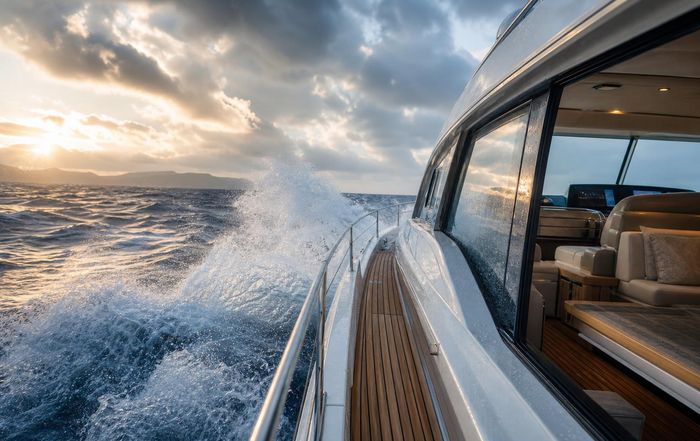
How to Judge Ride Comfort in Rough Water
Judging ride comfort in rough water has become a central concern for yacht owners, designers, and professional captains who increasingly expect offshore-capable vessels to deliver not only safety and speed but also a refined, predictable motion profile. For lucky yacht owning community here, the question is no longer whether a yacht can reach a destination, but how comfortably it can do so when the sea state deteriorates and the forecast proves optimistic rather than accurate.
As naval architecture, onboard technology, and owner expectations evolve, understanding how to evaluate ride comfort has become an essential skill for serious buyers and charterers. This article examines how experienced professionals assess ride comfort in rough conditions, which technical factors matter most, and how the latest innovations are reshaping what can reasonably be expected from modern yachts.
Why Ride Comfort Matters More Than Ever
Across the global yachting market, there has been a clear trend toward longer-range cruising and more ambitious itineraries. Owners and charter guests are increasingly willing to cross exposed stretches of water, from the Gulf Stream and the Bay of Biscay to the Aegean and the Coral Sea, in search of quieter anchorages and more authentic coastal experiences. Industry data published by Superyacht Times and Boat International over recent years has highlighted a growing interest in explorer-style yachts and long-range cruisers, underscoring a structural shift in how yachts are being used.
With that evolution comes a heightened focus on comfort underway. A vessel that performs well in calm water but becomes punishing in a moderate chop may still satisfy a day-boat buyer, yet it will disappoint an owner planning extended cruising. Professional captains interviewed in trade outlets such as Boat International and Yachting Magazine frequently note that guest satisfaction on longer passages is driven less by top speed and more by motion comfort, noise levels, and the sense of security when the sea state builds.
For our team, this has meant placing greater emphasis on sea-keeping and motion behavior in our boat and yacht reviews, and on explaining to readers how to interpret what they feel onboard in a structured, objective way.
The Fundamentals of Comfort: Motion, Noise, and Fatigue
Ride comfort in rough water is best understood as the combined outcome of three interrelated factors: motion characteristics, acoustic and vibration environment, and the cumulative fatigue they impose on those aboard.
Naval architects and maritime researchers, including those at DNV and Lloyd's Register, often start with motion. A yacht in waves moves in six degrees of freedom: heave, pitch, roll, surge, sway, and yaw. For passengers, roll and pitch are typically the most noticeable, especially when they occur at frequencies that coincide with human sensitivity to motion. Vertical accelerations at the bow and midships also play a decisive role in perceived comfort, as they are closely associated with slamming and the jarring impacts that many owners wish to avoid.
Noise and vibration form the second element. Studies on crew comfort by organizations such as the International Maritime Organization and class societies show that persistent noise and vibration, even at moderate levels, can significantly increase fatigue and reduce the perceived comfort of a passage. The perceived harshness of a ride in rough water is often amplified when structural vibrations, engine noise, and hull impacts are transmitted directly into the interior spaces.
Finally, there is fatigue over time. A yacht that feels acceptable in a short, two-hour run through a moderate chop may become exhausting over eight or ten hours. Experienced captains therefore judge comfort not only by instantaneous impressions but by how relaxed or drained guests appear at the end of a day's passage. Onboard routines, seating ergonomics, and the ability to move safely and easily around the vessel all contribute to this long-term comfort dimension.
Hull Design and Its Influence on Ride Comfort
From the perspective of yacht-review.com, no single factor shapes ride comfort more profoundly than hull design. The interplay between hull form, displacement, length, and weight distribution determines how a yacht responds to waves of different heights, lengths, and directions.
Deep-V hulls have long been favored in performance powerboats for their ability to slice through waves and reduce slamming. A deeper deadrise at the transom generally improves soft entry into head seas, but it may also increase drag and fuel consumption. Conversely, flatter aft sections can improve efficiency and stability at rest, which is valued by many cruising owners, but may transmit more impact forces when driven hard into a steep chop. Designers therefore seek a balance, often using variable deadrise and carefully shaped chines to modulate spray, lift, and impact.
On larger yachts, semi-displacement and full-displacement hulls offer different comfort profiles. Full-displacement forms, favored by many long-range cruisers and expedition yachts, are typically optimized for lower speeds and high efficiency, with a more predictable, gentle motion in ocean swell. Semi-displacement hulls aim to combine higher cruising speeds with reasonable sea-keeping, but they are more sensitive to loading and trim. Articles and technical notes from Royal Institution of Naval Architects (RINA) and SNAME highlight that fine-tuning the center of gravity, longitudinal center of buoyancy, and prismatic coefficient can significantly influence how a hull behaves in rougher water.
Catamarans and multihulls add further complexity. Their wide beam and twin-hull configuration can reduce roll significantly and often deliver a more stable platform in beam seas, which many guests find reassuring. However, multihulls can exhibit different motion patterns in short, steep seas, and bridge-deck slamming can become a concern if clearance is inadequate. When evaluating ride comfort on a multihull, experienced surveyors and captains pay particular attention to bridge-deck clearance, weight distribution, and the shape of the inner hull sections.
For readers exploring different hull philosophies, the design-focused features on yacht design and naval architecture provide deeper context on how these parameters are interpreted by leading studios and shipyards.
Length, Displacement, and the Sea State
Beyond hull shape itself, the relationship between yacht length, displacement, and prevailing sea conditions plays a crucial role in comfort. A longer waterline generally allows a yacht to bridge wave troughs more effectively and reduces the pitch amplitude in a given sea state, particularly when wave periods are shorter. This is one reason why many seasoned offshore cruisers gravitate toward yachts of a certain minimum length when planning bluewater passages.
Displacement adds another layer. Heavier yachts often possess greater momentum, which can help them push through chop with less abrupt deceleration and jarring. However, excessive weight positioned high or far from the center can worsen roll and pitch. Modern builders, including several leading European and North American yards regularly covered on yacht-review.com, have responded by using advanced composite materials and carefully engineered structural grids to concentrate mass low and central, improving both stability and comfort.
Independent testing organizations and magazines, such as Yachting World and Power & Motoryacht, frequently comment on the subtle interplay of length, displacement, and hull form in their sea trials, noting that two yachts of similar length may feel very different in identical conditions because of differences in weight distribution, structural stiffness, and underwater geometry.
For those planning extended passages, the cruising-focused insights on bluewater and coastal cruising illustrate how experienced owners match yacht size and displacement to their typical routes and weather windows.
The Role of Speed and Handling in Comfort
Judging ride comfort in rough water cannot be separated from speed and handling choices. A yacht that feels harsh and unpredictable when pushed to its maximum speed in a head sea may become significantly more comfortable at a slightly reduced pace, where the hull's natural motion aligns better with the wave pattern.
Professional captains typically experiment with different speed and heading combinations to find the "sweet spot" in a given sea state. In head seas, this may involve reducing speed to minimize slamming and vertical accelerations. In quartering or beam seas, adjusting course by a few degrees can dramatically reduce rolling and yawing. The ability of a yacht to maintain steerage and directional stability in these conditions, without excessive helm corrections, is a key indicator of both design quality and comfort potential.
Manufacturers of marine electronics such as Garmin, Raymarine, and Navico have introduced increasingly sophisticated autopilot systems that can help maintain a more consistent course and smoother motion, particularly when integrated with motion sensors and gyrocompasses. However, experienced navigators emphasize that autopilots should be used with judgment in rough water, as fine-tuning gain and response settings is often necessary to avoid overcorrections that can worsen motion.
Evaluating ride comfort therefore means considering not just how the yacht behaves at a single speed, but how flexible and predictable its behavior remains as speed and heading are adjusted in response to the sea state.
Stabilization Technologies and Their Impact
One of the most significant developments in ride comfort over the past two decades has been the widespread adoption of active stabilization systems. Gyroscopic stabilizers, such as those produced by Seakeeper and Quick, and fin-based systems from manufacturers like Naiad Dynamics and CMC Marine, have transformed expectations of what is possible in terms of roll reduction.
Gyro stabilizers use a rapidly spinning flywheel to generate torque that counteracts roll, and they are particularly effective at low speeds and at anchor. Fin stabilizers extend from the hull and adjust their angle of attack dynamically to resist rolling, and advanced systems now operate effectively across a wide speed range, including at displacement speeds. Independent tests and case studies, including those referenced by Professional BoatBuilder and several classification societies, indicate that modern stabilizers can reduce roll amplitudes by significant margins under many conditions, though actual performance depends on installation, tuning, and sea state.
When judging ride comfort in rough water, it is therefore essential to understand whether a yacht is equipped with stabilizers, which type, and how they are configured. A sea trial with stabilizers both active and inactive can reveal how much of the comfort is inherent to the hull and how much is provided by technology. For many buyers, particularly those focused on family cruising and charter, the ability to reduce roll at anchor or in a beam sea is a decisive factor in perceived comfort and in the usability of the yacht's living spaces.
Readers interested in the broader technological landscape can explore more on marine technology and onboard systems, where stabilizers, motion-control systems, and emerging innovations are examined in a business and design context.
Interior Layout, Ergonomics, and Human Perception
Ride comfort is not solely a function of hydrodynamics and machinery. Interior design, layout, and ergonomics significantly influence how motion is perceived and tolerated. An intelligently designed yacht will position primary living and sleeping spaces close to the longitudinal and vertical centers of motion, where accelerations are typically lowest. This is why many offshore-capable yachts locate owner and VIP cabins near the middle of the hull rather than far forward.
Seating orientation also matters. Studies in human factors and motion sickness, including research summarized by organizations such as NATO's Human Factors and Medicine Panel and maritime medical sources, suggest that passengers tend to experience less discomfort when facing forward with a clear view of the horizon. Yachts that provide comfortable, forward-facing seating both inside and on deck, with adequate handholds and secure foot bracing, generally receive higher marks for comfort on passage.
Interior noise insulation, vibration damping, and the quality of joinery and fittings all contribute to the impression of solidity and calm. A yacht that creaks, rattles, or transmits every wave impact into the furniture will feel less comfortable even if its motion envelope is objectively manageable. Premium builders invest heavily in floating floors, acoustic insulation, resilient mountings, and meticulous structural bonding to reduce these secondary sensations. Industry publications such as Boat International and Yachts International frequently highlight these construction details when describing the perceived refinement of high-end yachts.
For readers interested in how lifestyle expectations intersect with technical design choices, the yachting lifestyle and onboard living section offers examples of interiors that successfully balance aesthetics with motion-conscious ergonomics.
Objective Measurements versus Subjective Impressions
While ride comfort is inherently subjective, the industry has made considerable progress in developing objective measures that help frame and compare experiences. Classification societies and research institutions have created guidelines and comfort indices that quantify motion, noise, and vibration within certain parameters.
For example, ISO standards and comfort notations used by organizations such as DNV and Bureau Veritas provide frameworks for assessing habitability on larger vessels, including criteria for accelerations, noise levels, and vibration. Although these standards are often applied to commercial and passenger ships, the underlying principles are increasingly referenced by yacht designers and shipyards seeking to deliver measurable comfort performance.
During sea trials, naval architects and surveyors may use accelerometers to record vertical and lateral accelerations at key locations onboard, along with sound level meters to measure noise in decibels across different frequencies. These data can be compared against recognized thresholds for comfort and motion sickness risk. Research from maritime universities and institutes, including Chalmers University of Technology and TU Delft, contributes to the ongoing refinement of these models.
However, even the most sophisticated metrics cannot fully capture individual variability. Some guests are highly tolerant of motion but sensitive to noise; others may be the reverse. Cultural expectations and prior experience at sea also shape perceptions. A yacht evaluated by us may therefore receive excellent technical scores yet still be described as "lively" or "expressive" in motion, with clear explanations of what that means for different owner profiles.
How Experienced Professionals Evaluate Comfort on Sea Trials
When captains, surveyors, and experienced buyers assess ride comfort in rough water, they typically follow a structured yet practical approach that combines technical awareness with keen observation. Rather than relying on a single run, they seek a range of conditions and headings, ideally including head seas, following seas, and beam seas with at least a moderate wave height.
They pay close attention to how the bow behaves when meeting oncoming waves, noting whether it slices cleanly, pounds, or throws excessive spray. They observe roll behavior at different speeds and headings, looking for any tendency to snap roll or resonate unpleasantly. They listen for structural noises, rattles, and vibrations that may indicate either design compromises or construction shortcuts. They move through the interior to gauge how motion feels in different spaces, particularly in cabins and salons where guests will spend extended time.
Professionals also monitor helm response and steering feel, noting whether the yacht tracks confidently or requires constant correction. They test stabilizers, trim tabs, and other control systems to see how effectively they tame motion and whether they introduce any unwanted side effects, such as yawing or unusual heel angles in turns. Many will also solicit feedback from less experienced passengers onboard, as their reactions often mirror those of future guests.
The practical insights gathered through this process inform not only individual purchase decisions but also the editorial perspective, where detailed boat coverage aims to translate technical impressions into clear guidance for readers considering similar designs.
Sustainability, Efficiency, and the Comfort Equation
Sustainability has become a defining theme in the yachting industry, with major builders, suppliers, and owners increasingly focused on reducing fuel consumption, emissions, and environmental impact. This shift has implications for ride comfort, as hull efficiency, propulsion choices, and weight management all intersect with motion behavior.
Advances in hull optimization, including the use of computational fluid dynamics and extensive tank testing, have enabled designers to create forms that deliver both improved efficiency and more predictable motion. Hybrid propulsion systems and alternative fuels, such as methanol and biofuels, are being explored and implemented by forward-looking shipyards and operators, as reported by organizations like the Water Revolution Foundation and The Superyacht Life Foundation. These efforts often require careful balancing of additional equipment weight and space against stability and comfort goals.
Lightweight materials, including carbon fiber and advanced composites, can reduce displacement and improve efficiency, but they also demand meticulous engineering to ensure adequate stiffness and damping. A very light, very stiff hull may transmit more high-frequency vibrations and impacts if not properly designed. Builders who prioritize both sustainability and comfort therefore invest heavily in structural design, insulation, and shock-absorbing interfaces.
Readers who wish to delve deeper into the intersection of environmental responsibility and onboard experience can explore the sustainability in yachting coverage, where innovative projects and best practices are examined with an eye toward both performance and comfort.
Translating Knowledge into Better Decisions
For owners, charterers, and industry professionals, understanding how to judge ride comfort in rough water is ultimately about making better, more informed decisions. It means looking beyond glossy brochures and dockside impressions to consider how a yacht will behave when the forecast is marginal and the itinerary cannot be easily changed.
By focusing on hull design, length and displacement, stabilization technology, interior ergonomics, and objective measurements, prospective buyers can ask more targeted questions of shipyards, brokers, and captains. They can insist on sea trials that reflect realistic conditions rather than only calm-water demonstrations. They can interpret the nuanced language used in expert yacht reviews and sea-trial reports and match those insights to their own cruising plans and comfort thresholds.
For the industry, the growing sophistication of owners and guests in this area is encouraging continued innovation. Builders are investing in research and development, class societies are refining comfort standards, and technology providers are delivering ever more capable stabilization and control systems. As these trends converge, the expectation that a yacht should be not only safe and seaworthy but also genuinely comfortable in challenging conditions is becoming the new norm rather than an exceptional selling point.
This evolution is welcomed. It aligns with a broader vision of yachting as a refined, sustainable, and deeply rewarding way to explore the world's oceans and coasts. By sharing knowledge, highlighting best practices, and offering candid assessments grounded in experience and technical understanding, the platform aims to help its global readership choose yachts that will carry them farther, more safely, and with far greater comfort, even when the sea reminds everyone aboard who is truly in charge.
For those planning their next passage or considering a new build or refit, the broader perspectives in global yachting and market analysis, the historical context in yachting history and evolution, and the business-focused insights on yacht investment and ownership can complement the technical understanding of ride comfort, helping to ensure that every new chapter on the water is not only adventurous but genuinely enjoyable.