

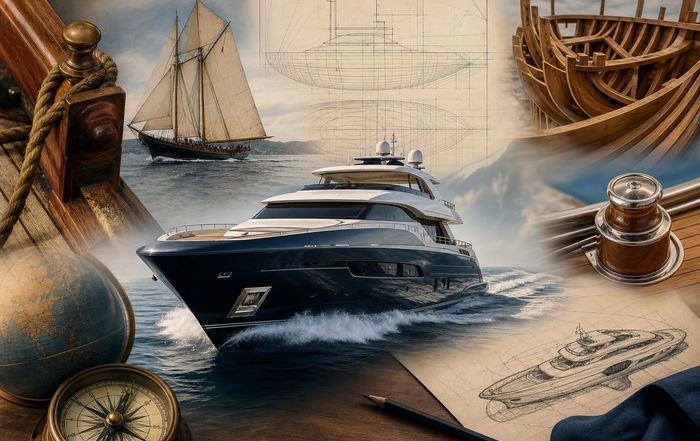
Maritime Traditions That Influence Yacht Design
Yacht design may appear to be a thoroughly modern discipline shaped by advanced composites, computational fluid dynamics and hybrid propulsion, yet much of what defines contemporary superyachts and premium production boats is rooted in centuries of maritime tradition. From the sheer line of a classic sailing yacht to the ceremonial role of the owner's suite, yacht designers continue to draw on a deep cultural and technical heritage that extends back to working fishing vessels, naval warships and the great age of sail.
For wave hardened community readers here, this interplay between history and innovation is more than a curiosity; it is a framework for understanding why yachts look, feel and behave the way they do, and why certain design cues remain so enduringly powerful in the marketplace. This article explores the principal maritime traditions that still shape yacht design, how leading builders interpret them today, and why these influences continue to resonate with owners, charter guests and crews around the world.
From Working Hulls to Luxury Platforms
Long before the modern yacht emerged as a dedicated leisure craft, boatbuilders in Northern Europe, the Mediterranean and Asia were optimising hull forms for trade, fishing, exploration and warfare. Contemporary naval architects still study these precedents because they represent solutions refined over generations of trial and error.
The sharp, wave-piercing bows and fine entries of Viking longships, for example, have informed the thinking behind many fast displacement and semi-displacement hulls. Modern hydrodynamic research from institutions such as Delft University of Technology and the U.S. Naval Academy confirms that slender hulls with carefully controlled prismatic coefficients can deliver efficient performance at a range of speeds, an insight that echoes the logic of long, narrow traditional craft.
Similarly, the beamy, load-carrying hulls of North Sea trawlers and Dutch barges, designed for stability and capacity rather than speed, have influenced the contemporary explorer yacht segment. Many expedition yachts borrow from these commercial working vessels, adopting high freeboard, a robust bow and a relatively full midship section to achieve long-range autonomy and sea-kindliness. When Yacht Review examines long-range cruisers in its dedicated cruising coverage, the lineage from commercial seafaring to private exploration is often clearly visible in both profile and performance.
This continuity is not nostalgic; it is pragmatic. Naval architects frequently reference proven traditional forms when developing new designs, then validate and refine them using tank testing and computational tools. In this way, maritime traditions become a starting point for innovation rather than a constraint.
The Enduring Power of the Sheer Line
Among the most recognisable traditional influences on yacht design is the sheer line, the subtle longitudinal curve of the deck when viewed from the side. Historically, sheer was not only aesthetic; it contributed to reserve buoyancy and helped working sailing vessels shed water in heavy seas. Today, sheer remains one of the primary visual signatures of a yacht and a key differentiator between design philosophies.
Classic sailing yachts and many modern motoryachts retain a pronounced sheer, rising towards the bow and sometimes the stern, evoking the elegance of early twentieth-century racing yachts and naval vessels. This curve can make a yacht appear longer, lower and more purposeful, and it often resonates strongly with owners who appreciate continuity with maritime heritage. Designers interviewed by Boat International and Superyacht Times frequently describe the sheer line as the "spine" of the exterior profile, around which other elements are composed.
At the same time, some contemporary designs, particularly in the high-volume production segment, adopt a straighter sheer to maximise internal space and simplify construction. The ongoing dialogue between a romantic, curved sheer and a more rectilinear, architecture-driven profile reflects a broader tension between tradition and modernity in yacht design. For discerning readers who follow our design features, understanding this vocabulary of lines and proportions provides a more nuanced lens through which to evaluate new launches.
Naval Heritage and the Language of Authority
Yacht design also inherits much from naval and coast guard vessels, not only in terms of technology but also in visual language. High, flared bows, vertical or near-vertical stems, and purposeful superstructures have long been associated with seakeeping and authority at sea. Many contemporary explorer and support yachts intentionally echo the aesthetic of patrol boats or small warships, signalling capability and seriousness of intent.
This influence is not purely stylistic. The flared bow, for instance, has deep roots in naval architecture, where it helps deflect spray and improve dryness on deck in rough conditions. Modern yachts that prioritise offshore passages and remote cruising often adopt pronounced bow flare and robust foredeck structures, translating a practical naval solution into the luxury sphere. Resources from Lloyd's Register and DNV show how classification standards for seagoing vessels, many developed for commercial and naval ships, now guide structural and safety requirements in the superyacht sector.
Traditional naval layout concepts also persist. The clear separation between command spaces, crew working areas and guest domains mirrors historical distinctions between bridge, working deck and officers' quarters. On many large yachts, the wheelhouse still occupies a commanding position with near-360-degree visibility, echoing the bridge of a naval vessel. Below, crew traffic routes are often designed to minimise interference with guest circulation, a principle that can be traced back to the hierarchical organisation of ships of the line and early steamships.
The Legacy of Classic Sailing Yachts
For many in the yachting community, the purest expression of maritime tradition lies in the great sailing yachts of the late nineteenth and early twentieth centuries. The J-Class racers of the 1930s, immortalised in America's Cup history, continue to influence modern performance cruisers and high-end sailing superyachts. Long overhangs, low freeboard, fine entries and powerful sail plans remain aspirational design references, even when today's yachts are built from carbon composites and feature advanced rigging systems.
Contemporary designers often reinterpret these classic proportions to meet current safety regulations, interior volume expectations and stability criteria. The result is a genre of "modern classics" that blend traditional aesthetics with state-of-the-art engineering. Many of these vessels, frequently reviewed in our boats section, showcase varnished brightwork, coved teak decks and subtly flared transoms that pay homage to wooden yacht traditions, even when the underlying structure is aluminium or composite.
Traditional rig configurations also exert a lasting influence. Ketch and schooner rigs, once chosen for their ability to divide sail area into manageable portions for small crews, now appeal to owners seeking versatility, redundancy and a particular silhouette. While sloop rigs dominate performance-oriented designs, the aesthetic and seakeeping advantages of multi-mast configurations ensure that ketches and schooners remain integral to the upper end of the sailing yacht market.
Interior Layouts and the Evolution of Life Afloat
Many aspects of yacht interior design can be traced back to the spatial organisation of historical ships. The concept of an "owner's suite," for example, echoes the captain's cabin or admiral's quarters on naval vessels and the grand staterooms on early ocean liners. These spaces, traditionally located aft where motion is reduced and privacy is enhanced, have inspired the positioning and treatment of owner accommodation on countless modern yachts.
The separation between guest and crew areas also has deep roots in maritime tradition. On commercial and naval ships, officers and enlisted crew had distinct messes and sleeping quarters, often physically segregated to reinforce hierarchy and maintain operational efficiency. Contemporary yachts adapt this logic to create discreet service routes, separate crew staircases and galleys that can function independently of guest social areas. This arrangement supports the high service standards expected in luxury hospitality while preserving the privacy of both guests and crew.
Furthermore, the idea of communal gathering spaces at sea, such as the wardroom or saloon, has evolved into the modern main saloon and sky lounge. These areas, often highlighted in our more detailed yacht reviews, reflect a long-standing maritime culture of shared meals, storytelling and social interaction during extended voyages. Designers still draw on the warmth and intimacy of traditional shipboard interiors, even as they incorporate contemporary materials, large windows and open-plan layouts that respond to current lifestyle preferences.
Craftsmanship, Materials and the Artisanal Tradition
The craftsmanship associated with wooden boatbuilding has a profound symbolic and practical influence on modern yacht design. Even as aluminium, steel and advanced composites dominate hull and superstructure construction, elements such as teak decks, fine joinery and hand-finished details remain central to the perception of quality and authenticity.
Teak, long valued for its durability, grip and resistance to rot, continues to be a defining material on many premium yachts, though its use is being reconsidered in light of sustainability concerns. Traditional deck layouts, with margin boards, king planks and carefully joggled seams, are still reproduced or emulated using synthetic alternatives, preserving the visual language of classic craft. Owners often associate this level of detailing with the heritage of prestigious yards and the continuity of maritime artistry.
The tradition of bespoke, hand-crafted interiors also persists, even as digital design tools and CNC machining streamline production. Many leading yards emphasise their in-house carpentry and finishing teams, positioning them as guardians of a craft lineage that stretches back generations. This emphasis on human skill and continuity aligns with broader luxury trends and reinforces the emotional connection between owners and their yachts. For readers interested in the intersection of heritage and lifestyle, our lifestyle coverage frequently highlights how these artisanal traditions shape the onboard experience.
Rituals, Customs and Symbolism in Design
Beyond physical form and materials, maritime traditions include a rich tapestry of rituals and symbols that subtly influence yacht design and culture. The practice of christening a vessel with a naming ceremony, often accompanied by the breaking of a bottle on the bow, remains common in both commercial and private yachting, reflecting centuries-old beliefs about luck and protection at sea. Designers sometimes incorporate dedicated nameplates, figureheads or decorative motifs that give architectural expression to this ritual significance.
Similarly, the tradition of the ship's bell, historically used for timekeeping and signalling, continues in modern yachts as a ceremonial object and design feature. Many vessels display a polished bell engraved with the yacht's name, often located on the foredeck or near the bridge, blending functional heritage with aesthetic presence. Maritime flags and ensigns, governed by international convention and national law, also shape exterior design, dictating the placement of masts, flagstaffs and light arrangements in accordance with the International Regulations for Preventing Collisions at Sea.
These customs influence not only physical arrangements but also the narrative that owners and builders construct around a yacht. Many design studios consciously weave heraldic elements, personal emblems or historical references into interior detailing, creating a sense of lineage and identity that resonates with the broader maritime story.
Global Traditions and Regional Influences
While much of the yachting world draws heavily on European and North American maritime traditions, global influences are increasingly visible in contemporary design. Traditional dhow construction in the Middle East, for instance, with its sweeping sheer and high stern, has inspired certain exterior styling cues on yachts based in the Gulf region. In Asia, the heritage of junks and fishing vessels informs local interpretations of hull form, deck layout and use of covered outdoor spaces.
The widespread growth of yachting in markets such as China, Southeast Asia and South America is encouraging designers to engage with a broader palette of cultural references. This may manifest in the choice of materials, interior aesthetics or the configuration of social spaces that reflect regional hospitality norms. For readers following the expanding international scene through our global coverage, these developments illustrate how maritime traditions are not static but continually evolving as new cultures participate in yacht ownership and design.
Historical research also plays a role. Institutions such as the National Maritime Museum in Greenwich and the Smithsonian's National Museum of American History preserve extensive collections of ship models, plans and artefacts that inform both scholars and practitioners. Designers often study these archives to better understand proportion, decoration and structural logic in historical vessels, then reinterpret those lessons for contemporary yachts.
Sustainability: Old Wisdom for New Challenges
The push toward sustainability in yachting is often framed as a cutting-edge technological challenge, yet many of the underlying principles have deep roots in traditional seafaring. Historical mariners were acutely aware of resource constraints, designing vessels that could travel long distances using only wind power and minimal stored provisions. Contemporary efforts to reduce fuel consumption, integrate sail-assist systems and optimise hull efficiency echo this earlier ethos of frugality and respect for the marine environment.
Modern hybrid propulsion, waste management systems and energy-efficient hotel loads are being developed and certified under frameworks from organisations such as the International Maritime Organization and class societies, but the philosophical foundation-a desire to live in balance with the ocean-has been part of maritime culture for centuries. Traditional practices such as careful route planning, speed management and preventive maintenance are now being reframed as elements of sustainable operation, reinforcing the idea that responsible yachting is both a technological and cultural endeavour.
Our readers can explore how these themes intersect with design and operations in more detail through the sustainability section, where case studies often show how designers are reinterpreting age-old seafaring wisdom in the context of regulatory requirements and owner expectations.
Technology, Innovation and Respect for Heritage
Contemporary yacht design operates at the intersection of tradition and advanced technology. Computational fluid dynamics, finite element analysis and integrated digital design environments allow naval architects to explore forms and systems that would have been impossible to evaluate using purely empirical methods. Yet many of the baseline assumptions and targets-seaworthiness, comfort, efficiency and aesthetic harmony-remain deeply informed by historical precedents.
Leading technical publications such as Professional BoatBuilder and research shared through The Royal Institution of Naval Architects often highlight this duality, presenting cutting-edge engineering solutions alongside discussions of classic hull forms and time-tested construction methods. The most successful yacht projects tend to be those that respect this continuum, leveraging technology to refine and validate ideas that have stood the test of time rather than pursuing novelty for its own sake.
From the perspective of yacht-review.com, which covers unique developments in marine technology alongside more traditional design topics, this balance is central to understanding where the industry is heading. Owners and charter guests increasingly seek yachts that feel contemporary and environmentally responsible yet still embody the romance and authenticity of the sea. Designers who can navigate this balance, drawing intelligently on maritime traditions while embracing innovation, are well positioned to shape the next generation of iconic yachts.
Tradition as a Strategic Asset in Yacht Business
Maritime traditions do not only influence the physical product; they also shape the business strategies of shipyards, brokers and service providers. Many leading yacht builders emphasise their heritage, sometimes spanning more than a century, as a core component of brand identity. This heritage narrative often references early fishing boats, pilot cutters or military contracts, positioning the yard as a custodian of hard-won seafaring knowledge.
In a competitive global market, the ability to demonstrate continuity with respected maritime traditions can be a powerful differentiator. Clients may perceive such heritage as a proxy for reliability, craftsmanship and long-term support. Brokers and charter companies, in turn, often highlight classic design cues, traditional build quality and the pedigree of naval architects in their marketing materials, appealing to clients who value a connection to the storied history of the sea.
For industry professionals and investors following our business analysis, this underscores the importance of tradition as more than an aesthetic choice; it is a strategic asset that influences brand equity, resale value and client loyalty. The challenge for companies is to ensure that references to maritime heritage are substantiated by genuine expertise and operational excellence, rather than deployed as superficial marketing language.
A Living Heritage: What It Means for Yacht Review Readers?
For the community that gathers around yacht-review.com, whether as owners, aspiring buyers, crew or enthusiasts, understanding the maritime traditions that influence yacht design offers a richer appreciation of the vessels they encounter. When a new motoryacht with a plumb bow and high freeboard appears in our latest news coverage, or when a sailing superyacht with classic overhangs is profiled in a feature, the design choices on display are part of a long conversation between past and present.
This awareness can inform not only aesthetic preferences but also practical decisions about cruising style, onboard lifestyle and long-term ownership. A yacht inspired by robust commercial workboats may be particularly well suited to high-latitude exploration, while a vessel rooted in classic sailing yacht proportions may appeal to those who view yachting as an expression of timeless elegance and seamanship. In both cases, the underlying traditions provide clues about how the yacht will perform, feel and age.
As the industry continues to evolve, incorporating new materials, propulsion technologies and digital systems, the influence of maritime traditions is unlikely to diminish. Instead, these traditions will serve as a compass, guiding designers, builders and owners as they navigate changing expectations, regulatory landscapes and environmental responsibilities. For those who follow our broader focused coverage of travel and cruising destinations, the continuity of maritime culture across regions and generations is part of what makes yachting such a compelling and enduring pursuit.
In this sense, every yacht-whether a compact family cruiser or a large custom superyacht-is both a product of its time and a vessel of accumulated maritime knowledge. By recognising and valuing the traditions that shape yacht design, the yachting community can ensure that progress at sea remains grounded in respect for the skills, experiences and stories that brought the industry to where it is today.