

What Makes a Yacht Tender Safe and Easy to Launch?
A yacht tender is only useful if it can be deployed quickly, handled confidently, and brought back aboard without drama. For many owners, that means the real measure of a tender is not just speed, comfort, or styling, but how safely it fits into the yacht's daily routine. Launching and recovering a tender is one of those behind-the-scenes operations that can feel routine until weather, weight, visibility, or crew fatigue turns it into a risk. The safest tenders are not necessarily the simplest-looking ones; they are the ones designed around clear handling geometry, predictable weight distribution, secure lifting points, and systems that reduce the chance of human error. For new and old visitors following yacht ownership and operations topics on Yacht Review, this is where engineering and practicality matter as much as aesthetics.
Safety starts with the tender itself
The tender's hull form, overall weight, and deck layout shape almost everything that happens during launch and recovery. A lighter boat is not automatically safer, because a very light tender can still be awkward if it sits high on chocks, has poor lifting balance, or moves unpredictably in a swell. Equally, a heavy RIB or a hard-chine runabout may be perfectly manageable if the yacht's davit system, crane, or garage is designed for it and the crew can operate it with clear sightlines. The key is compatibility between the tender and the yacht, not any single specification taken in isolation. That is why owners often benefit from thinking about tender choice alongside reviews, design, and technology rather than treating the tender as an afterthought.
Hull stability matters because the tender is often handled close to the water, where motion is amplified. A stable platform is easier to board, easier to secure, and less likely to shift unexpectedly while being lifted or floated clear. Inflatable collars can improve reserve buoyancy and help protect the tender and yacht from minor contact, which is one reason RIBs remain so common. But the safety benefit only holds if the tubes are properly maintained and the tender's overall structure is stiff enough to behave predictably under load. Engine placement, fuel tank location, battery position, and storage of loose gear all influence trim, and trim influences how the tender behaves when it is suspended, lowered, or nudged by a passing wake.
Why launch systems matter as much as the boat
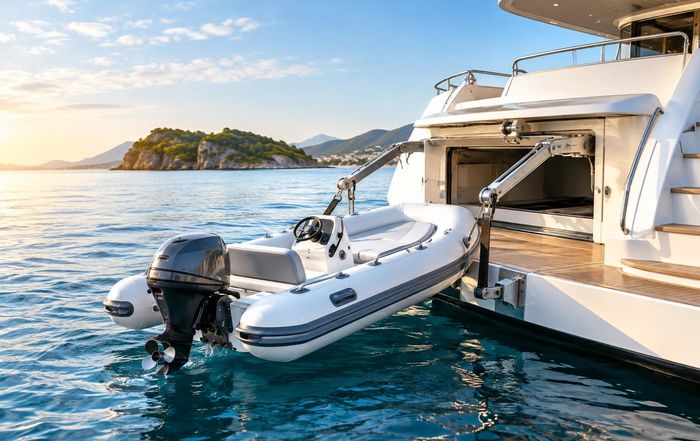
The safest launch is usually the one that relies least on improvisation. Modern yachts use a range of systems, from simple davits to integrated garages, side-launch arrangements, hydraulic platforms, and cranes. Each has advantages, but each also has its own failure points and crew requirements. A well-engineered cruising yacht will usually have a tender-handling setup that matches the likely sea state, the yacht's beam, and the crew available to operate it. The best systems reduce the number of steps between "secured on deck" and "ready in the water," while also ensuring the tender cannot swing, foul, or drop unexpectedly.
Hydraulic systems are often favored because they provide controlled movement and can be designed with redundant safety features. Still, hydraulics only improve safety when they are properly maintained, inspected, and used within their rated limits. Worn hoses, corroded fittings, poor maintenance of locking pins, or neglected control systems can turn a sophisticated setup into a liability. By contrast, a simpler manual arrangement can be very safe if the tender is small, the crew is trained, and the yacht's business model or ownership pattern does not demand frequent, high-speed deployments. The right answer depends on the yacht's size, operating profile, and how often the tender is used.
The hidden importance of balance, lifting points, and secure stowage
A tender that is easy to launch is almost always one that was designed to be lifted correctly. Proper lifting points are not decorative; they are structural necessities. When a tender hangs level, the crew can guide it more easily, the load on the davit or crane is more predictable, and the risk of the tender swinging into the hull is reduced. Poorly positioned lifting eyes, uneven weight distribution, or ad hoc slinging create instability that is especially dangerous when wind catches the boat. On larger yachts, this is one reason why custom tender packages are often integrated with the vessel's original design brief rather than added later.
Stowage matters just as much as lifting. A tender that is chocked securely, with tie-downs that prevent movement in all directions, is safer for the yacht and the crew. Pads, cradles, and restraints should be inspected regularly for wear, because a system that looks solid at rest may fail under vibration, spray, or repeated loading. Garage stowage can be especially elegant, but it demands careful attention to ventilation, drainage, and access. If the garage is cramped or cluttered, the crew may be forced into awkward movements that increase the chance of slips, pinched fingers, or impact damage. Many of the best solutions are the least flashy: clear deck space, consistent hardware, and a layout that lets crew work without crossing over one another.
Crew procedure is part of the safety system
Even the most advanced equipment cannot compensate for poor procedure. Safe launch and recovery depend on clear roles, standard commands, and a habit of checking the same critical points every time. The crew should confirm that the tender is empty of loose gear, that fuel and battery systems are in the correct state, and that passengers are not boarding until the boat is properly afloat and stable. In rougher conditions, the decision to delay or abort a launch is often the safest choice, especially if the yacht is pitching or the tender is likely to drift against the hull. A disciplined crew culture is often the difference between a smooth operation and a near miss.
Training is especially important because tender handling is often delegated to junior crew or rotating teams. A boat that is easy to launch should still be intuitive enough that a competent crew member can complete the procedure without guesswork. That means controls should be clearly labeled, emergency stops should be accessible, and the sequence of operations should be standardized. Good yacht operations also account for fatigue, lighting, and visibility. Night launches, for example, demand better illumination and stricter communication than daytime handling. For readers interested in how operational standards connect to wider yacht life, community and family use cases can be just as relevant as technical ones, because tenders are often moving guests, children, or equipment rather than just crew.
Design details that reduce risk in real use
Small design choices often have a disproportionate effect on safety. Non-slip deck surfaces help passengers board and crew move confidently when the tender is wet. Handholds should be placed where people naturally reach for them, not just where they look tidy in profile. Seating should be arranged so that weight is distributed sensibly and passengers are not forced to stand in vulnerable positions while the boat is moving at low speed during transfer. A broad, uncluttered boarding area can make the difference between a controlled step and a stumble. These are not luxury details in the abstract; they are operational safeguards.
Visibility is another overlooked factor. A tender with a helm position that gives the operator a clear view of the bow, stern, and surrounding water is easier to maneuver during docking and recovery. Poor sightlines increase the chance of contact with the yacht or nearby structures, particularly when wind and current are working against the crew. Lighting also matters, especially for enclosed garages and twilight operations. Navigation lights, deck lights, and practical work lights should support the crew without creating glare or washing out depth perception. The safest tenders are often those that make the operator's job feel calm and predictable, not those that rely on quick reflexes to correct avoidable design flaws.
Maintenance is part of launch safety
A tender can only be as safe as its least-maintained component. That includes the hull, engine, steering, lifting hardware, batteries, fuel system, and any hydraulic or electronic launch equipment used by the yacht. Corrosion, UV degradation, chafe, and vibration all take a toll, especially in saltwater environments. Regular inspection is not just about longevity; it is about preventing the kind of small mechanical failure that becomes dangerous when a tender is suspended over water or moving close to the yacht's side. This is where the broader maintenance culture visible across news and technology coverage becomes relevant, because innovations only help if they are maintained properly.
Battery management deserves particular attention on electric or hybrid tenders, which are becoming more visible as owners explore quieter and lower-emission options. The International Council on Clean Transportation, the International Maritime Organization, and classification and safety organizations such as Lloyd's Register, DNV, and ABS all reflect how seriously maritime safety and compliance are treated across the wider sector, even if tender-specific practices vary by vessel. For owners considering greener operating profiles, the trade-offs are practical as well as environmental: charging infrastructure, battery weight, thermal management, and emergency procedures all affect how safely the tender can be handled. Sustainability should be evaluated through the lens of real operations, not just emissions claims, which is why sustainability coverage is increasingly relevant to tender selection.
Weather, water, and location still set the limits
A tender that is easy to launch in calm water may become difficult in crosswind, swell, or tight marina conditions. That is why the surrounding environment is part of the safety equation. Launching from a protected anchorage is very different from recovering a tender in a rolling harbor entrance or alongside a busy quay. Crew need enough margin to account for current, windage, and the way the yacht itself moves at anchor. Even a well-designed tender can become awkward if the yacht is yawing or the sea state changes unexpectedly.
This is also where operational planning matters. The safest yachts think ahead about where the tender will be used, who will operate it, and how often it will be launched. A vessel cruising in the Mediterranean, for example, may face different docking patterns, marina congestion, and passenger-transfer habits than one operating in the Caribbean or the Pacific. That does not mean one region is inherently harder than another; it means the tender setup should reflect the actual itinerary. Owners planning longer passages or mixed-use itineraries often find it useful to compare travel and global reporting for a bigger sense of operating conditions and destination-specific practices.
What buyers should ask before choosing a tender
The best question is not "Which tender looks best?" but "Which tender will be easiest to handle safely on this yacht, with this crew, in these waters?" That question leads naturally to practical checks: Does the yacht have the right lifting system? Is the garage or deck space sized for the tender without forcing awkward compromises? Can the crew launch and recover it in a realistic time window? Are passengers able to board securely? Are the maintenance demands compatible with the owner's use pattern? These are the issues that determine whether a tender becomes a pleasure or a recurring operational headache.
It also helps to think about the tender as part of the yacht's overall operating ecosystem. A beautifully finished boat that is difficult to stow or launch may be less useful than a more modest tender that works flawlessly every time. For many owners, the ideal choice is the one that disappears into the routine: secure, predictable, and ready when needed. That is the real definition of easy to launch. In yacht operations, ease is not a luxury in itself; it is a form of safety.