

Choosing Between Shaft Drive and Pod Propulsion
For owners comparing propulsion systems on a new yacht or a major refit, the choice between shaft drive and pod propulsion is less about fashion than about how the boat will actually be used. The two systems can both deliver excellent results, but they shape the hull, the running gear, the maintenance routine, the handling characteristics, and even the long-term ownership experience in different ways. That is why the right answer depends on whether the priority is simplicity, cruising range, maneuverability, shallow-water flexibility, efficiency at certain speeds, or the kind of service support available where the yacht will spend most of its life. For readers following yacht design and ownership decisions closely, this is one of the most consequential choices in modern propulsion, and it sits naturally alongside broader discussions in reviews, design, and technology.
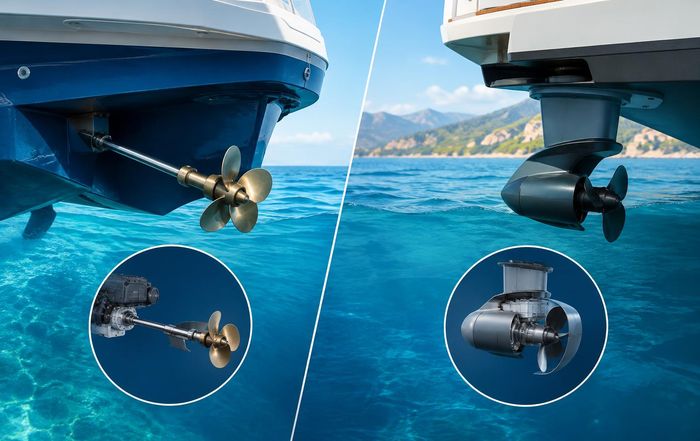
At a high level, shaft drive remains the traditional arrangement: engines mounted inside the hull turn propeller shafts that exit through the bottom and drive conventional propellers. Pod propulsion places the thrust unit outside the hull, usually in a steerable pod beneath the stern, with the propellers and steering integrated into the module. Both are established systems, but they serve different design philosophies. Shaft drive tends to favor robust simplicity and broad compatibility with many hull forms, while pod systems are often selected for their maneuverability, interior layout advantages, and potential efficiency gains in certain operating profiles. The better choice is not universal, and recent advances in both systems have made the comparison more nuanced rather than less.
What shaft drive still does especially well
Shaft drive has endured because it is mechanically straightforward, widely understood, and proven across decades of service in everything from semi-displacement cruisers to heavy-duty passagemakers. A conventional shaft system usually offers a familiar maintenance rhythm, a large global base of technicians, and parts compatibility that many owners value when cruising far from major service centers. That matters in practical terms: an owner heading into global cruising or planning extended time in less-developed harbors may prefer a setup that can be inspected, aligned, and repaired by a broader pool of yards and engineers. In the yacht world, that kind of operational resilience is often more valuable than a theoretical performance advantage.
Shaft drive also tends to fit naturally with deeper, more traditional hull shapes and with yachts where the engine room is not being optimized around a compact pod package. Because the propulsion train is internal and comparatively simple, designers can often achieve a very predictable handling character, especially at displacement or semi-displacement speeds. The trade-off is that shafts, struts, and rudders take up underwater space and can impose draft and efficiency penalties depending on the hull design. But for many owners, the system's virtues are exactly those: familiar behavior underway, less dependence on proprietary components, and fewer moving parts exposed outside the hull. That is why shaft drive remains common in many boat categories even as newer propulsion types gain attention.
There is also a design reason shaft drive persists. It can be easier to integrate with classic interior arrangements, particularly on yachts where the engine room, crew spaces, and accommodation plan are already optimized around a longitudinal machinery layout. For owners who value a more conventional engineering footprint, or for builders targeting long-range comfort over dockside agility, shaft drive often remains the conservative and rational choice.
Why pod propulsion changed the conversation
Pod propulsion became attractive because it rethinks how thrust and steering are delivered. By moving the propulsive unit outside the hull and making it steerable, pods can improve low-speed handling dramatically, especially when paired with joystick control and integrated navigation systems. Docking, tight marina maneuvers, and crosswind corrections can become easier and less stressful, which is one reason pod systems have been popular on many modern planing and fast cruising yachts. For owners who spend a lot of time in crowded marinas or enjoy short-handed operation, that convenience can be a genuine operational advantage rather than a novelty.
A second attraction is the way pods can free up interior volume. Because the engines and drivetrain can be arranged differently inside the hull, designers may gain more flexibility in the accommodation plan, machinery access, or guest spaces. That is not a universal benefit, and it depends heavily on the hull and builder's engineering philosophy, but it is one of the reasons pods have had such a visible impact on contemporary lifestyle-oriented cruising yachts. The system can also support efficiency gains in some speed bands by aligning thrust more effectively with the hull's running attitude. In the best cases, that can translate into smoother handling and, sometimes, better fuel economy at the speeds where the yacht is actually used most often.
The caveat is that pod systems are not simply "better" shafts. They are more integrated, more specialized, and often more dependent on electronics, proprietary components, and factory-trained service networks. That can be an advantage when the system is operating as intended and support is nearby. It can also become a constraint if the yacht cruises in regions where specialized service is limited. Owners who spend time in the Mediterranean, the United States, or other major yachting centers may find support easier to arrange than those venturing more broadly, which is why cruising plans should be considered before the propulsion choice is finalized.
Handling, docking, and the everyday ownership experience
The most visible difference between the two systems is often felt at slow speed. Pod propulsion excels at precise maneuvering because the thrust vector can be redirected quickly and intuitively, often in combination with thrusters and automated control systems. For many owners, that reduces stress in marinas and makes close-quarters handling more accessible to family members or guests who are not professional captains. In practice, this can influence how often a yacht is used and how confidently it is handled, which is no small factor in overall satisfaction.
Shaft drive, by contrast, usually demands more traditional seamanship in tight spaces. A skilled captain can handle a shaft-driven yacht beautifully, but the system does not provide the same level of immediate directional flexibility. Owners who enjoy the feel of conventional helm work may see that as a feature rather than a drawback. Others, especially those moving up to larger yachts or operating with a smaller crew, may prefer the assistance pods provide. The handling question therefore becomes partly about the owner's comfort level and partly about the intended operating environment. A yacht that will mostly make short coastal hops, visit marinas frequently, and carry a less experienced owner-operator may benefit more from pods than a yacht intended for long, open-water passages.
This is where the broader context of family use matters. If the yacht is expected to be run by different people over time, or if the goal is to reduce the learning curve for occasional operators, pod propulsion can be compelling. If the owner prioritizes mechanical transparency and a more classic bridge-to-engine-room relationship, shaft drive often feels more reassuring.
Efficiency, speed range, and hull design
Neither system is universally more efficient; the answer depends on hull type, displacement, cruising speed, and how the yacht is actually loaded. Pod propulsion can be very effective on planing and fast semi-displacement yachts, especially where the hull and running gear are designed together from the outset. The benefit often comes from better thrust angle, reduced drag in some configurations, and the ability to optimize the hull around the propulsion package. In the right speed range, that can improve performance and make the yacht feel more responsive.
Shaft drive, however, can be the more sensible choice for yachts that spend much of their time at displacement speeds or that are designed around a heavier, more traditional cruising profile. It is often a better fit for long-range passagemaking, where steady running, durability, and straightforward serviceability matter more than docking convenience. The efficiency comparison should therefore be made at the yacht's real operating profile, not on a brochure claim. A boat that looks efficient on paper at one speed may be less convincing once fuel burn, sea state, and payload are taken into account. That is why serious buyers often compare propulsion in the context of the whole vessel, not as an isolated technical feature.
This broader systems view also connects to sustainability. Propulsion choice affects fuel consumption, maintenance cycles, and long-term operating footprint, but the environmental picture is never just about the drivetrain. Hull efficiency, operating habits, generator load, and voyage profile all matter. A well-designed shaft-driven yacht used thoughtfully may outperform a poorly matched pod-driven yacht in real-world emissions and fuel use, while a well-engineered pod boat may deliver meaningful savings in its intended envelope.
Maintenance, reliability, and lifecycle cost
Maintenance is where many owners begin to see the hidden costs of a propulsion decision. Shaft drive is generally easier to understand, and many yards are comfortable with alignment, seals, bearings, and propeller service. The system's simplicity can make inspections more straightforward, and the parts ecosystem is broad. That does not make it maintenance-free, but it does mean that the service model is familiar and less dependent on a narrow support chain. For owners who value predictability in business terms, that can be important: downtime, haul-out scheduling, and repair logistics all affect the true cost of ownership.
Pod propulsion can be more expensive to service, particularly if specialized components or software diagnostics are required. The underwater unit itself is more complex than a conventional shaft line, and service intervals may involve procedures that are less routine for general yards. Insurance, resale perceptions, and regional service availability may also influence the overall lifecycle equation. None of this makes pods impractical; many owners run them successfully for years. But it does mean that the buyer should think beyond the first season. A yacht that is easy to buy can still be expensive to own if the propulsion system requires specialized attention in a location with limited support.
This is also where the reputation of the builder and propulsion supplier matters. Major manufacturers, including established marine engineering firms and classification-oriented organizations such as ABS, Lloyd's Register, and DNV, have helped standardize expectations around marine systems, but the owner still needs to ask practical questions: who services the system locally, how available are parts, what happens after warranty, and how much of the repair process is proprietary? Those questions are more important than glossy marketing language.
Safety, redundancy, and offshore practicality
For owners who cruise far from familiar marinas, the safety question is not whether one system is inherently "safe" and the other is not, but how each behaves when something goes wrong. Shaft drive has the advantage of long-established redundancy practices and a simpler mechanical chain. A competent engineer can often diagnose issues more directly, and the system's failure modes are well understood. That familiarity can be reassuring on extended voyages or in areas where support is limited. Relevant seamanship guidance from organizations such as the U.S. Coast Guard and MCA underscores the importance of maintenance, inspection, and conservative operating practices regardless of propulsion type.
Pod systems, meanwhile, depend more heavily on integrated electronics and proprietary engineering. That does not mean they are unreliable, but it does mean that owners should pay close attention to backup systems, service access, and the builder's support network. If the yacht's mission includes long offshore passages, remote anchorages, or itineraries where technical support may be delayed, the owner should ask whether the convenience of pods outweighs the operational dependence they introduce. For some yachts, the answer is yes. For others, especially those intended for travel across multiple jurisdictions and service environments, shaft drive remains the more conservative and comfortable choice.
How to decide without getting lost in brand claims
The most useful way to compare shaft drive and pod propulsion is to start with the yacht's mission profile, then work backward to the engineering. Ask where the boat will spend most of its time, who will handle it, how often it will dock in tight marinas, how far it will cruise from support centers, and whether the owner values maximum maneuverability or maximum mechanical simplicity. Those questions usually reveal the right answer faster than any brochure specification. A buyer who mostly runs short coastal trips with a smaller crew may find pods transformative. A buyer planning long passages, remote cruising, or a more traditional engineering philosophy may prefer shafts.
It is also worth involving the right experts early. Naval architects, surveyors, captains, and independent engineers can help assess whether a particular hull is genuinely suited to one system or merely adapted to it. The same propulsion type can feel very different when paired with a different hull form, weight distribution, or speed target. That is why serious buyers often read beyond sales material and compare how propulsion affects design, not just performance numbers. In many cases, the best choice is the one that aligns the yacht's structure, operating profile, and ownership style most coherently.
For readers exploring the broader world of modern yachts, that is the real lesson. Shaft drive and pod propulsion are not competing ideologies so much as different answers to different boating lives. The right system is the one that makes the yacht easier to use, easier to maintain, and better suited to the waters it will actually see.