

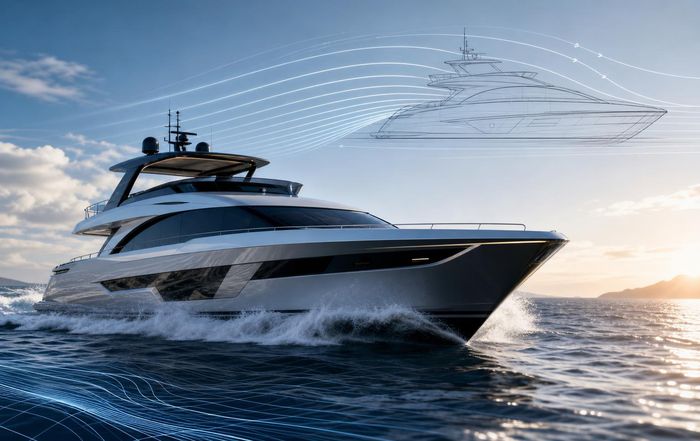
How Exterior Styling Shapes Yacht Performance
Yacht owners, designers and shipyards have long understood that a yacht's exterior is far more than an aesthetic statement. The sheer line that catches the light at sunset, the sweeping superstructure glazing that opens interiors to the sea, or the aggressive reverse bow that slices through a head sea all have a direct influence on how a yacht moves, how efficiently it uses energy, and how guests experience life on board. For freely, floating individuals travelling the world, this relationship between form and function is increasingly central to purchasing decisions, refit strategies and long-term asset value.
Modern naval architecture and computational tools have made it possible to quantify many of the performance impacts of exterior styling choices, from fuel burn and range to seakeeping and stability. At the same time, design trends driven by lifestyle expectations, charter demand and environmental regulation are reshaping the silhouettes of new builds from leading yards in Europe, North America and Asia. Understanding where style enhances performance and where it imposes compromises has become a key element of intelligent yacht ownership and project management.
This article explores how exterior styling shapes performance in practice, drawing on current industry developments, research from trusted technical bodies and the evolving portfolio of leading builders and designers.
The hydrodynamic foundations behind the lines
The starting point for any discussion of styling and performance is the underwater body. Naval architects emphasize that the hull form, rather than the superstructure, is the primary driver of resistance, seakeeping and propulsion efficiency. Yet above-water styling decisions inevitably cascade down to hull geometry, weight distribution and appendage layout, meaning that visual choices subtly reshape hydrodynamic performance.
Research published by RINA - The Royal Institution of Naval Architects and technical papers accessed through SNAME consistently show that relatively small changes in prismatic coefficient, bow entry angle or stern shape can lead to measurable differences in resistance and fuel consumption, particularly at semi-displacement and planing speeds. When an owner requests a dramatic plumb bow or an extended beach club platform, the design office must re-optimise the hull to preserve performance targets, which can involve iterative computational fluid dynamics (CFD) simulations and tank testing.
In practical terms, this means that the long, lean profiles currently favoured in many European yards are not simply an aesthetic response to automotive design trends, but also a way to increase waterline length relative to overall length, reduce wave-making resistance and improve pitch behaviour. Owners and project managers following developments on yacht-review.com/design.html will recognise how designers are using these tools to keep styling aligned with hydrodynamic fundamentals rather than allowing fashion to dictate performance.
Bow shapes: from clipper elegance to vertical efficiency
One of the clearest examples of styling influencing performance is the treatment of the bow. Traditional raked bows with overhangs were once associated with seakindly motion and classic elegance, while modern vertical or reverse bows are often perceived as aggressive and contemporary. The shift toward plumb and axe bows in both superyachts and large explorer vessels has been driven by more than visual preference.
A near-vertical bow allows the yacht to maximise waterline length relative to overall length, which typically improves efficiency at displacement speeds and can slightly increase top speed for a given power. Studies cited by DNV and other classification societies indicate that optimised vertical bows can reduce added resistance in waves and improve pitch response, particularly when combined with fine entries and carefully tuned flare. Many Northern European yards building high-latitude expedition yachts have adopted such bow geometries to enhance performance in challenging sea states.
However, the styling implications are considerable. A vertical bow alters the yacht's stance in profile, often requiring a more assertive superstructure line to maintain visual balance. It also changes deck layout forward, with less overhang and more exposure at the bow, which can affect anchoring operations and crew workflow. Designers such as Espen Øino, Winch Design and Feadship's in-house teams have invested significant effort in reconciling these technical advantages with the softer, more residential aesthetic many owners prefer. This is visible in recent projects that blend near-vertical stems with sculpted sheer lines and integrated foredeck lounges, illustrating how performance-driven bow styling can still feel inviting and luxurious.
Superstructure styling, windage and stability
Above the hull, superstructure styling has a direct effect on aerodynamic drag, windage and stability, all of which influence performance, comfort and safety. As yachts have grown in volume, with high freeboards and multiple deck levels to accommodate beach clubs, wellness centres and expansive owner suites, managing the performance penalties of increased topside area has become a priority.
A tall, slab-sided superstructure creates more windage, which can complicate close-quarters manoeuvring, increase side drift at low speeds and place higher demands on thrusters and dynamic positioning systems. Lloyd's Register and other classification societies have highlighted the importance of wind load assessments for large yachts, particularly when operating in marinas or restricted anchorages. Styling choices such as stepped decks, curved glazing and recessed balconies can reduce effective sail area and improve aerodynamic flow, resulting in more predictable handling and reduced loads on mooring equipment.
At the same time, every kilogram added high up in the superstructure affects the yacht's vertical centre of gravity and therefore stability. Panoramic glass, high ceilings and large overhangs are central to contemporary yacht styling, but they introduce weight and structural complexity. Naval architects must compensate with wider beams, deeper hulls or additional ballast, each with implications for resistance and fuel burn. Owners considering new builds or substantial refits can benefit from understanding these trade-offs, as decisions about exterior styling may require compromises in range, speed or internal volume.
For readers of the reviews, this interplay between superstructure styling and stability is increasingly evident in sea trial reports, where designers and shipyards highlight how they have used lightweight materials, advanced glazing systems and optimised structural layouts to deliver spacious, glass-rich exteriors without undermining seakeeping or comfort.
Windows, terraces and the performance cost of openness
The desire for seamless indoor-outdoor living has transformed yacht exteriors. Full-height windows, fold-down terraces and open stern platforms have become almost standard on new builds from major builders in the United States, Europe and Asia. This openness profoundly influences structure, weight and, indirectly, performance.
Large glazed surfaces require strong framing and occasionally thicker glass to meet class and flag requirements, especially on ocean-going yachts. This can add weight above the waterline, affecting trim and stability. Moreover, openings in the hull and superstructure must be carefully reinforced, which can lead to localised increases in structural mass. Naval architects working with leading yards such as Benetti, Heesen, Sanlorenzo and Feadship have adopted finite element analysis (FEA) to fine-tune these structures, allowing for expansive glazing while keeping weight under control.
From a hydrodynamic perspective, side terraces and beach club doors may introduce discontinuities in the hull shell that, if not faired correctly, could contribute to additional drag. However, with modern construction techniques and careful detailing, these effects can be minimised. The more significant performance impact often comes from the way such features change weight distribution and encourage lifestyle-driven equipment choices, such as larger tenders, water toys and gym installations, all of which must be accounted for in the yacht's weight budget.
Owners and captains evaluating new designs or refits can gain insight into these issues by following technical discussions on yacht-review.com/technology.html, where the relationship between structural innovation, glazing and performance is a recurring theme.
Stern design, beach clubs and wake behaviour
Perhaps the most visually transformative styling trend of the last decade has been the evolution of the stern. Traditional transoms have given way to multi-level beach clubs, open stern platforms and cascading steps down to the water. This change has strong lifestyle appeal, especially for charter-focused yachts, but it also has consequences for hydrodynamics, wake patterns and efficiency.
From a performance perspective, the stern is critical to how water flows off the hull and how the yacht's wake develops. Extended swim platforms and low transoms can increase wetted surface area at certain speeds, potentially increasing viscous resistance. On fast planing yachts, poorly integrated platforms can disturb transom flow, affecting trim and top speed. Naval architects use CFD and scale model testing to adjust the shape and immersion of these platforms, seeking a balance between usability at anchor and clean flow at speed.
On larger displacement and semi-displacement yachts, the integration of a beach club often leads to a fuller stern shape, which can increase internal volume and improve low-speed efficiency but may affect stern wave formation. Some yards have addressed this by adopting "cutaway" or "notched" sterns that preserve a clean run while accommodating generous beach clubs above the waterline. The resulting profiles can be visually striking, with strong horizontal lines that emphasise the yacht's length and connection to the sea.
Wake behaviour is increasingly relevant not only for comfort on board but also for environmental and regulatory reasons. Sensitive coastal regions and inland waterways, particularly in North America and parts of Europe, may impose wake-related speed limits or operating constraints. Thoughtful stern styling that manages wake height and energy can therefore contribute to more flexible cruising itineraries and lower local impact, aligning with broader sustainability objectives discussed on sustainability.
Materials, coatings and the hidden performance of surfaces
Exterior styling is not limited to geometry; it also encompasses material choices, finishes and surface treatments, all of which can influence performance in subtle but meaningful ways. The use of lightweight composites, aluminium and advanced steels allows designers to create bold, sculpted exteriors without excessive weight penalties, which in turn supports higher speeds, longer range or greater comfort.
Research published by ABS - American Bureau of Shipping and others has examined how composite superstructures on steel hulls can reduce mass high up in the vessel, improving stability and allowing more ambitious exterior forms. This hybrid approach is now common in large yachts, particularly in European yards, and has enabled the dramatic overhangs, multi-deck glazing and complex curves seen in many recent deliveries.
Surface coatings also play a role in performance. High-quality fairing and paint systems reduce surface roughness, which can marginally decrease resistance, while modern antifouling coatings are designed to minimise biofouling and maintain a smoother hull over longer intervals. Studies referenced by IMO in the context of greenhouse gas reduction highlight that well-maintained hull coatings can reduce fuel consumption by several percent over a typical operational profile, a non-trivial saving on large yachts.
From a styling perspective, the ability to achieve mirror-like finishes, deep metallic colours and complex graphics has expanded creative possibilities. However, darker hull colours may absorb more solar radiation, increasing cooling loads in warmer climates, while certain finishes may require more frequent maintenance to preserve their appearance and hydrodynamic smoothness. Owners who prioritise performance and low operating costs often consult with builders and independent surveyors to choose exterior treatments that balance visual impact with long-term efficiency, an approach that aligns with the practical guidance frequently shared on yacht-review.com/business.html.
Aerodynamics, comfort and noise
While hydrodynamics usually dominate discussions of performance, aerodynamics are increasingly important as yacht exteriors become more architectural and as cruising speeds rise in the semi-displacement and planing segments. Wind tunnel testing and CFD analyses of airflow around superstructures reveal how styling choices affect not only drag but also comfort on deck and even interior noise levels.
A well-shaped superstructure can guide airflow smoothly over the yacht, reducing turbulence and wind noise around exterior lounges and dining areas. Conversely, abrupt changes in section, large overhangs and complex mast structures can create eddies and buffeting, which may make certain decks less comfortable at speed or in strong winds. On high-speed yachts, aerodynamic lift and side forces can also influence handling, especially in quartering winds, making streamlined profiles and carefully faired hardtops more than just a visual preference.
Technical articles from Boat Design Net and similar forums where professional naval architects participate show that some design teams now treat aerodynamics as a core part of the exterior styling process, particularly for yachts exceeding 20 knots. This attention to airflow can also improve the efficiency of HVAC systems by reducing unwanted air ingress and pressure differentials, thereby contributing indirectly to lower energy consumption and quieter, more stable interior environments.
For readers exploring cruising-focused content on cruising, these aerodynamic considerations translate into more pleasant passages, less noise fatigue and more usable deck spaces underway, underscoring how styling decisions resonate with day-to-day onboard experience.
Performance, lifestyle and the owner brief
Exterior styling is ultimately the physical expression of an owner's priorities, whether that is speed, range, entertainment, exploration or understated elegance. Each priority implies a different performance profile, and successful projects are those where the styling team and naval architects collaborate closely from the earliest stages to align the yacht's appearance with its intended mission.
Owners focused on Mediterranean or Caribbean day boating, for example, may gravitate towards low-profile, open or semi-open yachts with aggressive lines and expansive aft decks, accepting higher fuel consumption and more limited interior volume in exchange for speed and lifestyle. In contrast, long-range cruisers heading for higher latitudes or remote archipelagos often prefer more enclosed superstructures, higher bows and robust, expedition-style exteriors that signal capability and seaworthiness, even if that means a less overtly glamorous silhouette.
The most sophisticated projects, particularly at the top end of the market in the United States and Europe, now treat exterior styling as part of a holistic design and operational strategy. Builders and design studios such as Lürssen, Oceanco, Feadship, Benetti and Sunseeker increasingly present potential clients with performance-validated design options, supported by CFD, tank testing and detailed weight studies, rather than purely visual renderings. Owners and representatives who follow yacht intelligence and market coverage on yacht-review.com/news.html can see this trend in the way new projects are announced, with greater emphasis on efficiency, range and environmental performance alongside styling.
Sustainability, regulation and the future of exterior form
Environmental regulation and evolving social expectations are adding new dimensions to the relationship between styling and performance. As the International Maritime Organization and regional authorities push for lower emissions and greater energy efficiency, exterior design must increasingly support, rather than hinder, sustainable operation.
Streamlined hulls with efficient bows, optimised sterns and reduced superstructure windage all contribute to lower fuel consumption, which in turn reduces greenhouse gas emissions. Features such as integrated solar panel surfaces, optimised shading to reduce cooling demand and provisions for alternative fuels are beginning to influence exterior styling, particularly on concept designs and forward-looking projects. Learn more about sustainable business practices and regulatory trends through organisations such as the World Ocean Council, which engages maritime industries, including yachting, on ocean stewardship.
Many leading shipyards now publish data on fuel consumption and emissions under standardised operating profiles, and some are exploring independent verification or alignment with frameworks inspired by commercial shipping's Energy Efficiency Design Index. Exterior styling that visibly communicates efficiency and responsibility, without sacrificing elegance, can enhance a yacht's reputation and charter appeal, particularly among younger, sustainability-conscious clients. This aligns closely with the editorial focus of global, where the global context of yachting, from environmental impact to coastal community relations, is increasingly in view.
Learning from history while looking forward
The interplay between styling and performance is not new; it is woven through the history of yacht design, from the fine entries and long overhangs of early racing cutters to the beamy, high-volume motor yachts of the late twentieth century. Historical perspectives, such as those highlighted on history, reveal cycles in which fashion temporarily overrode performance, only for practical experience and advances in naval architecture to restore balance.
Today's environment is distinguished by vastly more powerful design tools, more demanding regulatory frameworks and a far more informed client base. Owners, captains and project managers can now interrogate performance data, compare CFD results and draw on a global community of expertise when making styling decisions. This transparency encourages solutions where beauty and efficiency are mutually reinforcing rather than opposing goals.
As new technologies such as hybrid propulsion, advanced foils, air lubrication systems and energy recovery devices mature, they will open further avenues for exterior styling to influence performance. Foil-assisted yachts, for example, may adopt specific hull and superstructure geometries to optimise lift and minimise spray, while air lubrication systems may benefit from particular hull surface treatments and chine configurations. Coverage of these developments on yacht-review.com/boats.html and technology will continue to highlight how exterior form and technical innovation evolve together.
A more informed approach to beauty and speed
For the business-oriented audience of yacht-review.com, the key insight is that exterior styling is a strategic variable with direct implications for performance, operating costs, charter potential and long-term asset value. Decisions about bow shape, superstructure height, glazing, terraces, stern configuration and material finishes are not merely matters of taste; they are design levers that can either enhance or undermine the yacht's mission profile.
Owners who engage early with both stylistic and technical teams, request performance-backed design options and remain open to subtle adjustments in profile or detailing often achieve yachts that are not only visually compelling but also efficient, comfortable and future-resilient. Brokers, family offices and project managers who understand these dynamics are better placed to guide clients toward intelligent investments, whether commissioning a new build, selecting a series model or planning a performance-oriented refit.
As global yachting continues to expand into new cruising grounds and as expectations around sustainability, comfort and connectivity rise, exterior styling will remain at the forefront of innovation. The most successful yachts will be those where every line, surface and proportion serves both beauty and performance, delivering the kind of inspiring, ocean-connected lifestyle that defines the very best of the industry and that Yacht Review is committed to documenting across its lifestyle and travel coverage.