

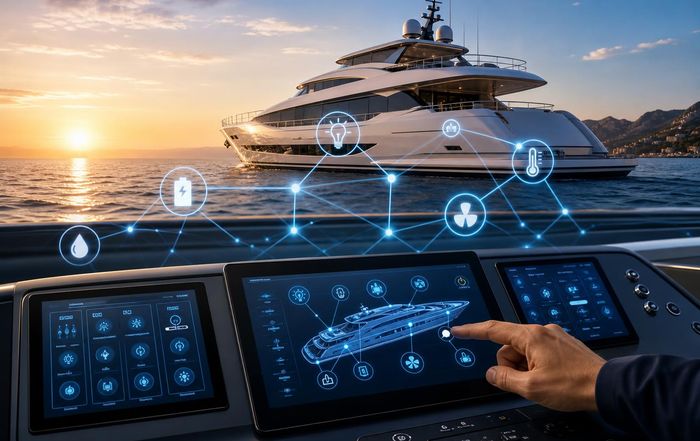
How Digital Switching Simplifies Yacht Systems
Digital switching has moved from being a niche innovation to an increasingly standard feature on new yachts, reshaping how owners, captains and crew interact with onboard systems. Where traditional yachts relied on sprawling breaker panels, mechanical switches and complex wiring looms, contemporary vessels are progressively adopting networked power distribution, touchscreen interfaces and intelligent control logic. For the boat loving audience here, this transition is not merely a technological curiosity; it is a practical evolution that changes how yachts are designed, operated, maintained and ultimately enjoyed.
From Mechanical Panels to Networked Intelligence
For decades, yacht electrical systems were built around analogue switchboards and breaker panels, often located in engine rooms or behind helm consoles. Each circuit required its own physical switch and breaker, leading to extensive wiring runs, substantial weight and limited flexibility. Troubleshooting faults could be time-consuming, and adding or modifying circuits typically demanded invasive rewiring.
Digital switching, sometimes referred to as distributed power or digital power management, replaces many of these mechanical components with electronically controlled circuit breakers and relay modules connected over a data network, commonly using protocols such as CAN bus. Systems from companies such as Garmin (via its EmpirBus technology), Raymarine, CZone (part of Mastervolt and the Brunswick Corporation group), and ABB in the broader marine and industrial sectors, illustrate the trend toward intelligent, software-configurable distribution and monitoring.
Top engaged readers can explore broader developments in marine electronics through sources such as Garmin Marine and Raymarine, which both highlight digital switching integration in their current helm solutions.
By shifting control from discrete hardware to networked modules, digital switching allows yacht builders and integrators to centralize user interfaces, decentralize power distribution and embed logic that was previously impossible or prohibitively complex using mechanical components alone.
Core Principles of Digital Switching on Yachts
The essence of digital switching lies in separating the user interface from the physical switching hardware. Instead of a direct mechanical connection between a switch and a load, a low-current digital command is sent over a network to a module that controls the circuit. This architecture enables several defining characteristics.
First, it allows multiple user interfaces to control the same systems. A cabin light, for example, can be operated from a wall keypad, a helm touchscreen, a smartphone app or even an automation routine such as "night mode," all without duplicating heavy-gauge wiring. Second, it supports sophisticated logic, so that a single command can trigger a sequence of actions-lowering blinds, dimming interior lights, switching navigation lights and adjusting air conditioning settings in one operation.
The trend is visible in production and custom yachts alike. Builders such as Sunseeker, Princess Yachts, Azimut-Benetti, Ferretti Group brands and several North American manufacturers have worked with digital switching suppliers to streamline helm layouts and reduce wiring complexity, while high-end custom yards in Northern Europe and Italy increasingly specify fully integrated power management from the design phase. For a sense of how these systems are evaluated from an owner's perspective, readers may wish to review comparative assessments in the yacht-review.com reviews section, where ease of use and system integration are recurring themes.
Simplifying Day-to-Day Operation for Owners and Crew
From the user's standpoint, the most visible benefit of digital switching is operational simplicity. Instead of navigating multiple breaker panels and unlabeled switches, owners encounter clear, graphical interfaces that group functions logically by zone or activity. A single touchscreen at the main helm can present pages for interior lighting, exterior lighting, pumps, entertainment systems and hotel loads, with context-sensitive controls and status indicators.
Digital switching systems can present feedback that analogue panels could not easily convey. A crew member can see at a glance whether a circuit is on, off, faulted or in an alarm state, and in many cases can view current draw, voltage and historical data. When coupled with integrated monitoring platforms, such as those supported by NMEA-based networks and marine automation providers, this information can be displayed on multifunction displays, dedicated panels or remote devices. The National Marine Electronics Association provides useful background on the standards that underpin many of these integrations.
For charter operations and owner-operators, this clarity reduces the learning curve. Preset modes-such as "dock," "cruise," "at anchor," or "night passage"-can be configured so that complex sequences are reduced to a single touch. A captain bringing guests back to the yacht after dinner can select an "arrival" scene that activates passerelle lighting, soft interior illumination and stabilizer readiness without manual intervention on each circuit. On smaller yachts and express cruisers, where the owner often serves as skipper, such simplification can be decisive in making the vessel feel manageable rather than overwhelming.
At yacht-review.com, feedback from owners interviewed for our cruising features frequently emphasizes the sense of confidence that comes from knowing that critical systems are clearly labeled, logically grouped and accessible both at the helm and, increasingly, via mobile devices when on board.
Design Freedom and Cleaner Aesthetics
Digital switching is not only about convenience; it also has profound implications for yacht design. Traditional switchboards consume significant space and constrain where controls can be located. By contrast, digital switching allows designers to replace large panels with slim keypads, touchscreens or integrated helm displays, freeing prime real estate for navigation equipment, storage or aesthetic treatments.
Interior designers gain flexibility to place lighting and climate controls in visually discreet locations, while still providing intuitive access. Because the heavy-gauge power wiring terminates at local distribution modules, low-voltage data cables can run to keypads and user interfaces, reducing both visual clutter and the need for large conduits in finished spaces.
Naval architects and engineers also benefit from the ability to optimize cable runs. Distributed power modules can be located near clusters of loads-such as in the forepeak for windlass and bow thruster, or in the flybridge structure for overhead lighting and navigation equipment-minimizing cable lengths and reducing voltage drop. This can be particularly advantageous on larger yachts, where runs from a central switchboard to far-flung consumers can be long and complex.
The design community's enthusiasm for this flexibility is reflected in trade discussions and case studies shared by organizations such as Boat International and Superyacht Times, which often highlight the role of integrated electrical and digital systems in enabling cleaner, more contemporary interiors and helms. For readers interested in how these capabilities translate into concrete design choices, the yacht-review.com design section regularly examines helm ergonomics and interior control layouts in new model reviews.
Weight Reduction, Efficiency and Sustainability
While owners tend to notice the user interface first, naval architects and yard management often focus on weight and efficiency. By reducing the number and length of heavy-gauge cables and consolidating traditional switchgear, digital switching can deliver meaningful weight savings, especially on larger yachts with extensive electrical systems. Manufacturers and yards have reported reductions in wiring weight and complexity in case studies, although the exact numbers vary by vessel and cannot be generalized without specific data.
Weight savings contribute directly to fuel efficiency and performance, particularly on planing hulls where every kilogram influences acceleration and top speed. Even on displacement and semi-displacement yachts, lower weight can marginally improve range and reduce fuel burn. Combined with optimized power distribution and better monitoring of loads, digital switching helps owners and captains make more informed decisions about generator use, battery management and shore power consumption.
This aligns with a broader industry movement toward more sustainable yachting practices, from hybrid propulsion to advanced energy management. Initiatives highlighted by organizations such as Water Revolution Foundation and the sustainability programs covered by SuperyachtNews underscore the importance of intelligent systems in reducing environmental impact. Readers looking to place digital switching within this wider context may find additional perspectives in the yacht-review.com sustainability coverage, where energy-efficient systems and responsible cruising practices are recurring themes.
Integration with Navigation, Monitoring and Lifestyle Systems
One of the most powerful aspects of digital switching is its capacity for integration. Modern yachts are already dense with electronics: navigation systems, engine and generator monitoring, tank level sensors, security systems, entertainment networks and, increasingly, connectivity platforms. Digital switching acts as a bridge between these domains, enabling coordinated behavior.
On an integrated bridge, a multifunction display can show electrical status alongside navigation data. If a generator load approaches its limit, non-critical consumers can be shed automatically, or the crew can be alerted to start an additional generator. When a yacht switches from shore power to generator or battery mode, certain loads can be prioritized or limited to prevent overloads. When integrated with navigation lights and safety systems, digital switching can enforce rules-based behavior, such as preventing conflicting light configurations or ensuring that bilge pumps remain powered even when other circuits are switched off.
Lifestyle systems also benefit from this integration. Entertainment zones, HVAC, blinds and lighting can be orchestrated through digital scenes that reflect how owners actually use their yachts: relaxing at anchor, entertaining on the aft deck, or working remotely from a main-deck office. As connectivity solutions from providers such as KVH and Inmarsat Maritime continue to improve, remote monitoring and, in some cases, remote control of digital switching systems have become more feasible, subject to appropriate security and safety constraints.
Within the yacht-review.com technology section, the interplay between digital switching, navigation electronics and onboard connectivity is an increasingly important topic, as owners seek seamless experiences that mirror the smart-home environments they enjoy ashore.
Safety, Diagnostics and Proactive Maintenance
Safety and reliability are paramount in any marine context, and digital switching has introduced new tools for managing risk and maintenance. Electronic circuit protection can respond faster and more precisely than traditional breakers in certain fault conditions, and systems can log events to aid in root-cause analysis. When a breaker trips, the crew can see not only that the circuit is off, but also information about the reason, duration and frequency of similar events.
Many digital switching platforms provide centralized alarm management, consolidating alerts from bilge pumps, tank levels, battery systems and other sensors. Instead of scattered indicator lights and buzzers, alarms can be prioritized and displayed with context, guiding the crew's response. In some installations, remote diagnostics allow shipyards or service partners to review system data and advise on corrective actions without needing to be physically on board.
Organizations such as Lloyd's Register and DNV have published guidance on integrated bridge and automation systems, emphasizing the importance of redundancy, fail-safe behavior and clear human-machine interfaces. While digital switching itself is typically only one component of a yacht's automation environment, its growing centrality means that classification societies and flag states are increasingly attentive to its design and implementation.
For owners and managers, this translates into a new approach to maintenance. Rather than reacting to visible failures, engineers can track trends in current draw, temperature and breaker behavior, identifying components that may be degrading before they fail outright. In the yacht-review.com business section, such predictive maintenance capabilities are often discussed in terms of lifecycle cost reduction and improved charter reliability, as fewer unplanned outages mean higher guest satisfaction and better utilization.
Implications for Builders, Refit Yards and the Supply Chain
The shift to digital switching has strategic implications for yacht builders and refit yards. Implementing these systems effectively requires close collaboration among naval architects, electrical engineers, system integrators and equipment suppliers. Shipyards need to invest in training, design tools and documentation to ensure that digital switching is not simply an add-on but a fully integrated part of the vessel's architecture.
In the new-build segment, this has led to partnerships between yards and electronics manufacturers, with some builders offering branded helm and automation packages that integrate digital switching, navigation, propulsion and monitoring under a unified interface. The aim is to deliver a cohesive user experience and streamline support. In refit projects, digital switching can be a powerful way to modernize older yachts, especially when combined with helm upgrades, LED lighting retrofits and new entertainment systems, although space constraints and legacy wiring can make such projects complex.
The supply chain has also evolved. Component manufacturers must meet marine standards for vibration, temperature and corrosion, while ensuring long-term availability and support. Owners and captains increasingly ask about the future-proofing of digital systems, including software updates, backward compatibility and the risk of vendor lock-in. These concerns have prompted some integrators to emphasize open architectures and adherence to widely adopted standards, while still offering the bespoke customization expected in the yachting sector.
Coverage in industry outlets such as Marine Electronics Journal and IBI - International Boat Industry highlights both the opportunities and the challenges facing businesses that embrace digital switching. On yacht-review.com, our news coverage continues to track product launches, strategic partnerships and notable refit projects that demonstrate how the technology is maturing.
Owner Experience, Lifestyle and the Human Element
Despite the technical nature of digital switching, its ultimate measure of success is the human experience on board. Yacht owners increasingly expect the same intuitive, app-driven control they enjoy in their homes, cars and offices. Digital switching makes it possible to deliver that familiarity, with clear icons, customizable scenes and responsive controls that feel modern rather than mechanical.
For families and guests, this can translate into a more relaxed and enjoyable time on board. Instead of calling crew to adjust lighting or climate settings, guests can operate clearly labeled keypads or simple interfaces in their cabins. For owner-operators, the sense of mastering their vessel without being overwhelmed by complex panels and cryptic labels is often a decisive factor in how frequently and confidently they use the yacht.
From a lifestyle perspective, digital switching supports the growing trend toward multi-purpose spaces. A main salon can shift from a bright, open daytime environment to a cinema-like evening setting with a single command, coordinating lighting, blinds and audiovisual systems. On explorer-style yachts, where long-range travel and self-sufficiency are priorities, the ability to monitor and manage onboard resources closely can enhance both comfort and safety over extended passages.
These themes are reflected in the stories and profiles featured in the yacht-review.com lifestyle section, where owners and designers often describe how smart systems help align the onboard environment with personal habits, work routines and leisure preferences.
Challenges, Cybersecurity and the Path Ahead
While the advantages of digital switching are substantial, the transition is not without challenges. Increased reliance on software and networks introduces new failure modes and requires careful attention to redundancy and cybersecurity. A well-designed system will provide manual overrides for critical circuits, independent power supplies for essential controls and clear procedures for reverting to safe modes in the event of a network or processor failure.
Cybersecurity has become a growing concern for connected yachts, particularly in the superyacht segment where privacy and security are paramount. Guidance from organizations such as IMO and classification societies emphasizes the need to protect onboard networks from unauthorized access, which includes ensuring that remote access to digital switching and automation systems is appropriately secured. While incidents specifically involving digital switching remain relatively rare in public reports, the broader trend toward networked vessels underscores the importance of robust design and ongoing vigilance.
Another challenge lies in change management. Crew accustomed to traditional panels may need training to feel comfortable with touchscreen-based systems and diagnostic tools. Documentation, clear labeling and intuitive interface design are critical to ensuring that digital switching truly simplifies operations rather than introducing new complexity. Owners should work with builders and integrators to ensure that handover processes include thorough familiarization and that ongoing support is readily available.
Despite these considerations, the trajectory of adoption suggests that digital switching will continue to spread from larger custom yachts into mid-size production boats and even smaller segments. As costs decrease and integration with navigation and monitoring systems becomes more standardized, the value proposition becomes increasingly compelling.
For people following the evolution of yacht systems globally, the yacht-review.com global section provides a broader completely independent perspective on how different markets and regions are adopting digital technologies, from North American production builders to European custom yards and emerging Asian manufacturers.
Digital Switching as a Foundation for the Next Generation of Yachting
Digital switching is best understood not as an isolated feature but as a foundational layer in the ongoing digitalization of yachting. It underpins smarter energy management, more integrated bridges, enhanced comfort and more efficient operations. When combined with advances in hybrid propulsion, battery technology, connectivity and automation, it forms part of a cohesive vision in which yachts are more responsive to their owners, more efficient in their use of resources and easier to operate safely.
For the hard-working team at yacht-review, evaluating a new yacht now invariably includes assessing how its digital switching and automation systems contribute to the overall experience. Readers exploring our often daily updated boats overview and travel features will find that the most compelling cruising narratives increasingly involve vessels where technology quietly supports, rather than dominates, life on board.
As the industry continues to innovate, the guiding principle remains clear: technology should simplify, not complicate. When thoughtfully specified, carefully integrated and well supported, digital switching achieves precisely that, transforming complex electrical architectures into intuitive, reliable and adaptable systems that allow owners, captains and crew to focus on what matters most-the enjoyment of time at sea.