

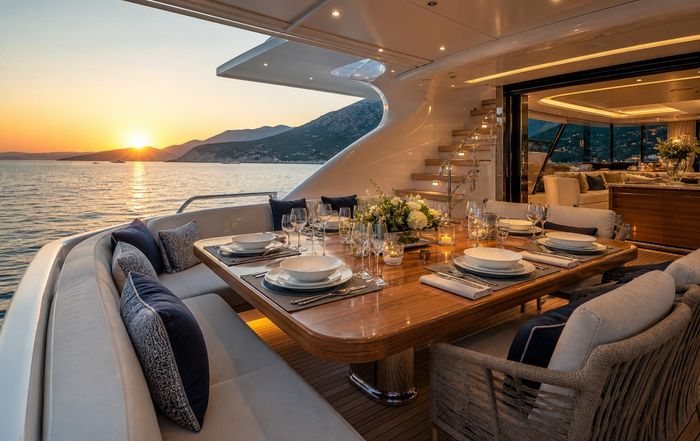
Dining Afloat: Better Layouts for Yacht Entertaining
Designing a yacht for memorable entertaining has become a central priority for many owners, charter clients, and builders, and dining is increasingly at the heart of that experience. Across the fleet, from compact 20-metre family cruisers to 100-metre-plus superyachts, naval architects and interior designers are rethinking how guests gather, eat, and socialize on board. For the experienced team at Yacht Review, which has followed these developments closely through detailed yacht reviews and design coverage, the shift is clear: dining afloat is no longer an afterthought squeezed into a formal saloon, but a defining element of the onboard lifestyle.
This evolution is driven by several converging trends. Owners are spending more time on board, charters are increasingly experience-led, and the global hospitality industry is setting new benchmarks in culinary theatre, wellness, and sustainability that clients expect to see reflected at sea. At the same time, advances in naval architecture, space planning, and marine technology have opened new possibilities for layouts that would have been difficult to execute reliably a decade ago. The result is a new generation of yachts where dining areas are more flexible, more connected to the sea, and more attuned to the rhythms of modern entertaining.
From Formal Saloon to Fluid Social Hub
Traditional yacht layouts typically reserved a single, formal dining table within the main deck saloon, often separated from the aft cockpit and somewhat detached from the open air. This arrangement reflected a more hierarchical, dress-code-driven form of entertaining that mirrored grand hotels and private residences of the late twentieth century. While such spaces still have their place, particularly on larger yachts with diplomatic or corporate roles, the current preference in many markets is for informal, fluid spaces that can transition seamlessly from breakfast to business lunch to cocktail party.
Design studios such as Winch Design, RWD, and Nuvolari Lenard have publicly discussed how their clients now ask for dining areas that are less about ceremony and more about connection, both with fellow guests and with the surrounding environment. Coverage in publications like Boat International and SuperYacht Times has highlighted projects where the main deck dining table is no longer a fixed, dominant object but part of a flexible ensemble of seating and lounging options. In many recent deliveries, glass sliding doors, fold-out terraces, and open-plan layouts allow the aft deck, main saloon, and dining zone to operate as a single continuous entertaining space when desired.
For readers of yacht-review.com, this shift is particularly evident in the way newer models are evaluated in our boats section, where the emphasis often falls on how well the yacht supports real-world use: casual meals, multi-generational gatherings, and relaxed evenings at anchor. Layouts that allow guests to circulate freely between interior and exterior zones, without feeling constrained to one formal table, score highly among owners and charterers alike.
The Rise of Indoor-Outdoor Dining Decks
The most significant transformation in yacht entertaining layouts has arguably come from the reimagining of the aft decks and upper decks as multi-purpose, indoor-outdoor dining platforms. Yacht yards such as Feadship, Lürssen, Benetti, and Sanlorenzo have all launched models in recent years where glass is used more expansively, deck overhangs are carefully calibrated for shade and weather protection, and wind protection is subtly integrated to make al fresco dining comfortable in a wider range of conditions.
Articles from SuperyachtNews and BOAT International have pointed to the growing popularity of "winter gardens" or convertible aft saloons, which can be fully enclosed in poor weather or opened wide in fair conditions. On these decks, dining tables often sit at the nexus of interior and exterior, with sliding glass panels, overhead louvres, and climate control systems enabling the crew to adjust the ambience quickly. This architectural approach extends the usable dining season in cooler regions such as Northern Europe or the Pacific Northwest, while also providing welcome shade and ventilation in the Mediterranean, Caribbean, and South Pacific.
For those planning cruising itineraries, the flexibility of these dining decks is particularly attractive. A yacht might host a formal, fully enclosed dinner while transiting cooler waters, then open the same space for a breezy, informal lunch at anchor in a tropical bay. Owners and charter guests benefit from a sense of continuity and familiarity, while the crew gains a versatile platform that can accommodate different styles of service without constant reconfiguration. At yacht-review.com, this trend is frequently discussed in our cruising coverage, where the interplay between layout and lifestyle is a recurring theme.
Multi-Level Entertaining and the New Role of the Sundeck
As yachts have grown in both length and gross tonnage, the vertical dimension has become increasingly important. The sundeck, once dominated by sunpads and perhaps a modest bar, has evolved into a fully fledged entertaining and dining level, often with its own galley support, bar, and even teppanyaki or barbecue stations. On many recent launches, the sundeck dining area is now one of the most coveted spots on board, offering panoramic views and a relaxed, resort-style atmosphere.
Shipyards and designers have responded by refining the way these upper decks are protected and serviced. Hardtops with retractable sections, glass windbreaks, and carefully positioned staircases help mitigate wind and sun exposure while preserving views. Coverage by Yachting Magazine and Boat International has shown how new models integrate dining tables that can expand or contract depending on guest numbers, while freestanding furniture allows the layout to be adapted for cocktail parties, family-style brunches, or more intimate dinners.
For the team at yacht-review.com, this multi-level approach to entertaining is particularly relevant when assessing how a yacht supports different modes of use, from owner-only cruising to high-end charter. Our lifestyle features frequently highlight yachts where the sundeck, bridge deck aft, and main deck aft each offer distinct yet complementary dining experiences, allowing guests to choose the setting that best suits the time of day, weather, and occasion.
Galley Placement and the Theatre of the Open Kitchen
Another key evolution in yacht dining layouts concerns the galley, which has traditionally been tucked away in the lower decks or discretely behind service corridors. While this arrangement still makes sense for many operational profiles, especially on larger yachts where crew separation and logistics are paramount, a growing number of owners are embracing the concept of the show kitchen or open galley, inspired by trends in land-based hospitality.
High-profile chefs working in yachting, some of whom have been profiled by The World's 50 Best Restaurants and Condé Nast Traveler, have noted that guests increasingly enjoy watching dishes being prepared and interacting with the culinary team. On some recent yachts, particularly in the explorer and crossover segments, designers have introduced semi-open galleys on the main deck or upper deck, where a chef can present tasting menus, cooking demonstrations, or casual breakfasts around a central island.
From a technical standpoint, this requires careful attention to ventilation, noise control, and safety, and leading classification societies such as Lloyd's Register and DNV provide guidance on the integration of commercial-grade equipment in guest areas. Nevertheless, when executed well, an open galley can become a powerful social magnet, transforming dining from a static experience into a dynamic, participatory event. For readers exploring yacht design concepts, our design section offers deeper insight into how galleys are being reimagined as part of the broader spatial narrative on board.
Flexible Furniture and Transforming Spaces
Underlying many of the most successful dining layouts is a sophisticated approach to furniture and spatial flexibility. Rather than relying solely on a single, fixed table, designers are increasingly using modular, extendable, and convertible pieces that allow the crew to reconfigure spaces quickly and without excessive effort. Tables that can adjust in height and length, banquettes with integrated storage, and chairs designed to stack or nest discreetly are now common on both custom and semi-custom yachts.
Reports from major furniture houses and superyacht outfitting specialists, often covered by Boat International and SuperYacht Times, highlight how marine-grade materials and lightweight construction techniques have enabled more ambitious furniture concepts. On some yachts, a lounge area can be transformed into a dining space for twelve within minutes, or a breakfast nook can convert into a bar area for evening events. This level of adaptability is particularly valuable on yachts in the 24-40 metre range, where every square metre must work hard to support multiple functions.
For those who follow our in-depth reviews, it is evident that the most successful yachts in this size bracket are those where the design team has anticipated the full range of social scenarios the owner may wish to host, and has provided furniture solutions that do not compromise comfort or aesthetics when reconfigured. The best examples feel intuitive to use, with crew able to make changes discreetly and efficiently, preserving the sense of effortless hospitality that high-end yachting demands.
Regional Influences and Cultural Expectations
Dining customs vary significantly across regions and cultures, and successful yacht layouts increasingly reflect this diversity. Owners from Mediterranean countries may prioritize long, leisurely lunches outdoors, with large tables that can accommodate extended family and friends, while clients from Northern Europe or North America might place greater emphasis on sheltered dining with robust climate control. In Asia, where shared dishes and circular tables are common, designers have responded with layouts that support family-style service and wider circulation space around the dining area.
Market analyses from organizations such as Wealth-X and Knight Frank, along with industry insights published by SuperyachtNews, suggest that as the client base for large yachts becomes more global, there is growing demand for culturally adaptable spaces. For example, some yachts now incorporate both Western-style formal dining and more casual, lounge-like settings that can be used for tea ceremonies, informal business meetings, or family gatherings. This adaptability extends beyond furniture to include lighting, acoustics, and even the integration of technology for presentations or remote conferencing.
At yacht-review.com, this global perspective is reflected in our travel and global coverage, where the interplay between regional cruising grounds, cultural expectations, and onboard entertaining is examined in detail. Owners and charterers planning itineraries that span continents benefit from layouts that can shift gracefully between different modes of dining and hospitality, ensuring that guests from varied backgrounds feel at ease and well catered for.
Sustainability and Conscious Entertaining
Sustainability has become an increasingly important consideration in yacht construction and operation, and dining layouts are not immune to this broader shift. Owners and charter guests are more aware than ever of the environmental impact of their choices, and many expect their onboard experience to align with the principles of responsible luxury. This can be seen in several aspects of dining design and operation, from the sourcing of ingredients to the materials used in furniture and tableware.
Leading classification societies and industry bodies, including the Water Revolution Foundation, have promoted best practices for reducing environmental impact in yachting, and many shipyards have responded with initiatives to improve energy efficiency and reduce waste. In the context of dining, this may involve designing galleys and storage areas that support more efficient provisioning, enabling the use of fresh, local produce with minimal packaging, or integrating advanced refrigeration and waste management systems that reduce food waste.
Owners who are particularly committed to sustainability may request layouts that support plant-forward menus, onboard herb gardens, or partnerships with local suppliers in cruising destinations. Such choices often require thoughtful planning of storage, preparation areas, and serving flows. Readers interested in how these trends intersect with yacht design can explore our dedicated good news sustainability section, where the relationship between responsible practices and onboard lifestyle is examined in a business-focused context. External resources such as UNEP and OECD also provide broader frameworks for those who wish to learn more about sustainable business practices that can inform decisions in yachting.
Technology-Enhanced Dining Experiences
Technology has quietly transformed many aspects of life on board, and dining is no exception. Beyond the obvious integration of high-end galley equipment, there is now a sophisticated layer of digital infrastructure that supports everything from climate control and lighting to audio-visual ambience and service coordination. Smart control systems allow crew to adjust lighting scenes, temperature, and music at the touch of a tablet, helping to create distinct moods for breakfast, lunch, and dinner without disrupting guests.
Reports from The Superyacht Group and technical briefings by companies such as Crestron and Control4 describe how integrated systems can link dining areas to the yacht's broader network, enabling, for example, synchronized lighting across multiple decks during an event, or discreet communication between service staff to ensure a seamless flow of courses. On some yachts, hidden screens and projectors can turn a dining area into a presentation space or cinema, particularly valuable for corporate charters or owner business use.
From a design perspective, the challenge is to integrate this technology without compromising the elegance and warmth that guests expect from a high-end dining environment. At yacht-review.com, technology is frequently examined through a lifestyle lens in our new technology features, where the focus is on how innovations enhance the human experience on board rather than becoming an end in themselves. When thoughtfully applied, technology can support more precise climate control for comfort, reduce noise from mechanical systems, and enable more efficient service, all of which contribute to a more enjoyable dining experience.
Charter Considerations: Layouts that Work for Many Guests
The charter market exerts a powerful influence on yacht design, and dining layouts are a prime example. A yacht that will spend significant time on charter must be able to accommodate a wide range of guest profiles, from families with children to corporate groups and special-occasion parties. This places a premium on flexibility, circulation, and service logistics, as well as on aesthetic choices that feel welcoming and neutral enough to suit different tastes.
Charter brokers and management companies, including those covered regularly by Fraser, Burgess, and Northrop & Johnson, consistently emphasize the value of multiple dining options: a formal interior table, at least one substantial exterior dining area, and ideally a more casual or shaded spot for snacks and informal meals. The ability to host themed dinners, cocktail receptions, and even small-scale live music events can significantly enhance a yacht's appeal in a competitive charter market.
For owners and investors considering charter as part of their ownership strategy, the business case for well-conceived dining layouts is compelling. A yacht that photographs well, offers clear zones for different types of entertaining, and allows crew to deliver high-quality service without congestion or backtracking is more likely to achieve strong booking rates and positive guest feedback. At yacht-review.com, our recent business coverage often explores how design decisions made at the build stage can influence long-term charter performance and asset value, with dining and entertaining spaces frequently cited as differentiating factors.
Human-Centric Design: Crew Workflow and Guest Comfort
While guest experience is the visible face of dining afloat, the underlying success of any layout depends heavily on crew workflow and operational practicality. Naval architects and interior designers now spend significant time modelling how food and beverages will move from storage to galley to table, how service staff will circulate during meals, and how quickly spaces can be reset between uses. Poorly planned layouts can lead to bottlenecks, visible clutter, or excessive noise, all of which undermine the sense of calm and effortless luxury that owners expect.
Industry training organizations and crew-focused media, such as The Crew Report and PYA publications, have highlighted the importance of involving experienced captains, chefs, and chief stewards in the design process. Their input on storage, access routes, and service stations can make the difference between a dining area that looks impressive on paper and one that performs reliably under real-world conditions. For example, the placement of dumbwaiters, the width of service corridors, and the proximity of pantry areas to main dining zones are all crucial factors that may not be immediately apparent to a first-time owner.
At yacht-review.com, this human-centric perspective informs not only our design analysis but also our broader unique coverage of yacht cruising and travel, where the interplay between guest comfort and crew efficiency is a recurring theme. The most successful dining layouts are those that respect both sides of the equation, creating spaces where guests feel relaxed and well cared for, while crew can work safely, discreetly, and efficiently behind the scenes.
Looking Ahead: Future Directions in Dining Afloat
As the yachting industry continues to evolve, several emerging themes are likely to shape the next generation of dining layouts. One is the integration of wellness-oriented concepts, such as menus and spaces designed to support healthier lifestyles, with more natural light, biophilic design elements, and materials chosen for their tactile and acoustic qualities as much as their visual appeal. Hospitality trends observed in leading land-based resorts and restaurants, documented by organizations like World Travel & Tourism Council and high-end hotel groups, are already influencing expectations at sea.
Another is the growing importance of experiential dining, where storytelling, local sourcing, and immersive design play a central role. As yachts explore more remote and culturally rich regions, from the Arctic to Southeast Asia, there is increasing interest in menus and settings that reflect the destinations visited, whether through locally inspired dishes, collaborations with shore-based chefs, or special events staged on beach clubs and floating platforms. Layouts that can support pop-up experiences, from chef's tables to outdoor cooking stations, will be well placed to meet this demand.
Finally, there is a broader recognition that dining is not an isolated function but a nexus that connects many aspects of the onboard experience: design, technology, sustainability, business, and family life. Owners are looking for yachts that can host multi-generational gatherings, celebrate milestones, facilitate discreet business discussions, and provide a sanctuary of comfort and pleasure far from shore. In this context, the dining layout becomes a powerful expression of values and priorities.
For those exploring these possibilities, yacht-review.com remains committed to providing in-depth daily analysis, informed by industry developments and real-world experience. From our coverage of news and launches to our features on community and family life afloat, the goal is to help readers understand not only what is possible, but what truly works when dining and entertaining at sea.
In the end, better layouts for yacht entertaining are not defined solely by square metres or lavish finishes, but by how well they bring people together, create memorable moments, and make life on the water feel both extraordinary and effortlessly natural. As design, technology, and sustainability continue to advance, the possibilities for dining afloat will only expand, offering owners and guests new ways to enjoy the timeless pleasures of good food, good company, and the open sea.