

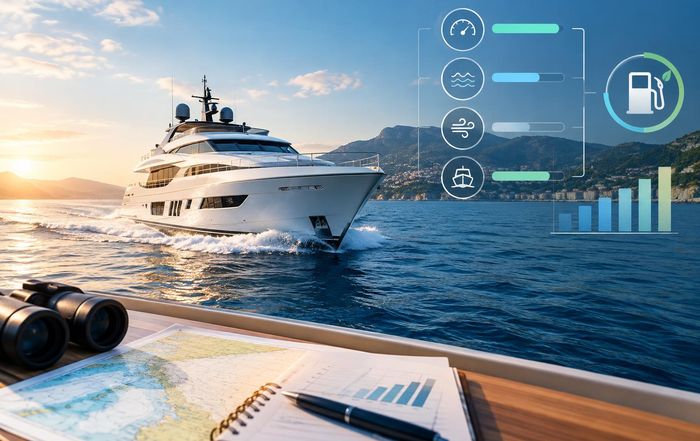
How to Compare Yacht Fuel Efficiency Under Real Conditions
Fuel efficiency is one of the easiest yacht metrics to oversimplify and one of the hardest to compare fairly. Published range figures, brochure consumption numbers, and anecdotal owner reports can all be useful, but they rarely describe the same operating profile. A yacht that appears efficient at displacement speed may become far less frugal once loaded for cruising, pushed into a head sea, or run at a different speed band than the one used in marketing material. For buyers, charter operators, and owners trying to budget realistically, the more useful question is not "Which yacht has the best number?" but "How should that number be measured, and under what conditions does it still hold up?"
That distinction matters because fuel burn is shaped by more than engine size. Hull form, propeller choice, weight, sea state, trim, air temperature, generator load, hotel systems, route planning, and even the way a skipper handles throttle changes can all alter the result. A serious comparison therefore starts with a consistent method, not a headline figure. It also helps to understand how efficiency relates to broader yacht design choices, which is why site visitors interested in performance often benefit from pairing this topic with our content around design, technology, and reviews.
Start with the right question
Before comparing yachts, define what "efficient" means for the way the vessel will actually be used. A long-range passagemaker, a family cruiser, a sport yacht, and a superyacht tender all face different operating priorities. For one owner, the key metric may be miles per gallon at a steady 10 knots. For another, it may be the ability to cross open water quickly without fuel anxiety, or to run generators and stabilizers comfortably at anchor for days. Efficiency is therefore not a single universal number; it is a relationship between consumption, speed, payload, and real cruising habits.
The right comparison also depends on whether the yacht is being judged as a new build or an existing vessel. New-build specifications can be compared against class rules, naval architecture predictions, and sea-trial data, while used yachts often need to be assessed through logs, maintenance records, and actual owner operating patterns. If the goal is to understand how a model performs in practice, the most useful comparison is usually between yachts operating in the same speed band, with similar load conditions and similar mission profiles. That is especially important in segments where cruising style, onboard systems, and itinerary shape the fuel bill as much as the engines themselves.
Separate brochure numbers from usable data
Manufacturer figures are a starting point, not a verdict. Brochure consumption data is often generated under controlled conditions: calm water, light load, clean hull, optimized trim, and a specific rpm or speed point that flatters the vessel's design. Those numbers are not false, but they are selective. Real-world operation introduces variables that can move consumption materially in either direction, sometimes by enough to change the economics of a season.
The most credible comparisons come from sea trials and logged operating data. Sea-trial reports can show speed, rpm, fuel burn, and sometimes range at multiple throttle settings, but the quality of those trials varies. A well-run trial will note displacement, fuel and water load, sea state, wind, temperature, and whether the yacht was carrying tenders or guests. If those details are missing, the figure should be treated cautiously. For independent context on marine fuel measurement and operating efficiency, readers can look to organizations such as the International Maritime Organization, the International Council on Clean Transportation, and the U.S. Environmental Protection Agency, all of which publish useful background on emissions, operating efficiency, and marine environmental standards.
Compare at the same speed, not the same horsepower
A common mistake is to compare yachts by engine output alone. Two vessels with similar horsepower can have very different fuel consumption because one may need more power to overcome hull resistance, carry more weight, or maintain the same speed in less favorable form. The more meaningful comparison is fuel burn at a matched speed, ideally across several speeds. A yacht that uses less fuel at 8 knots but much more at 18 knots may be ideal for slow coastal cruising yet less attractive for owners who regularly run longer passages at planing speed.
This is where speed curves matter. Efficient yachts often show a "sweet spot" where consumption per mile is minimized, but that sweet spot can shift with load and sea conditions. A displacement or semi-displacement yacht may be most efficient at a modest cruising speed, while a planing yacht may have a narrow band where extra speed costs disproportionately more fuel. When comparing models, it is worth plotting fuel burn against speed rather than relying on one advertised cruise figure. That approach is especially useful when reading technical coverage alongside broader boats reporting, because it reveals whether a design's efficiency is a structural advantage or simply a favorable test condition.
Account for displacement, load, and trim
Weight is one of the most underrated variables in yacht fuel efficiency. A yacht loaded with water toys, provisions, spare parts, guests, full tanks, and cruising gear may displace far more than the lightly equipped boat used in a demonstration run. Added weight increases hull resistance, changes trim, and can force the engines to work harder to hold the same speed. On some yachts, a few tonnes make little difference; on others, especially faster hulls, the penalty can be substantial.
Trim is just as important. A yacht that sits slightly bow-up or stern-heavy may burn more fuel than one running at the intended attitude. Hull efficiency depends on how cleanly the boat moves through the water, and that is affected by load distribution, trim tabs, stabilizer settings, and even where passengers are seated. For this reason, a real-world comparison should note whether the yacht was tested in a typical cruising configuration. A vessel that appears efficient on paper but only under ideal loading may disappoint once it is actually prepared for a season of travel. This is one reason many owners studying family cruising plans pay as much attention to stowage and liveaboard comfort as they do to nominal range figures.
Use the same units and the same assumptions
Fuel efficiency data is often presented in different ways: liters per hour, gallons per hour, nautical miles per gallon, liters per nautical mile, or total range at a stated speed. Those formats are not interchangeable unless the underlying assumptions are identical. A yacht that burns more fuel per hour may still be more efficient per mile if it travels faster. Likewise, a vessel with a larger tank may appear to have better range even if its consumption rate is worse, simply because it carries more fuel.
A fair comparison should normalize the numbers. The most practical method is to compare fuel burn per nautical mile at matched speeds and then check the operating range after applying a conservative reserve. That reserve matters because published maximum range often assumes near-empty tanks, calm conditions, and a willingness to run fuel lower than many prudent captains would accept. For planning purposes, the useful figure is usually lower than the brochure figure. This is where operational discipline intersects with business reality: fuel is not just a technical metric, but a budget line, a charter cost, and a logistical constraint.
Sea state and weather can change the answer
A yacht's efficiency in flat water can look very different once the sea builds. Head seas, quartering seas, windage, and current all affect the power required to maintain speed. A vessel with a high superstructure may be more efficient in calm conditions than a lower-profile boat, yet pay a larger penalty in strong wind or rough water because more energy is spent fighting resistance and motion. Conversely, a heavier displacement yacht may be slower but more consistent across a broader range of conditions.
This is why the most useful real-world comparisons include operating context. Was the yacht measured on a protected lake, a sheltered coastal route, or open water? Was the current helping or hindering? Was the boat running into chop, or on a long following sea? A yacht that seems inefficient on one day may be perfectly reasonable on another. Independent weather data from organizations such as the National Oceanic and Atmospheric Administration or the Met Office can help interpret sea-trial conditions, while route planning tools and charting systems can show how much of a passage was truly representative of normal use.
Don't ignore hotel loads and onboard systems
On many yachts, especially larger ones, propulsion is only part of the fuel story. Air conditioning, gyros or stabilizers, watermakers, entertainment systems, galley equipment, and lighting can all add to generator demand. At anchor, those hotel loads may dominate the day's fuel use. In some cases, a yacht with slightly less efficient propulsion can still be the more practical choice if its onboard systems are better integrated and less power-hungry in normal use.
This matters because many owners judge efficiency by "how much fuel did we use this trip?" rather than by propulsion alone. That is a sensible instinct, but it means the comparison must include the whole vessel. A yacht optimized for quiet comfort and high electrical demand may consume more fuel than a stripped-back performance cruiser, even if both are equally efficient at a fixed speed. For loyal visitors weighing design trade-offs, Yacht Review's coverage of lifestyle and sustainability is useful context, because onboard comfort and lower-impact operation are increasingly part of the same conversation.
Look for repeatability, not just one good run
A single impressive figure is not enough. Real efficiency should be repeatable across multiple outings, different crews, and varying conditions. The best comparisons come from logs that show a pattern: similar fuel burn at similar speeds over several passages, with notes on load, weather, and route. If a yacht only performs well once, under unusually favorable conditions, it is not a reliable benchmark.
Repeatability also helps distinguish design efficiency from operational skill. A careful captain can improve fuel economy through smoother throttle management, better routing, and more disciplined trim control. That does not make the yacht inherently efficient; it means the vessel is sensitive to handling. A comparison should therefore ask whether the fuel data reflects the boat's capability, the crew's expertise, or both. In practical terms, owners who cruise frequently will care less about a theoretical best case and more about whether the yacht delivers predictable consumption week after week.
Consider the lifecycle, not only the tank-to-tank number
A yacht that uses less fuel on a passage is not automatically the better choice if its efficiency advantage comes with trade-offs in maintenance, reliability, or usability. Lightweight materials, more aggressive propulsive systems, and highly tuned hull forms can improve performance, but they can also narrow the operating envelope or increase upkeep. The most sensible comparison balances fuel burn against the broader cost and complexity of ownership.
That broader view is becoming more relevant as the industry faces pressure to reduce emissions and improve operational transparency. Classification societies, regulators, and manufacturers are all placing greater emphasis on measured performance rather than marketing claims. For owners and buyers, the result is a more data-rich market, but also one that requires more careful reading. Organizations such as Lloyd's Register, DNV, and Bureau Veritas are useful reference points for understanding how technical standards, verification, and class expectations shape yacht design and operation.
A practical way to compare yachts honestly
The simplest useful method is to build a comparison around a few fixed questions. At the same speed, under similar load, how much fuel does each yacht burn? What range does that imply after a realistic reserve? How sensitive is the result to sea state, trim, and hotel load? Does the yacht stay efficient across the speed range the owner will actually use, or only at a single ideal point? Those questions produce a fairer answer than asking which yacht has the lowest advertised number.
For buyers, the best practice is to request sea-trial data, ask for the test conditions, and compare against independent owner reports where available. For existing owners, a trip log with speed, rpm, fuel used, weather, and load can quickly reveal whether the yacht is performing as expected. For charter operators, the same method helps set realistic itineraries and fuel allowances. And for anyone following the wider evolution of yacht design, the most interesting developments are not just about lower consumption, but about better matching between hull, propulsion, and real cruising habits. That is where efficiency becomes more than a specification and starts to reflect the actual way a yacht is used on the water.