

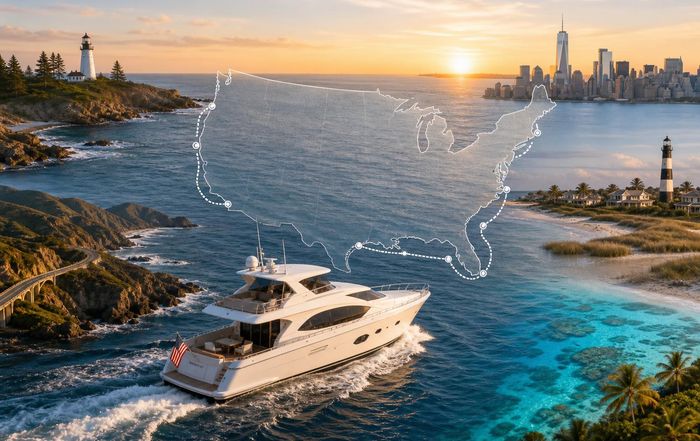
Best Cruising Routes Along the United States Coast
Cruising the coasts of the United States offers a rare combination of navigational variety, cultural depth and year-round seasonality that continues to captivate both private owners and professional captains. From the tide-swept inlets of New England to the mangrove-framed channels of Florida and the dramatic headlands of the Pacific Northwest, the country's shorelines present a portfolio of routes that can be tailored to almost any yacht, itinerary or style of onboard life. For many sailing and cruising fans here, these routes are more than lines on a chart; they are evolving corridors of design innovation, hospitality, gastronomy and sustainable practice that increasingly define what modern cruising can be.
While every voyage remains shaped by weather, vessel capability and crew experience, several coastal routes have emerged as enduring favorites among experienced skippers, charter professionals and long-distance cruisers. What follows is an overview of the most established and inspiring coastal passages, with an emphasis on practical considerations, lifestyle experiences and the broader business and sustainability trends that are reshaping how and where yachts travel.
New England and the Northeast: Classic Harbors and Short-Hop Cruising
The northeastern seaboard, stretching roughly from the approaches of New York Harbor to the Downeast coast of Maine, remains one of the most celebrated summer cruising grounds in the United States. Its appeal lies in the density of safe harbors, modest daily passage lengths and the blend of maritime history and contemporary coastal culture.
Many itineraries begin near New York City, where marinas in New Jersey and western Long Island Sound provide urban access combined with practical provisioning and service infrastructure. From there, crews often trace an eastward arc through Long Island Sound, stopping at ports such as Port Jefferson and Mystic, before crossing to Newport, Rhode Island, which has long been a yachting capital and a focal point of both classic and cutting-edge yacht design. Visitors can explore the region's regatta heritage and learn more about offshore racing traditions through organizations such as Sail Newport and the New York Yacht Club, and the city continues to host major events that are widely covered in international yachting media.
From Newport, cruising yachts typically fan out toward the islands of Martha's Vineyard and Nantucket, or continue east and north along the Massachusetts coast. These legs offer a mix of open-water passages and well-marked approaches that reward careful tide and fog management. The islands are notable not only for their picturesque harbors but also for a mature hospitality ecosystem that includes boutique hotels, high-end provisioning and shore-side experiences that are increasingly tailored to yacht guests. For readers interested in assessing how these destinations compare from a guest-experience perspective, the destination coverage and vessel insights on the yacht-review.com cruising section provide helpful context on how different boats perform in coastal conditions.
Beyond Cape Cod, the route toward Maine introduces a more intricate navigational environment. The rocky shoreline, strong tidal currents and frequent fog banks demand reliable electronics and conservative passage planning, making this region particularly attractive to owners who value seamanship as much as scenery. Harbors such as Camden, Rockland and Bar Harbor offer secure moorings and access to Acadia National Park, which U.S. National Park Service sources describe as one of the most heavily visited parks on the East Coast. This section of the coast is also a living museum of wooden boatbuilding and classic yacht restoration, with facilities and events that are often highlighted in yacht-review.com's history coverage.
The Intracoastal Waterway: Protected Passage from Norfolk to Miami
The Atlantic Intracoastal Waterway (ICW) remains one of the most strategically important and popular cruising corridors in the United States. Extending along the Atlantic and Gulf coasts, the section most relevant to coastal cruisers runs from the Norfolk, Virginia area to southern Florida, providing a largely protected route that allows vessels to avoid many offshore hazards.
The ICW combines man-made canals with natural sounds, rivers and estuaries, and is maintained under the oversight of the U.S. Army Corps of Engineers, which publishes detailed information on waterway conditions, dredging and bridge operations. Skippers frequently consult resources such as NOAA charts and the United States Coast Guard Local Notices to Mariners for up-to-date guidance on shoaling and restricted areas, and these official sources are widely regarded as the primary references for safe navigation.
From the Hampton Roads region, cruisers heading south enter a world of low-lying marshes, swing bridges and small towns that have grown up around the waterway. North Carolina's Albemarle and Pamlico Sounds, South Carolina's Lowcountry and Georgia's sinuous tidal creeks each offer distinct scenery and cultural experiences. The route is especially attractive to yachts with moderate draft that can take advantage of the full range of anchorages and marinas, although larger superyachts also make extensive use of the ICW where depths allow.
For owners and captains planning seasonal migrations, the ICW is an essential component of the so-called "snowbird" pattern, in which yachts reposition between northern bases such as New England or the Mid-Atlantic and winter cruising grounds in Florida and the Bahamas. This migration supports a substantial marine services economy along the route, from refit yards in the Carolinas to fuel docks and provisioning hubs in Florida, and is often discussed in the business context on yacht-review.com's marine industry pages.
While the ICW is fundamentally a navigation infrastructure, it also offers a distinct lifestyle experience. Many crews appreciate the slower pace, the opportunity to stop in historic towns such as Beaufort, North Carolina and Charleston, South Carolina, and the relative shelter from ocean swell. The trade-off is the need for careful attention to bridge opening schedules, tidal windows and shoal-prone reaches that are subject to ongoing dredging priorities. Authors and experienced cruisers routinely note that successful ICW passages reward patience and flexible planning more than speed.
Florida's Atlantic Coast and the Gateway to the Bahamas
Florida's Atlantic shoreline, from the St. Johns River to Key Biscayne, combines some of the United States' busiest boating areas with critical departure points for international cruising. Cities such as Jacksonville, Fort Lauderdale, Palm Beach and Miami provide deep-water access, extensive marina capacity and a concentration of yacht support services that has made this region a global hub for both private yachts and charter fleets.
Fort Lauderdale in particular, often referred to as the "Yachting Capital of the World," hosts the Fort Lauderdale International Boat Show, one of the largest in-water boat shows globally, which is regularly profiled by outlets such as Boat International and Yachting Magazine. The region's yards and service providers support everything from routine maintenance to complex refits, and many of the vessels reviewed in the yacht-review.com boats section can be seen at major Florida marinas during the winter high season.
From a cruising perspective, the Florida coast offers a sequence of inlets and nearshore routes that can be tailored to weather and vessel type. Many yachts alternate between offshore hops and ICW segments, taking advantage of calm conditions to run outside and retreating to the waterway when seas build. The Gulf Stream, which flows northward relatively close to shore, can be both a challenge and an asset, shortening northbound passages but demanding respect when wind opposes current.
One of the most significant aspects of Florida cruising is its role as a gateway to the Bahamas and wider Caribbean. Departures from Miami, Fort Lauderdale or Palm Beach to destinations such as Bimini or Grand Bahama are routine for capable yachts, and the short crossing distances make these routes accessible to a wide range of vessels, provided that customs, immigration and weather are carefully managed. Organizations such as the Bahamas Ministry of Tourism and various official port authorities publish detailed entry requirements and conservation guidelines, reflecting a growing emphasis on protecting fragile marine ecosystems. Readers interested in broader sustainability issues in these waters can learn more about sustainable cruising practices in related coverage on this site.
South of Miami, the Florida Keys present a uniquely American island chain cruising experience. The Overseas Highway links the islands by road, but from the water the Keys reveal shallow banks, coral patches and mangrove channels that reward accurate charting and local knowledge. Key Largo, Islamorada, Marathon and Key West each offer marinas and anchorages, along with access to protected areas overseen by agencies such as the Florida Keys National Marine Sanctuary, which provides guidance on mooring buoys, no-discharge zones and reef protection.
The Gulf Coast: From Emerald Beaches to the Bayous
The U.S. Gulf Coast, stretching from the Florida Panhandle through Alabama, Mississippi, Louisiana and Texas, remains less publicized in international yachting media than the Atlantic or Pacific coasts, yet it offers some of the most relaxed and culturally rich cruising in the country. The region is characterized by broad continental shelves, barrier islands and extensive estuaries, with a climate that supports almost year-round boating.
In the eastern Gulf, the so-called "Emerald Coast" of Florida, including Destin and Pensacola, is known for its white sand beaches and clear, shallow waters. These areas attract a mixture of local boaters and visiting yachts, with marinas that have steadily upgraded facilities to accommodate larger vessels over the past decade. Moving west, the ports of Mobile, Biloxi and Gulfport combine industrial and recreational maritime activity, with harbors that can serve as convenient staging points for further travel.
Louisiana and Texas introduce a different cruising character, with large-scale energy infrastructure, busy commercial shipping and intricate bayou systems. The approaches to New Orleans via the Mississippi River require careful coordination with traffic and river pilots, yet for yachts that manage these constraints, the city offers a distinctive cultural and culinary experience that is difficult to match elsewhere in the United States. Farther west, Galveston, Clear Lake and Corpus Christi provide marina networks that support both offshore fishing vessels and cruising yachts, while also hosting regattas and events that reflect a strong local boating culture.
Environmental and resilience issues are particularly salient along the Gulf Coast, where hurricanes and coastal erosion have had profound effects on communities and infrastructure. Agencies such as the National Oceanic and Atmospheric Administration (NOAA) and academic institutions including Louisiana State University publish extensive research on coastal restoration and storm risk, and many marina developers now incorporate elevation, breakwater design and emergency planning into new and upgraded facilities. For yacht owners considering long-term berthing or seasonal cruising in this region, these resilience factors increasingly sit alongside traditional considerations of access and amenities, a dynamic that aligns with the broader sustainability discussions featured on yacht-review.com's global pages.
California and the Pacific Coast: Long Legs and Ocean Drama
The Pacific coast of the United States, from San Diego to the Canadian border, offers some of the most dramatic ocean cruising available in North America, but it also demands a higher level of preparation and offshore capability than many Atlantic routes. The coastline is relatively exposed, with fewer all-weather harbors, stronger seasonal wind patterns and Pacific swell that can make bar crossings and harbor entrances challenging.
Southern California, anchored by San Diego, Newport Beach, Long Beach and Marina del Rey, is the natural starting point for many Pacific coastal cruises. These ports offer comprehensive yacht services, active racing scenes and access to the Channel Islands, a group of islands off the coast that combine rugged natural beauty with protected anchorages. The Channel Islands National Park and National Marine Sanctuary provide detailed guidance on anchoring, wildlife protection and visitor facilities, and their official materials highlight the ecological significance of these waters.
From a lifestyle perspective, Southern California marinas integrate boating with a broader coastal culture that includes dining, entertainment and design-forward waterfront development. Several of the production and custom yachts profiled in the yacht-review.com design section have strong connections to this region, either through local dealers, design offices or testing grounds, reflecting California's role as a showcase market for new models.
North of Point Conception, conditions typically become cooler and more variable, with the Central Coast and Northern California offering fewer harbors but memorable stops such as Morro Bay, Monterey and San Francisco. The entrance to San Francisco Bay, passing under the Golden Gate Bridge, is one of the iconic landfalls in American yachting, although it can be subject to strong tidal currents and fog. Inside the bay, marinas in Sausalito, Berkeley and the city itself provide access to urban amenities and a vibrant sailing community, supported by clubs and organizations that are frequently referenced by Sail World and similar outlets.
Continuing north into Oregon and Washington, cruisers encounter longer distances between safe harbors and bar entrances that require local knowledge and up-to-date weather information. Official bar reports from the U.S. Coast Guard and marine forecasts from NOAA's National Weather Service are critical tools for safe planning. For yachts equipped and crewed for offshore conditions, however, this coastline offers a powerful sense of adventure and a pathway toward one of North America's finest cruising grounds: the inland waters of Washington and British Columbia.
The Pacific Northwest and Inside Waters: Fjords, Forests and Long Seasons
The Pacific Northwest presents a markedly different cruising environment from the open Pacific. Once inside the Strait of Juan de Fuca and the sheltered waters of Puget Sound and the San Juan Islands, yachts find a network of protected passages, forested shorelines and well-equipped marinas that support extended seasonal cruising. Cities such as Seattle, Tacoma and Bellingham serve as primary bases, while smaller communities throughout the region cater to visiting yachts with moorage, fuel and provisioning.
The San Juan Islands in Washington State, together with the Gulf Islands and further north the Inside Passage of British Columbia and Southeast Alaska, offer a progression of increasingly remote and wild cruising grounds. While the Canadian and Alaskan segments lie beyond U.S. borders, many itineraries for U.S.-based yachts integrate these waters, creating a continuous cruising arc that spans hundreds of miles under the partial shelter of coastal mountains and island chains.
The region is also a focal point for marine conservation, indigenous cultural heritage and emerging approaches to low-impact boating. Organizations such as Washington State Parks, Parks Canada and various First Nations and tribal authorities provide guidance on anchoring, shore access and wildlife viewing, particularly regarding orca and other marine mammals. For yacht owners and charter operators, compliance with these guidelines is increasingly seen not only as a regulatory requirement but as a core aspect of responsible cruising, echoing the themes explored in yacht-review.com's sustainability coverage.
Technologically, the Pacific Northwest has been an early adopter of electric and hybrid propulsion in smaller vessels, and there is growing interest in how these technologies can scale to larger yachts. Industry analysts and publications such as Professional BoatBuilder and WorkBoat have documented pilot projects in electric ferries and harbor craft in Washington and British Columbia, which could foreshadow future infrastructure for charging and alternative fuels that would benefit private cruising yachts as well. Readers seeking a deeper understanding of these trends may find useful context in the technology-focused articles on yacht-review.com.
Seasonal Strategies and Vessel Selection for U.S. Coastal Routes
Choosing the best cruising route along the U.S. coast is not only a matter of geography; it is also a question of timing, vessel capability and personal priorities. Many experienced owners adopt a seasonal strategy that leverages the strengths of different regions at different times of year, creating an annual rhythm that might include New England in the summer, the Mid-Atlantic and Carolinas during the shoulder seasons, and Florida or the Bahamas in the winter.
Vessel selection plays a decisive role in how these routes are experienced. Shallow-draft trawlers and motor yachts can take fuller advantage of the ICW and the backcountry channels of Florida and the Gulf Coast, while performance-oriented sailing yachts may prefer offshore legs that capitalize on prevailing winds. Larger superyachts, with deeper draft and higher service expectations, gravitate toward major hubs such as Newport, Fort Lauderdale, Miami, San Diego and Seattle, where yards, crew agencies and specialized suppliers are concentrated. The boat reviews and comparative insights on yacht-review.com can be a valuable starting point for owners considering how different hull forms and systems align with their preferred cruising grounds.
Insurance, regulatory compliance and crew management also influence route planning. Insurers often specify named-storm exclusion zones or seasonal constraints, especially in hurricane-prone regions such as the Southeast and Gulf Coast, and these requirements can effectively dictate when and where a yacht can operate. Agencies including the National Hurricane Center and academic groups such as the University of Miami's Rosenstiel School of Marine, Atmospheric, and Earth Science provide data and analysis that underpins many of these risk assessments, and captains increasingly integrate this information into long-range planning.
Lifestyle, Shore Experiences and the Evolving Coastal Economy
Beyond navigation and seamanship, the appeal of U.S. coastal cruising lies in the diversity of shore-side experiences. The same voyage that includes a quiet anchorage in a Maine cove can also encompass a weekend of fine dining in Boston or New York; a trip through the Carolina marshes can be paired with historic tours in Charleston or Savannah; a Pacific Northwest itinerary can combine remote anchorages with time in Seattle's technology-driven urban environment.
This interplay between sea and shore has important implications for coastal economies. Many waterfront communities have invested in marina upgrades, waterfront redevelopment and cultural programming to attract visiting yachts, recognizing their contribution to local restaurants, shops and service providers. Organizations such as NOAA's Office for Coastal Management and think tanks including the Brookings Institution have documented the broader economic significance of the "blue economy," which includes sectors from tourism and recreation to shipbuilding and marine technology. For business-focused readers, the interplay between yacht cruising and regional development is an increasingly important lens, and related topics are explored in depth on yacht-review.com's business pages.
From a lifestyle perspective, coastal cruising has also become more inclusive and family-oriented. Many owners now design itineraries that balance time underway with activities suitable for children and multi-generational groups, such as museum visits, wildlife excursions and shore-based sports. The lifestyle and family sections of yacht-review.com and its dedicated family content reflect this shift, highlighting vessels and destinations that support comfortable, safe and engaging experiences for all ages.
Sustainability and the Future of U.S. Coastal Cruising
As environmental awareness grows, sustainability is becoming a central consideration in how yachts use U.S. coastal waters. Regulations on emissions, waste discharge and protected areas are evolving, and many owners are voluntarily adopting practices that go beyond minimum compliance. These include the use of advanced wastewater treatment systems, careful anchoring to avoid seagrass damage, support for marine conservation organizations and participation in citizen science initiatives.
Government agencies such as the Environmental Protection Agency (EPA) and NOAA continue to refine guidelines and regulatory frameworks for vessel discharges, air quality and habitat protection, while non-governmental organizations including Oceana and The Ocean Conservancy advocate for further protections. In parallel, yacht builders and equipment manufacturers are investing in more efficient hull designs, alternative propulsion technologies and digital tools that optimize routing and fuel consumption. Readers can learn more about sustainable business practices in yachting through ongoing coverage that connects technological innovation with operational best practices.
Sailing ahead, it is likely that U.S. coastal cruising will be shaped by a combination of infrastructure investment, climate resilience planning and continued innovation in yacht design and operations. Ports and marinas are exploring shore power, alternative fuels and resilient construction; technology companies are developing more capable navigation and monitoring systems; and owners are increasingly viewing their cruising choices through a lens that balances enjoyment with stewardship.
For the community that gathers around Yacht Review, these developments reinforce a central idea: the best cruising routes along the United States coast are not only defined by geography but by the quality of experience they support, the safety and professionalism with which they are undertaken and the contribution they make to a thriving, sustainable maritime world. Whether exploring the foggy coves of Maine, the sunlit waters of Florida, the vibrant harbors of California or the forested inlets of the Pacific Northwest, well-prepared cruisers can find routes that align with their aspirations and values, and in doing so, help shape the next chapter of coastal yachting.